

0 引言
【研究意义】日光温室墙体传热过程是一个复杂的、多元的建筑热物理过程,包括导热、对流和辐射3种方式。该过程不仅受日光温室外大气候环境影响,还受室内小气候环境影响,如太阳光照射、土壤、果蔬作物、空气温度、空气湿度等。运用建筑热物理学、热工学、传热学、流体力学、农业生物环境学等理论,分析日光温室墙体的传热与流动有实际意义。日光温室因为围护结构是重质实心材料组成,对太阳辐射热能只吸收和反射,该传热过程为不稳定传热。研究墙体的热质传递规律,进行数值模拟,分析墙体内温度分布规律和变化趋势,为日光温室墙体的设计、建设和维护提供科学合理的方法和依据[1]。【前人研究进展】日光温室热环境模拟预测软件以有限差分数值解法为理论基础,采用横截面内二维传热模型,分析日光温室墙体、后屋面和土壤的传热,反映了梯形截面墙体、复合材料建筑墙体和下沉式日光温室土壤中的蓄热过程,其模型可靠性已被验证[2]。郭慧卿等[3]分别在 1992 年及 1994 年利用非稳态传热理论搭建了日光温室数学模型, 模拟20 种后墙日光温室,总结北墙内表面热得失,评价墙体保温性。利用上述几个指标为墙体热工特性优劣的评价标准是可行的,所得结论与日光温室实测的保温效果一致;均较容易计算若干层均质稳定材料组成的一维墙体或屋面的动态热性能[4]。佟国红[5] 利用频率响应法建立日光温室热环境模型并分析后得出,从频率响应、传热量计算及实测结果看,单独用聚苯板或砖作为墙体材料都不合适。佟国红[6]对日光温室墙体材料温度环境影响的CFD模拟研究认为上午卷帘前,复合墙中隔热层以内的砖墙和隔热层为放热体,砖墙靠近室内近1/3的墙体温度高于室内温度,而全苯板墙仅内表面附近高于室气温度。白天全砖墙、复合墙及全苯板墙温度均低于室内温度,都为吸热体。【本研究切入点】孟力力等[7]根据日光温室各个部分的传热机理和质能守恒定律,采用VB和MATLAB相结合离散的思想分析处理了墙体导热过程,模拟日光温室分层墙体各位置的温度值,后墙表面温度模拟精度IA可达0.83,模型模拟值与实测值吻合程度好,且利用该模型对日光温室后墙进行优化。张立明等[8]采用现场试验的方法并以ANSYS软件为技术手段,模拟分析吸热过程中的复合材料的温度场及热梯度场情况,模拟结果中复合材料的温度场及热梯度场情况与实际情况符合。目前随着日光温室结构的不断优化和发展,需要建立新的模型来模拟和优化日光温室结构。【拟解决的关键问题】用ansys分析软件进行温度场和流场模拟,使用UG软件对日光温室进行造型,将顶部保温被、骨架等结构适当简化,计算域分为内部空气与外部空气2部分。采用DO辐射模型和湍流模型进行模拟,采用CFX-Post计算处理,得到温度云图,分析对比2种墙体温室内温度分布规律和变化趋势,明确砌块复合墙体和砖墙日光温室的热性能。
1 材料与方法
1.1 材料
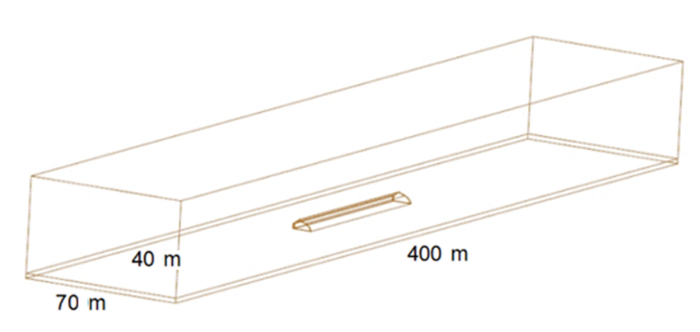
模拟日光温室长度80 m,跨度8.5 m,脊高3.9 m;北墙墙体高2.2 m;外部空气设定为长400 m,宽70 m,高40 m。图1
图1
1.2 方法
1.2.1 网格划分
根据实际尺寸划分网格,为降低网格数量,采用结构性网格对计算域进行划分,总结点数295×104,总网格数305×104。表1
表1 计算域结点、网格数 (104)
Table 1
| 位置 Seat | 结点数 Number of nodes | 网格数 Mesh number |
|---|---|---|
| 内部空气 Internal air | 58.4 58.4 | 61 61 |
| 外部空气 External air | 236.7 236.7 | 24.4 24.4 |
网格外形与质量如下图2所示:
图2
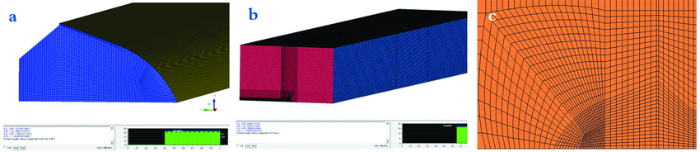
图2
网格示意
a.内部空气网格示意 b.外部网格示意 c.外部空气网格示意
Fig.2
Grid diagram
a.Schematic diagram of internal air grid; b.Schematic diagram of external grid; c.Schematic diagram of external air grid
1.2.2 Boussinesq假设
式中,
1.2.3 控制方程
流体流动满足以下3大方程[11]:
(1)质量守恒方程
质量守恒定律,即:单位时间内,流体微元体里所增多的质量等于同时段内流进其微元体的净质量。该数学表达式为:
适合可压和不可压流动;源项Sm为分散的二级项中进到连续相的质量,亦能为自定义源项;ρ是流体密度,kg/m3;u1是i方向质量的平均速度,m/s;xi是i方向微元体的长度,m。
(2)动量守恒方程
式中:p——平均压力;
ρ——流体密度;
μ——流体分子粘度;
$-\rho \overline{u_{i} u_{j}}$——雷诺应力。
(3)能量守恒方程
达到微元体的净热流量与对微元体所做功的和等于微元体中能量的增加率,该方程如下:
式中:
1.2.4 辐射模型
选用DO辐射模型对太阳辐射进行模拟。辐射方程如下:
式中:
1.2.5 湍流模型
判断流体流态采用雷诺数Re,计算公式:
式中:
其中,μt是涡流粘度,k为湍流动能,标准k-ε模型,湍流动能k和湍流耗散率ε由以下两个方程求解,所示:
湍流动能k方程:
耗散率ε方程:
其中,方程中GK和Gb是湍流动能,YM是可压缩湍流,C1,C2,C3是常量,σk和σe是湍流动能方程和耗散方程的湍流Prandtl数,Sk和Se是用户定义的。
1.2.6 边界条件
数值模拟新疆南疆和田地区的复合墙体和砖墙日光温室所在位置的经度为79.87°、纬度37.04°,时区东八区,模拟时间是冬季2019年1月20日。墙体的材料不同(普通砖与砂浆复合砌块)、模拟的时间不同(白天与夜晚)。定常计算需要在计算域相应位置设定初始边界条件,主要初始条件为日光温室各墙体温度、地面温度、内外部空气温度(均由实测知道)、有无日照及日照强度。墙体、后屋面模拟时都设定为一种单一材料,前屋面白天只有棚膜,夜间只考虑保温被。模拟白天时,采用下午02:00时的实测温度条件;模拟黑夜时,采用凌晨03:00和06:00时的实测温度。模拟的时间段,初始温度由实测给出。该模拟将墙体的参数设置在墙体壁面上,直接模拟日光温室内温度分布规律和变化。表2,表3,表4
表2 普通砖墙日光温室初始温度
Table 2
| 时间 Time | 位置 Seat | 温度值 Temperature value(℃) |
|---|---|---|
| 白天(14:00) Day(14:00) | 墙体 | 12.7 |
| 后屋面 | 13.8 | |
| 外部空气 | -13.3 | |
| 内部地面 | 14.3 | |
| 外部地面 | -6.8 | |
| 夜间(03:00) Night(03:00) | 墙体 | 11.2 |
| 后屋面 | 10.2 | |
| 外部空气 | -15.9 | |
| 内部地面 | 12.0 | |
| 外部地面 | -13.1 | |
| 夜间(06:00) Night(06:00) | 墙体 | 10.3 |
| 后屋面 | 10.0 | |
| 外部空气 | -16.3 | |
| 内部地面 | 11.2 | |
| 外部地面 | -16.0 |
表3 砌块复合墙日光温室初始温度
Table 3
| 时间 Time | 位置 Seat | 温度值 Temperature value(℃) |
|---|---|---|
| 白天(14:00) Day(14:00) | 墙体 | 14.5 |
| 后屋面 | 13.8 | |
| 外部空气 | -13.3 | |
| 内部地面 | 14.3 | |
| 外部地面 | -6.8 | |
| 夜间(03:00) Night(03:00) | 墙体 | 12.9 |
| 后屋面 | 11.2 | |
| 外部空气 | -15.9 | |
| 内部地面 | 12.0 | |
| 外部地面 | -13.1 | |
| 夜间(06:00) Night(06:00) | 墙体 | 12.0 |
| 后屋面 | 11.0 | |
| 外部空气 | -16.3 | |
| 内部地面 | 11.2 | |
| 外部地面 | -16.0 |
表4 日光温室各材料性质[19]
Table 4
| 名称 Name | 密度 Density (kg/m3) | 比热容 Specific heat ( J/(kg·k)) | 导热系数 Thermal conductivity (w/(m·k)) | 吸收系数 Absorption coefficient | 散射系数 Scattering Coefficient | 扩散系数 Diffusion Coefficient |
|---|---|---|---|---|---|---|
| 普通砖 Brick | 1 400 | 1 050 | 0.580 | 0.6 | 1 | 1 |
| 砂浆砌块砖 Mortar brick | 1 119 | 1 180 | 0.774 | 0.6 | 1 | 1 |
| 保温苯板 Benzene Board for thermal insulation | 20 | 1 500 | 0.046 | 0.2 | 1 | 1 |
| 前屋白天薄膜 Film | 900 | 2 550 | 0.029 | 0.1 | 0 | 1 |
| 夜间保温被 Thermal quilt | 134 | 1 230 | 1.182 | 0.7 | 1 | 1 |
| 地表土壤 Surface soil | 1 680 | 2 000 | 0.1 | 0.5 | 1 | 1 |
| 室内空气 Indoor air | 1.29 | 1 030 | 0.023 | 0 | 0 | 1 |
2 结果与分析
2.1 白天2种墙体的温度分布特点和规律
图3
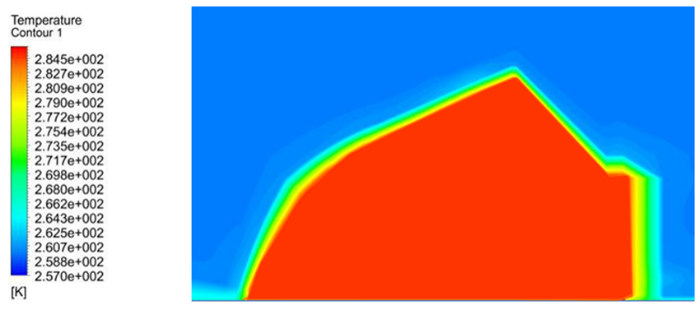
图4
2.2 夜间03:00时2种墙体的温度分布特点和规律
研究表明,夜间03:00时砖墙墙体温度较日光温室内部温差较小,热量从北部墙体向日光温室内部散发。日光温室内部空气温度由室内下部往上部降低,后屋面和屋脊处温度最低,约280.9 K,即7.75℃。日光温室内北部墙体处约2 m高、1 m宽扇形最高温区,最高温达到285 K,即11.85℃,整个日光温室南到北部有高度约0.5 m、宽度8 m的高温区,温度约284 K,即10.85℃,大部分区域的温度约为283.15 K,即10.0℃,日光温室内温度的分布均匀性较差,不利于植物的均匀生长。夜间阳光辐射作用极弱,对流传热占主导作用,普通砖墙白天蓄热能力较弱;后屋面和屋脊处是夜间热量散失较多的部位。前屋面因为有5 cm厚的保温被,所以温度云图显示前屋面有厚约20 cm的淡蓝色低温区。日光温室外部由于墙体与外部环境间的温差较大以及空气流动,散热明显,在墙体表面形成明显的温度梯度。图5
图5
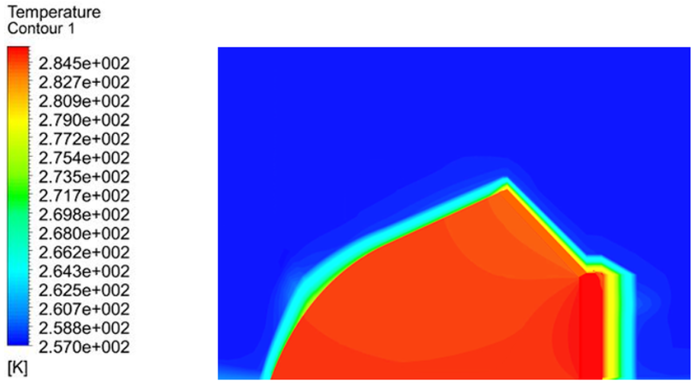
图5
普通砖墙夜间03:00时温度云
Fig.5
Night temperature nephogram of common brick wall at 03:00
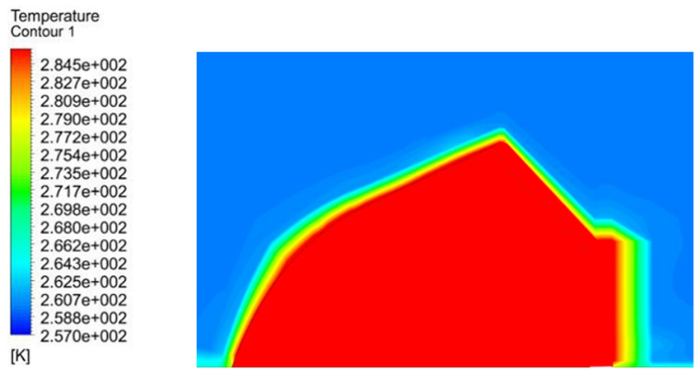
研究表明,夜间06:00时砖墙的墙体温度较日光温室内部低,日光温室内部空气温度由室内南部往北部逐渐降低,南部最高温区域约284.2 K,即11.05℃,北墙体和后屋面温度最低,约280 K,即6.85℃;大部分区域的温度约为280.9 K,即7.75℃。日光温室内温度的分布均匀性较差,不利于植物的均匀生长。说明夜间06:00时,没有阳光辐射作用,也没有墙体散热,室内热量散失较多,只能靠室内现有热量维持。日光温室外部由于墙体与外部环境间的温差较大以及空气流动,散热明显,在墙体表面形成明显的温度梯度。图6
图6
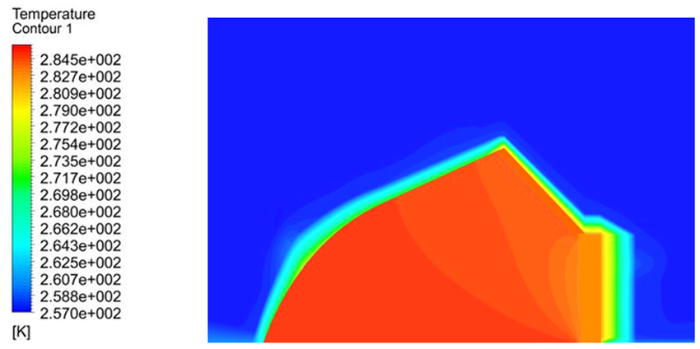
图6
普通砖墙夜间06:00时温度云
Fig.6
Night temperature nephogram of common brick wall at 06:00
2.3 夜间06:00时2种墙体的温度分布特点和规律
研究表明,夜间03:00时砌块复合墙体温度明显高于日光温室内部空气温度,北部墙体向日光温室内部显著散热,起到增温作用。日光温室内部空气温度由北部往南部缓慢降低,后屋面和屋脊处温度最低,整个日光温室南到北部有高度大于2.2 m、宽度8 m的高温区,大部分区域的温度达到284.5 K,即11.35℃,高温区的覆盖范围较大、分布均匀性较好,利于作物的生长。也说明复合墙体白天蓄热能力较强,较砖墙蓄积了更多的热量,夜间03:00时温室内温度较砖墙温室高约1.35℃。在后屋面和屋脊附近区域,室内温度较低,约281.2 K,即8.05℃,说明后屋面和屋脊是夜间热量散失较多的部位。日光温室外部由于墙体与外部环境间的温差较大以及空气流动,散热明显,在墙体表面形成明显的温度梯度。图7
图7
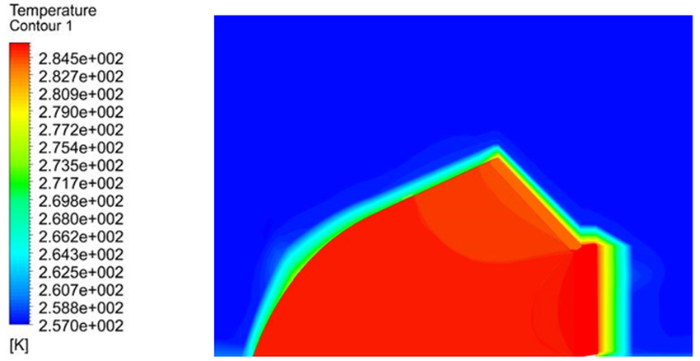
图7
复合砌块墙夜间03:00温度云
Fig.7
Temperature nephogram of composite block wall at 03:00 at night
研究表明,夜间06:00时砌块复合墙体温度略高于日光温室内部空气温度,北部墙体向日光温室内部散热,起到增温作用。日光温室内部空气温度由北往南、由下往上降低,后屋面和屋脊处温度最低,日光温室内北部墙体附件最高温达到284.5 K,即11.35℃,大部分区域的温度为283 K,即9.85℃。复合墙体白天蓄热能力较强,较砖墙蓄积了更多的热量,到夜间06:00时依然向日光温室内散热,是日光温室夜间的热源。日光温室外部由于墙体与外部环境间的温差较大以及空气流动,散热明显,在墙体表面形成明显的温度梯度。图8
图8
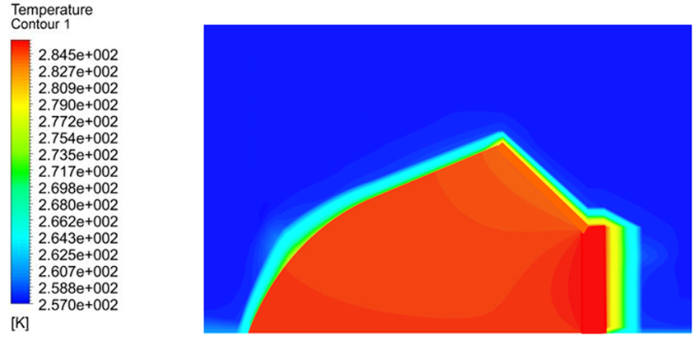
图8
复合砌块墙夜间06:00温度云
Fig.8
Temperature nephogram of composite block wall at 06:00 at night
2.4 2种墙体对日光温室保温作用的影响
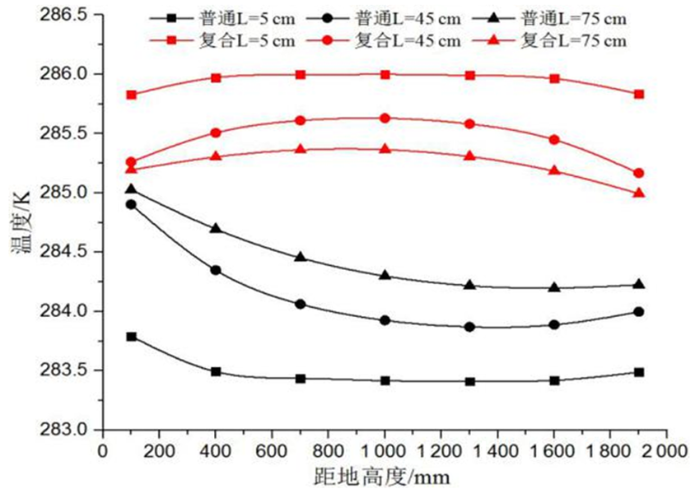
研究表明,夜间06:00时,与墙体表面距离相同的情况下,复合墙体日光温室的温度值明显高于普通砖墙温度值。L=5 cm处,复合墙日光温室温度比普通砖墙高约2.5 K;L=45 cm处,复合墙日光温室温度比普通砖墙高约1.5 K;L=75 cm处,复合墙日光温室温度比普通砖墙高约1 K 。距地面L=5 cm处,两日光温室温差最大,随着高度增加,温差减小。距离墙体表面越远,两日光温室温差逐渐降低,但复合墙体日光温室温度始终高于普通砖墙日光温室,砌块复合墙体对日光温室的保温效果明显优于普通砖墙日光温室。图9
图9
3 讨论
侯加林[20]基于有限元日光温室土墙温度场模拟和试验,用ANSYS软件模拟,研究墙体蓄、放热层1 d 24 h内的温度周期性变化,土墙因外界温度变化少,下半部分温度高,水平方向变化梯度小,10~14℃稳定时间久;20 cm厚度位置是最高温,往北外侧缓慢降低,土质墙体北面外表面的温度是最低的。
3.1
日光温室砌块复合墙体为内外扰均为周期性非线性条件的二维非稳态热传导,用ANSYS分析软件模拟日光温室温度场和流场,白天14:00时由于阳光辐射热较明显,2种墙体日光温室内部温度较高,超过12.0℃,各墙面间温差较小,对流传热不明显;日光温室外侧由于墙体与外部环境间的温差较大以及空气流动,散热明显,在墙体表面形成明显的温度梯度。砖墙日光温室和砌块复合墙体日光温室间温度云图无明显差别,白天日光温室的热传递方式以阳光辐射占主导作用,砖墙日光温室和砌块复合墙体日光温室室内温度没有明显差异。
3.2
夜间03:00时,砌块复合墙体日光温室地面上部有高度2.2 m的高温区,温度达到11.2℃,高温区的覆盖范围较大、分布均匀性较好,利于作物的生长。与墙体表面距离相同的情况下,砌块复合墙体日光温室的温度值明显高于砖墙温度值,距离墙体表面越远,两日光温室温差逐渐降低,但砌块复合墙体日光温室温度始终高于砖墙日光温室,砌块复合墙体对日光温室的保温效果明显优于砖墙。且随着时间的推移,两日光温室温差逐渐增加,到夜间06:00时,砖墙温度低于室内,没有散热;砌块复合墙体温度仍高于室内,继续散热。复合墙体白天蓄热能力较强,较砖墙蓄积了更多的热量,到夜间06:00时依然向日光温室内散热。该模拟,后屋面只设定了彩钢板一种材料,后屋面是热量散失较多的部位,后期设计时,需要注重后屋面的保温性。脊高处也是热量损失较多的部位,需要加强脊高处的密封性。
4 结论
日光温室墙体为内外扰均为周期性非线性条件的二维非稳态热传导,白天14:00时2种墙体温室内超过12.0℃,各墙面间温差较小,对流传热不明显。夜间03:00时,砌块复合墙体日光温室地面上部有高度2.2 m、温度11.2℃的高温区。砌块复合墙体日光温室的热性能明显好于砖墙日光温室,与实际栽培试验结果相同。日光温室砌块复合墙体为内外扰均为周期性非线性条件的二维非稳态热传导,白天日光温室的热传递方式以阳光辐射占主导作用,砖墙日光温室和砌块复合墙体日光温室室内温度没有明显差异。夜间砌块复合墙体对日光温室的保温效果明显优于砖墙。
参考文献
新材料墙体日光温室的试验研究
[D].
Experimental study on new material wall solar greenhouse
[D].
下沉式日光温室温度环境模拟与实验研究
[D].
Simulation and Experimental Research on Temperature Environment of Sunken Solar Greenhouse
[D].
日光温室墙体保温蓄热性能模拟分析
[J].
Simulation analysis of thermal insulation and heat storage performance of solar greenhouse wall
[J].
加气混凝土墙体非稳态传热的数值模拟
[J].
Numerical Simulation of Unsteady Heat Transfer of Aer Concrete Wall
[J].
日光温室自然对流蓄热中空墙体蓄放热效果研究
[J].
Study on the Effect of Natural Convective Heat Storage hollow Wall Heat Storage in Solar Greenhouse
[J].
墙体材料对日光温室温度环境影响的CFD模拟
[J].
Christopher. CFD Simulation of Wall Materials' Environmental Impact on Solar Greenhouse Temperature
[J].
基于VB和MATLAB的日光温室热环境模型构建与结构优化
[D].
Solar Greenhouse Thermal Environment Model Construction and Structural Optimization Based on VB and MATLAB
[D].
日光温室墙体复合相变材料的制备与有限元分析
[J].
Preparation and Finite Element Analysis of Composite Phase Change Materials for Solar Greenhouse Walls
[J].
日光温室湿度分布规律的数值模拟研究
[D].
Numerical simulation study of humidity distribution law in solar greenhouse
[D].
日光温室湿度分布的数值模拟
[J].
Numerical Simulation of Humidity Distribution in Solar Greenhouse
[J].
日光温室环境因子时空分布CFD模型构建及预测分析研究
[D]
Research on CFD Model Construction and Predictive Analysis of Spatial-Temporal Distribution of Environmental Factors in Solar Greenhouse
[D]
基于CFD的现代化日光温室环境数值模拟与优化研究
[D].
Numerical Simulation and Optimization of Modern Solar Greenhouse Environment Based on CFD
[D].
基于CFD的屋顶全开型日光温室自然通风流场分析和降温调控
[D].
Natural ventilation flow field analysis and cooling regulation of roof fully open solar greenhouse based on CFD
[D].
Unsteady numerical simulation for gas-liquid two-phase flow in self-priming process of centrifugal pump,
Circular Free Jets: CFD Simulations with Various Turbulence Models and Their Comparison with Theoretical Solutions,
Improvement of k-epsilon turbulence model for CFD simulation of atmospheric boundary layer around a high-rise building using stochastic optimization and Monte Carlo Sampling technique,
湍流模型对离心泵扬程预测准确性的影响
[J].
Effect of Turbulence Model on Accuracy of Centrifugal Pump Head Prediction
[J].
自然通风对日光温室小气候影响的CFD模拟研究
[D].
CFD simulation study on the effect of natural ventilation on the microclimate of solar greenhouse
[D].


