

0 引言
【研究意义】土壤有机碳是土壤质量的核心,也是土壤碳库的重要组成部分,不仅为植被生长提供碳源、维持土壤良好的物理结构,也向大气提供碳源[1]。土壤有机碳含量的变化是影响土壤肥力水平的重要指标[2]。土壤有机碳已经成为土壤学、环境化学和地球化学的重要研究内容之一[3-4]。【前人研究进展】目前我国对于农田土壤有机碳的变化特征及其影响因素的研究主要集中在土壤有机碳组分特征变化[5⇓-7]、农田管理措施对有机碳含量的影响[8⇓⇓-11]、不同土地利用方式对有机碳含量的影响[12]和不同土壤类型有机碳的储量变化特征[13⇓-15]等。【本研究切入点】新疆北疆为温带大陆性干旱半干旱气候,全年降水量150~200 mm以上,土壤有机碳含量及分布特征复杂多样[16],北疆土壤类型较多,该区域土壤具有较为典型的代表性。目前综合各影响因素系统性探讨新疆不同类型土壤有机碳含量的时空变化的对比研究较为缺乏,尤其对耕地土壤有机碳的变化及其影响机理的研究更少。需研究近40年来新疆北疆耕地土壤有机碳含量变化特征及其影响因素。【拟解决的关键问题】采集1980年新疆第二次土壤普查和2014年土系调查数据,管理汇总,运用方差分析、相关性分析和回归分析等方法。综合分析土壤有机碳在典型区域受自然条件影响及变化特征,研究反映土壤在这段时期的变化特征,为新疆土壤碳研究、土壤的合理利用提供数据支持。
1 材料与方法
1.1 材料
天山山脉将新疆分为南北两大部分,天山以北称为北疆。北疆气温较南疆较低,多年平均降水量在100~200 mm以上,降水季节分布较均匀[17]。研究区地形地貌复杂,成土母质类型繁多。山区主要分布残积物和坡积物,部分山区迎风坡有黄土分布。平原地区的成土母质主要为洪积物、冲积物、砂质风积物以及各种黄土状沉积物。
1.2 方法
1.2.1 土壤样品
土壤样品采集参照全国第二次土壤普查方法,置于室内风干、去除细根杂质、研磨,过0.25 mm筛。土壤有机质含量采用重铬酸钾-浓硫酸外加热法测定、土壤全氮采用半微量开氏法、全磷采用氢氧化钠熔融—钼锑抗比色法、土壤pH测定采用电位测量法[20]。
1.3 数据处理
对所得数据利用Microsoft Excel 2016和IBM Statistics SPSS 25.0进行统计分析,使用ArcGis10.6做采样点分布图,并用Sigma Plot 13.0绘图。
2 结果与分析
2.1 北疆不同土壤类型耕地土壤有机碳平均含量总体变化趋势
研究表明,北疆土壤灰漠土有机碳含量上升最为显著,变化率达20.27%(6.87 g/kg);其次为棕钙土有机碳含量变化率达15.75%(5.36 g/kg);灰钙土、潮土和栗钙土土壤有机碳含量上升变化率分别为5.66%(1.93 g/kg)、7.65%(2.60 g/kg)和4.02%(1.37 g/kg)。相反,沼泽土的有机碳含量损失显著,变化率达到81.58%(27.74 g/kg),黑钙土和草甸土有机碳含量下降变化率分别为7.61%(2.59 g/kg)、3.18%(1.08 g/kg)。2014年不同土壤类型有机碳平均含量为9.87 g/kg,与1980年第二次土壤普查结果相比增加了1.61 g/kg。表1
表1 北疆不同土壤类型耕地土壤有机碳平均含量总体变化
Table 1
| 土壤类型 Soil type | 1980年 | 2014年 | 变化量 Amount of change (g/kg) | 变化率 Rate of change (%) | ||
|---|---|---|---|---|---|---|
| 样本数 Number ofsamples | 有机碳平均含量 Soil organic carbon (g/kg) | 样本数 Number of samples | 有机碳平均含量 Organic carbon (g/kg) | |||
| 黑钙土 Chernozems | 13 | 26.04±6.13B | 3 | 23.45±5.43A | -2.59 | -7.61 |
| 栗钙土 Castanozems | 16 | 9.68±5.18CD | 11 | 11.05 ±4.53BC | 1.37 | 4.02 |
| 灰钙土 Sierozems | 16 | 6.52±2.59CD | 7 | 8.44±2.53C | 1.93 | 5.66 |
| 棕钙土 Brown pedocals | 16 | 5.58±1.24CD | 9 | 10.94±6.04BC | 5.36 | 15.75 |
| 灰漠土 Graydesery soils | 18 | 5.06±2.50D | 7 | 11.96±2.89BC | 6.89 | 20.27 |
| 草甸土 Meadow soils | 4 | 11.10±1.99C | 8 | 10.02±5.02BC | -1.08 | -3.18 |
| 潮土 Fluvo-aquic soils | 48 | 7.68±4.22CD | 16 | 10.28±3.82BC | 2.60 | 7.65 |
| 沼泽土 Bog soils | 3 | 43.65±27.91A | 5 | 15.91±12.39B | -27.74 | -81.58 |
| 总计 Total | 134 | 9.87±9.27 | 66 | 11.47±5.94 | 1.61 | 4.73 |
注:表中数据为1980年和2014年土壤样品分析结果的平均值±标准差;大写字母表示同一时期不同土壤有机碳含量0.05水平显著差异
Note: The data in the table is the average ± standard deviation of the soil sample analysis results in 1980 and 2014; capital letters indicate significant differences in soil organic carbon content at 0.05 levels in the same period
2.2 北疆耕地土壤有机碳2个时期剖面垂直变化特征
研究表明,从同一个时期不同土层相比较,大部分土壤类型有机碳含量呈现随土层深度加深而降低的趋势。2014年黑钙土、栗钙土、草甸土和沼泽土耕地表层(0 ~ 20 cm)土壤有机碳含量比1980年有机碳含量的平均值降低,分别下降了8.35、2.30、6.17和41.20 g/kg,降幅达24.57%、6.76%、18.15%和121.174%。而2014年棕钙土和灰漠土有机碳含量平均值则比较1980年平均值增加,分别增加了5.42和5.48 g/kg,增幅为15.95%和16.12%。灰钙土和潮土土壤有机碳含量平均值的变化率不到10%,变化不明显;2014年与1980年相比,20 ~ 40 cm土层栗钙土、草甸土和沼泽土的土壤有机碳含量减少,分别下降了0.76、0.44和32.91 g/kg,降幅达6.7%、1.28%和96.78%。而黑钙土、灰钙土、棕钙土、灰漠土和潮土土壤有机碳含量呈增加趋势,分别增加了3.70、1.07、5.88、7.11和2.28 g/kg,增幅达10.89%、3.15%、17.29%、20.93%和6.77%;40 ~60 cm土层,灰钙土、栗钙土、棕钙土、灰漠土和潮土土壤有机碳含量呈上升趋势外,其它土壤类型均呈下降的趋势。图1
图1
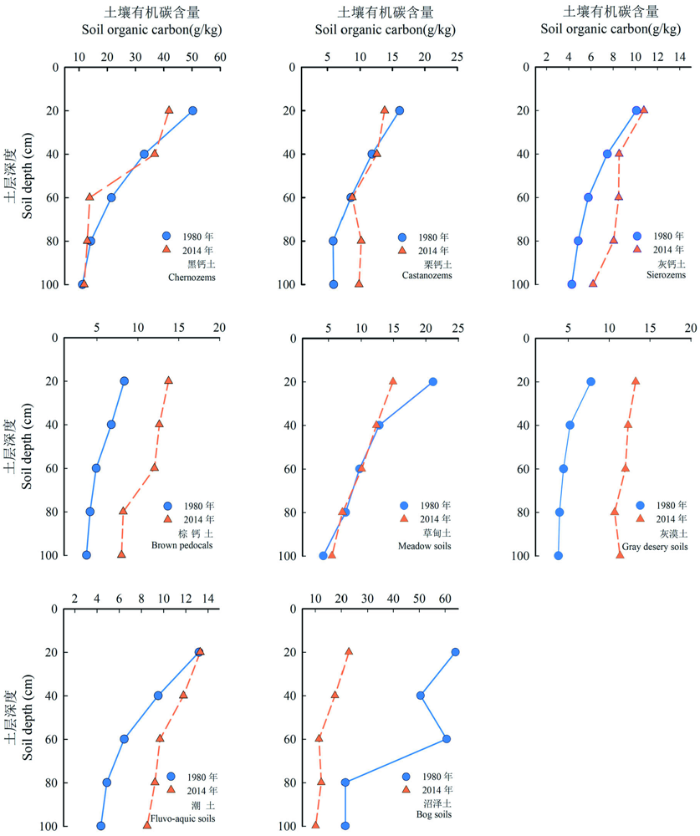
图1
北疆1980年和2014年耕地土壤有机碳含量垂直变化特征
Fig.1
Vertical change characteristics of cultivated soil organic carbon content in northern Xinjiang in 1980 and 2014
2.3 北疆农田土壤1980年和2014年土壤有机碳、全氮、全磷和pH统计特征值
研究表明,1980年和2014年土壤有机碳、全氮、全磷和pH均存在于不同程度的变异。1980年土壤有机碳介于1.46~75.80 g/kg,全氮介于0.13~5.67 g/kg,全磷介于0.27~4.48 g/kg,pH介于2.50~9.66。1980年土壤有机碳、全氮、全磷和pH最小值都小于年的最小值。表2
表2 北疆农田土壤1980年和2014年0~100 cm土壤有机碳、全氮、全磷和pH统计特征值
Table 2
| 特征值 Eigenvalue | 有机碳 Organic carbon(g/kg) | 全氮 Total nitrogen(g/kg) | 全磷 Total phosphorus(g/kg) | pH | ||||
|---|---|---|---|---|---|---|---|---|
| 1980年 In 1980 | 2014年 In 2014 | 1980年 In 1980 | 2014年 In 2014 | 1980年 In 1980 | 2014年 In 2014 | 1980年 In 1980 | 2014年 In 2014 | |
| 最小值Minimum | 1.46 | 3.88 | 0.13 | 1.10 | 0.27 | 0.37 | 2.50 | 6.41 |
| 最大值Max | 75.80 | 36.11 | 5.67 | 5.10 | 4.48 | 1.46 | 9.66 | 9.19 |
| 平均值Mean | 9.87 | 11.47 | 0.95 | 3.05 | 0.82 | 0.71 | 7.77 | 8.16 |
| 标准偏差SD | 9.27 | 5.94 | 0.87 | 1.11 | 0.53 | 0.20 | 1.21 | 0.41 |
| 变异系CV | 0.94 | 0.52 | 0.91 | 0.36 | 0.64 | 0.28 | 0.16 | 0.05 |
2.4 不同时期土壤有机碳含量与土壤全氮、全磷和pH的关系
研究表明,1980年土壤有机碳与全氮呈极显著正相关,拟合最优曲线为一元线性函数,相关系数R2=0.722 1。2014年土壤有机碳与全氮拟合最优曲线为二次项曲线,呈显著正相关,相关系数R2=0.116 1,比1980年相关系数低。1980年土壤有机碳与全磷拟合最优曲线为一元线性函数,呈显著正相关,相关系数R2=0.080 9。2014年土壤有机碳与全磷拟合最优曲线为二次项曲线。2个时期土壤有机碳与pH呈微弱相关。图2
图2
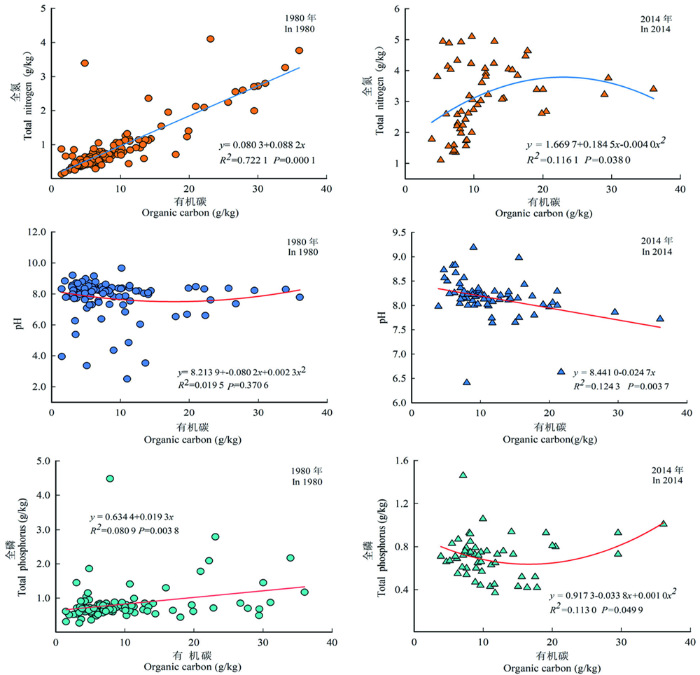
图2
土壤有机碳与全氮、全磷和pH的关系
Fig.2
The relationship between Soil Organic C and Total N, Total P and pH
2.5 不同时期全疆化肥使用量变化
研究表明,新疆全年化肥施用量逐年增加,2003年至2014年化肥施用量明显上升,其中复合肥施用量和磷肥施用量较为突出;整个施用量占大部分的是氮肥,其次为磷肥。图3
图3
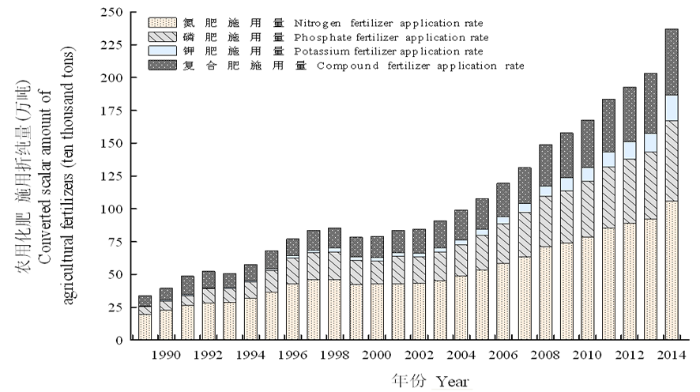
图3
1990~2014年全疆化肥施用量
Fig.3
The amount of chemical fertilizer used in Xinjiang from 1990 to 2014
3 讨论
有机肥为农田带来大量的碳源,提高土壤微生物的活性,有利于保持碳素的输入和输出平衡,进而提高土壤的固碳能力[30]。高伟等[31]经过34年长期定位施肥试验得出,农家肥的使用以及秸秆还田措施的应用,能有效的增加作物根系和土壤中的有机质含量,使土壤团聚体的形成,从而增加有机碳含量。有机无机配合施肥、施用化肥和不施肥土壤有机碳分别比试验开始时增加52.9%, 29.0%和11.1%,研究中结合全疆的化肥使用总体上呈上升趋势,其中氮肥施用量较多,其次为磷肥。齐中凯等[32]经过19年的长期定位试验,得到所有施肥处理都会显著增加表层(0~10 cm)中有机碳含量。侯晓静等[33]研究报告,采取农家肥、商品有机肥和化肥的施肥处理后,均能显著增加0 ~ 30 cm土壤有机碳含量,其中以农家肥的施用效果最优。Mandal等[34]研究表明, 长期施用氮磷肥及氮磷钾肥显著提高有机碳含量。近年来,北疆地区对农田有机肥的施用也得到了重视,使主要类型土壤有机质得到了提高[35]。
4 结论
4.1 2014年北疆不同耕地土壤类型有机碳平均含量总体上比1980年上升1.61 g/kg,变化率为4.73%,其中上升最为显著的是灰漠土和棕钙土,变化率分别为20.27%和15.75%。沼泽土的有机碳含量损失显著,变化率达到81.58%(27.74 g/kg)。
4.2 大部分土壤类型有机碳含量呈现随土层深度加深而降低的趋势;从不同时期,同一土层相比较,2014年黑钙土、栗钙土、草甸土和沼泽土耕地表层(0~20 cm)土壤有机碳含量比1980年有机碳含量的平均值降低,降幅达24.57%、6.76%、18.15%和121.174%。而2014年棕钙土和灰漠土有机碳含量平均值则比较1980年平均值增加,增幅为15.95%和16.12%。
4.3 1980年和2014年土壤有机碳与全氮呈显著正相关,相关系数分别为R2=0.722 1,R2=0.116 1,与全磷呈正相关,但与pH呈微弱相关。
4.4 近40年来北疆土壤有机碳含量呈上升趋势,有机碳含量变化,主要受土壤类型、气候因子、土壤理化性质、化肥施用量等因素的影响。
参考文献
天山云杉林土壤有机碳含量沿海拔梯度变化
[J].
【目的】 研究天山中部地区海拔对土壤有机碳含量的影响,研究区域尺度上土壤有机碳含量随海拔梯度变化,以及土壤其他因子之间的相关分析,精确估算森林生态系统土壤有机碳库。【方法】以新疆天山三个样区云杉林为对象,利用单因素方差分析和最小显著差异法等统计分析方法,研究不同海拔各土壤层有机碳含量垂直分布、积累特征及其与土壤全氮、全磷和pH值的关系。【结果】不同海拔梯度下,不同林区土壤有机碳含量随着土层深度呈逐渐减少的趋势;海拔梯度对有机碳含量的影响比较明显,尤其是2 000和2 200 m处的有机碳含量最高,1 800 m处次之,而2 400 m处最低;【结论】 三个林区有机碳含量在不同土层厚度中随海拔高度的增加无明显规律;土壤各土层有机碳含量与全氮含量为极显著正相关和土壤全磷含量为显著正相关,而与土壤pH值为弱负相关关系。
Distribution Characteristics of Soil Organic Carbon of Spruce Forest along Elevation Gradients in Tianshan Mountains
[J].
近30年中国农田耕层土壤有机质含量变化
[J].
Variation of Soil Organic Matter Content in Croplands of China over the Last Three Decades
[J].
中国土壤有机质含量变异性与空间尺度的关系
[J].
The Relationship between the Spatial Scale and the Variation of Soil Organic Matter in China
[J].
中国表层土壤有机质空间分布模拟分析方法研究
[J].
Study on Method for Spatial Simulation of Topsoil SOM at National Scalein China
[J].
中国不同地区土壤有机质特征比较研究
[J].
Characterization of soil organic matter in different regions of China
[J].
喀斯特小流域不同土地利用方式土壤活性碳组分的变化特征
[J].
Changes of soil active organic carbon pool under different land use types in Karst mountainous area
[J].
海南岛东部地区不同类型农用地土壤有机碳分布特征及影响因素
[J].
Distribution of Soil Organic Carbon in Different Agriculture Lands in East Areas of Hainan Island and Its Controls
[J].
秸秆还田条件下中国农田土壤有机碳含量变化及其影响因素的Meta分析
[J].
Residue returning induced changes in soil organic carbon and the influential factors in China's croplands: A meta-analysis
[J].
不同施肥管理措施对农田土壤植物和微生物残留组分的影响
[J/OL].
Effects of different fertilization managements on microbial necromass and plant lignin accumulation in a Mollisol
[J/OL].
农田管理措施对土壤有机碳周转及微生物的影响
[J].
Effects of farmland management measures on soil organic carbon turnover and microorganisms
[J].
耕作措施对旱作农田土壤颗粒态有机碳的影响
[J].
Distribution of soil particulate organic carbon fractions as affected by tillage practices in dry farmland of the Loess Plateau of central Gansu Province
[J].
基于ArcGIS的县域耕地表层土壤有机碳储量估算—以洪江市为例
[J].
An Estimation on Organic Carbon Reserves in Cultivated Land Surface Soil of a Country based on ArcGIS — Taking Honghu for Example
[J].
30年来东北主要黑土区耕层土壤有机碳密度与储量动态变化研究
[J].
Changes of Organic Carbon Density and Storage in Northeastern Black Soil Areas in Past 30 Years
[J].
吉林省耕层土壤有机碳储量及影响因素
[J].
Organic Carbon Storage of Cultivated Topsoils and Its Influencing Factors in Jilin Province
[J].
新疆人工灌溉绿洲的形成和发展演变
[J].
Formation, Development and Evolution of the Artificially-irrigated Oases in Xinjiang
[J].
土壤有机碳储量研究进展
[J].
Research Progress in Soil Organic Carbon Storage
[J].
Organic carbon content and distribution in soils un-der different land uses in tropical and subtropical China
[J].
Land use induced changes of organic carbon storage in soils of China
[J].
土壤有机碳的主导影响因子及其研究进展
[J].
Advances in Controlling Factors of Soil Organic
[J].
1980-2014年天山北麓不同土地覆被土壤有机碳的变化特征
[J].
Characteristics of Soil Organic Carbon Change under Different Land Covers in the North Part of Tianshan Mountain in 1980-2014
[J].
北京市耕地表层土壤有机碳分布及其影响因素
[J].
Distribution and influencing factors of soil organic carbon of cultivated land topsoil in Beijing
[J].
天山北麓近50年气温和降水的变化特征
[J].
Variation Characteristics of Temperature and Precipitation in the North of Tianshan Mountains in Recent 50 Years
[J].
气候变化影响的黄土高原农业土壤有机碳与碳排放
[J].
The Effect of Climate Chang on Soil Organic Carbon and Carbon Emissions for Agro-Ecosystem of Lost Plateau
[J].
东北地区旱地土壤有机碳密度的主控自然因素研究
[J].
Main natural factors controlling soil organic carbon density in the uplands of Northeast China
[J].
环鄱阳湖区农田土壤有机碳影响因素空间分布格局分析及制图研究
[J].
Spatial Distribution and Mapping of Influencing Factors of Farmland Soil Organic Carbon in the Poyang Lake Region
[J].
23-year manure and fertilizer application increases soil organic carbon sequestration of a rice-barley cropping system
[J].
长期不同施肥模式下华北旱作潮土有机碳的平衡特征
[J].
Balance characteristics of soil organic carbon under different long-term fertilization models in the upland fluvo-aquic soil of North China
[J].
不同施肥措施对华北平原土壤有机碳的影响
[J].
Impacts of Different Fertilization Measures on Soil Organic in the North China Plain
[J].
不同施肥措施对滨海盐渍土有机碳含量的影响
[J].
Effects of Different Fertilization on Soil Organic Carbon in Costal Saline Soil Region
[J].
Effect of long-term application of manure and fertilizer on biological and biochemical activities in soil during crop development stages
[J].


