

0 引言
【研究意义】当归[Angelica sinensis(Oliv.)Diels]为伞形科2年生草本植物[1]。主要种植在海拔2 000~2 800 m的高寒阴湿地区[2],甘肃的岷县、漳县、宕昌县、卓尼县和临潭县为当归主产区[3]。当归药材的生产主要以育苗移栽为主,种苗质量的优劣直接影响药材产量和品质[4⇓⇓-7]。近年来,当归种苗需求激增[8]。当归种苗繁育传统生荒地育苗技术即第1年7、8月,在海拔2 800 m以上的高寒二阴区选择土层深厚、质地疏松的坡地开荒。冬季农闲时,将草皮垒成草堆点燃。第2年5月底、6月初整地作畦,用“生灰”作底肥,在整好的畦面上均匀撒种后覆盖薄土,覆麦草或遮阳网遮阴。9月下旬至10月初采挖,扎把运回后放置在阴凉通风处晾苗,当苗子含水量降至60%~70%时堆藏或窖藏,翌年春天移栽。生荒地育苗不占耕地且育成当归种苗病虫害少、产量高,增加了药农对生荒地育苗的主观依赖性[9]。温室效应的加剧导致适宜当归育苗区域愈加狭窄,育苗向更高海拔荒地延伸[10,11]。探寻可替代生荒地育苗的当归熟地育苗技术成为亟需解决的关键问题。【前人研究进展】赵庆芳等[12]开展了当归熟地育苗试验研究,肯定了熟地育苗方式的可行性。武延安等[13,14]研究表明,日光温室冬季熟地育苗可明显抑制当归早期抽薹,并总结出了当归日光温室冬季育苗技术,但因成本较高未进一步推广。通过当归熟地育苗试验,选择出适合当归熟地育苗的黄芪、蚕豆茬口[15⇓⇓⇓-19]。【本研究切入点】但在实际生产中,当归熟地育苗仍然存在着播期和播种量不明确、种苗产量低、移栽后抽薹率高等问题[10]。亟需研究播期和播种量对熟地育成当归种苗及药材的影响。【拟解决的关键问题】设置当归熟地育苗试验及种苗移栽比较试验,比较不同播期和播种量条件下熟地育成当归种苗在植株形态指标、产量间的差异及种苗移栽后抽薹率、药材产量及阿魏酸含量间的差异,研究适合当归熟地育苗的播期、播种量及田间管理技术。
1 材料与方法
1.1 材料
表1 试验地基本信息
Table 1
| 地理信息 Geographic information | 2018年育苗地 The breeding ground in 2018 | 2019年种苗移栽地 Transplant seedlings into the ground in 2019 |
|---|---|---|
| 经度 Altitude | E103°40'92″ | E103°40'92″ |
| 纬度 Latitude | N35°26'14″ | N35°26'14″ |
| 海拔 Altitude(m) | 2 430 | 2 430 |
| 土壤温度范围 Soil temperature range(℃) | 4.48~26.91 | 4.11~21.74 |
| 土壤平均温度 Mean soil temperature(℃) | 15.83 | 14.02 |
| 土壤湿度范围 Soil moisture range(%) | 19.57~30.46 | 6.35~37.65 |
| 土壤平均湿度 Mean soil moisture(%) | 20.25 | 19.74 |
当归种子为2017年在甘肃岷县生荒留种地3年生当归种株采集的种子,种子采收后晾干贮藏备用,经甘肃中医药大学杜弢教授鉴定为当归(Angelica sinensis(Oliv.)Diels)种子。
1.2 方法
1.2.1 育苗
2018年设置当归熟地育苗试验,采用二因素随机区组设计,以播期(T1:6月15日、T2:6月28日、T3:7月13日)和播种量(B1:5 kg/667m2、B2:6 kg/667m2、B3:7 kg/667m2)为试验因素分别设3个梯度,共9个处理,每个处理重复3次,共计27个小区,每小区面积7 m2。
试验前结合翻地施磷酸二铵10 kg/667m2,深翻做垄,垄宽100 cm,垄高15 cm,垄间距30 cm。起垄后整平耙细垄面,捡去石块、草根等杂物。播种前将拌好的毒土(多菌灵2 kg/667m2、硫酸亚铁3 kg/667m2、15%毒辛颗粒剂2 kg/667m2,加15 kg细土拌匀)均匀撒施在地表,将当归种子均匀撒播在垄面。用铁网筛将土筛于垄面,种子覆土厚度约0.3 cm,以不见浮籽为度。播种完成后立即在离地面30 cm处搭盖遮光度为50%的遮阳网。2018年10月10日,种苗采挖后拌鲜土扎把,运回后放置在阴凉通风处晾苗,苗子含水量降至60%~70%时堆藏,翌年春天移栽。
1.2.2 种苗移栽
2019年4月15日,设置当归种苗大田栽培试验。采用随机区组设计,将2018年熟地育成当归种苗按9个处理分别移栽,每个处理重复3次,共计27个小区,每小区面积10 m2。
移栽前结合翻地施三元复合肥40 kg/667m2。翻耕平整后起垄,垄面宽140 cm,高20 cm,垄间距30 cm,用黑色地膜覆盖。选择健康、无病斑的当归种苗,按行株距30 cm×20 cm的栽植密度开穴移栽,每垄移栽4行,每穴栽苗2株,填土压实,苗头上覆土5~6 cm。田间管理措施与大田一致,根据生长状况,适时除草。
1.2.3 指标测定
1.2.3.1 种苗形态及产量
2018年10月10日,田间采挖种苗时,每小区随机取样,调查当归种苗形态指标:单根重(g)、根粗(mm)、根长(cm)、侧根数(条)、小区产量(kg)。
1.2.3.2 种苗成活率和早期抽薹率
种苗移栽后按重复小区依次统计成活株数和早期抽薹株数,最后分别计算成活率和早期抽薹率。
成活率(%)=(移栽后成活株数/移栽总株数)×100%;
早期抽薹率(%)=(早期抽薹株数/成活总株数)×100%。
1.2.3.3 药材形态指标及产量
2019年9月28日,当归药材生长期调查株高(cm)、株幅(cm)、叶片数(个);11月3日,当归药材采挖后调查根长(cm)、芦头粗(mm)、单根鲜重(g)、侧根数(条)及小区产量(kg);晾干后测定干重(kg),计算折干率(%)和单产(kg/667m2)。
1.2.3.4 阿魏酸含量
阿魏酸含量的测定参照2015版《中国药典》方法[1]。
1.3 数据处理
数据采用SPSS2 4.0统计软件进行分析,用Excel 2019软件作图。
2 结果与分析
2.1 不同处理对当归种苗形态指标及产量影响
研究表明,不同播期和播种量对熟地育成当归苗形态指标的影响显著。随着播期的延后,当归苗的全株重、单根重、根长、根粗均有不同程度的降低。其中,全株重最大的处理为T2B3,达0.76 g,与第3播期的3个处理间差异极显著(P<0.01);全株重最低的处理为T3B1,仅0.29 g。单根重最高的处理为T1B1,达0.63 g,与第3播期的3个处理间差异极显著(P<0.01);单根重最低的处理为T3B2,仅0.21 g。根长最长的处理为T2B2,达12.36 cm,仅与根长最短的处理T3B2间差异极显著(P<0.01)。根粗最粗的处理为T2B3,达4.22 mm;最细的处理为T3B1,仅2.89 mm,两者间差异极显著(P<0.01)。侧根数各处理间虽有不同,但均未达到显著水平(P>0.05)。第1播期下3个播种量的当归苗产量均极显著高于第2和第3播期(P<0.01),其中处理T1B2产量最高,达60.19 kg/667m2,与第2、第3播期的其他处理间差异达显著水平。产量最低的处理为T3B1,仅1.88 kg/667m2。同一播期下不同播种量的当归苗产量间虽有差异,但差异性均未达到显著水平(P>0.05)。表2
表2 不同播期和播种量下熟地育成当归苗形态指标及产量变化
Table 2
| 处理 Treatment | 全株重 Weight (g) | 单根重 Single weight (g) | 根长 Root length (cm) | 根粗 Root diameter (mm) | 侧根数 Lateral root (条) | 种苗产量 Yield of Seedlings (kg/667m2) |
|---|---|---|---|---|---|---|
| T1B1 | 0.74±0.14aA | 0.63±0.09aA | 11.50±0.57abAB | 3.90±0.82aABCD | 0.5±0.50a | 49.98±20.34aA |
| T1B2 | 0.66±0.10aA | 0.45±0.11bA | 12.11±0.30abAB | 3.65±0.57abcABCD | 0.1±0.23a | 60.19±21.86aA |
| T1B3 | 0.61±0.02aA | 0.56±0.06abA | 11.54±0.13abAB | 3.74±0.32abABCD | 0.4±0.06a | 50.97±9.49aA |
| T2B1 | 0.62±0.14aA | 0.52±0.13abA | 11.65±1.25abAB | 4.00±0.40aABC | 0.2±0.26a | 11.50±2.76bB |
| T2B2 | 0.68±0.17aA | 0.51±0.09abA | 12.36±0.84aA | 4.06±0.09aAB | 0.2±0.23a | 11.37±4.31bB |
| T2B3 | 0.76±0.19aA | 0.58±0.11abA | 12.22±1.04aA | 4.22±0.23aA | 0.4±0.64a | 12.97±4.02bB |
| T3B1 | 0.29±0.04bB | 0.23±0.05cB | 11.27±0.33abcAB | 2.89±0.14dD | 0.3±0.46a | 2.02±1.50bB |
| T3B2 | 0.30±0.07bB | 0.21±0.05cB | 10.13±0.75cB | 3.05±0.19bcdBCD | 0.3±0.42a | 1.88±1.81bB |
| T3B3 | 0.30±0.01bB | 0.23±0.04cB | 10.76±0.48bcAB | 2.98±0.09cdCD | 0.1±0.17a | 2.73±1.54bB |
注:同列不同小写字母表示不同处理间差异显著(P<0.05),同列不同大写字母表示不同处理间差异极显著(P<0.01),下同
Note:Different lowercase letters within the same column indicate differencesamong different factorsat the 0.05 level.Different uppercase letters within the same column indicate significant differencesamong different factorsat the 0.01 level.The same as below
2.2 不同处理对当归种苗移栽成活率的影响
研究表明,播期和播种量对熟地育成当归苗移栽成活率具有较大的影响。移栽后成活率最高的处理为T2B1,达57.99%,且与其他处理间差异显著;成活率最低的处理为T3B2,仅为34.72%,两者间差异极显著(P<0.01)。图1
图1
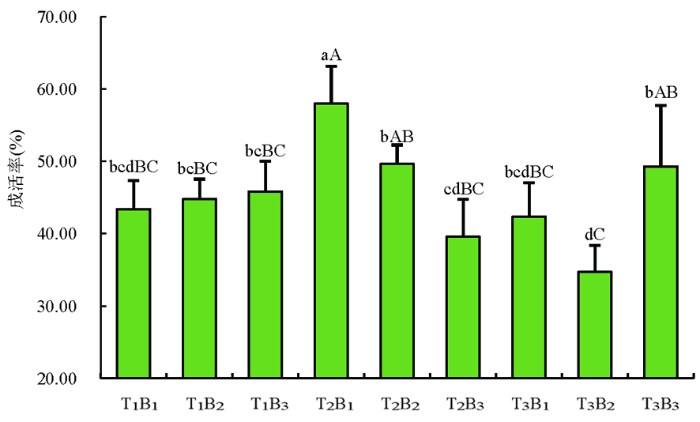
图1
不同处理下当归苗移栽成活率比较
注:不同小写字母表示不同处理间差异显著(P<0.05),不同大写字母表示不同处理间差异极显著(P<0.01),下同
Fig.1
Comparison of transplantrate of A.sinensis
Note:Different lowercase letters indicate differencesamong different factorsat the 0.05 level.Different uppercase letters indicate significant differencesamong different factorsat the 0.01 level.The same as below
2.3 不同处理对移栽后地上部生长及早期抽薹率的影响
研究表明,不同播期和播种量对熟地育成当归苗移栽后地上部的生长及早期抽薹率均有影响。株高最高的处理为T3B3,达34.07 cm,且与T1B2、T2B3、T3B13个处理间差异显著(P<0.05),株高最低的处理为T2B3,仅25.93 cm。各处理对株幅和叶片数有影响,但均未达到显著水平(P>0.05)。其中,株幅最大的处理为T1B1,达63.47 cm,株幅最小的处理为T2B3,为53.20 cm;叶片数最多的处理为T3B1,达8.87个,最少的处理为T2B2,仅6个。早期抽薹率最高的处理为T1B1,达4.77%,其次为T2B3;抽薹率最低的处理为T1B2、T2B1、T3B1、T3B2以及T3B3,抽薹率均为0,与其他处理间差异极显著(P<0.01)。表3
表3 不同播期和播种量下熟地育成当归苗移栽后地上部生长及早期抽薹率变化
Table 3
| 处理 Treatment | 株高 Plant height (cm) | 株幅 Plant length (cm) | 叶片数 Leaf number (个) | 早期抽薹率 Earlier-bolting rate (%) |
|---|---|---|---|---|
| T1B1 | 30.73±2.08abcA | 63.47±12.90a | 8.33±3.72a | 4.77±0.52aA |
| T1B2 | 27.20±1.00bcA | 56.47±3.92a | 8.13±5.52a | 0.00±0.00cB |
| T1B3 | 30.53±3.72abcA | 63.20±7.98a | 7.47±3.86a | 1.76±1.53bcAB |
| T2B1 | 30.93±3.26abcA | 55.60±4.16a | 6.20±0.69a | 0.00±0.00cB |
| T2B2 | 32.67±3.33abA | 54.73±7.05a | 6.00±2.50a | 3.74±1.76abA |
| T2B3 | 25.93±4.47cA | 53.20±2.46a | 7.73±0.12a | 3.34±3.50abAB |
| T3B1 | 26.00±3.34cA | 56.13±4.56a | 8.87±7.64a | 0.00±0.00cB |
| T3B2 | 32.60±2.09abA | 62.40±3.29a | 7.87±2.76a | 0.00±0.00cB |
| T3B3 | 34.07±3.38aA | 59.20±5.20a | 7.53±1.45a | 0.00±0.00cB |
2.4 不同处理下对当归种苗移栽后地下部的影响
研究表明,播期和播种量对熟地育成当归苗移栽后地下部的影响显著。其中,单根鲜重最高的处理为T1B1,达125.00 g,与T1B2、T2B3、T3B2 3个处理间差异极显著(P<0.01);单根鲜重最低的处理为T1B2,仅68.67 g,且与其他处理间差异极显著(P<0.01)。各处理间根长和根粗虽有差异,但均未达到显著水平,其中根长最长的处理为T3B2,达27.9 cm,根粗最粗的处理为T3B1,达31.55 mm。侧根数最多的处理为T1B3,达9.80条;侧根数最少的处理为T1B2,仅6.82条,两者间差异显著(P<0.05)。药材干重产量最高的处理为T2B1,达283.07 kg/667m2,其次为处理T2B2和T2B1。产量最低的处理为T2B3,仅160.50 kg/667m2,与T2B1间差异极显著(P<0.01)。表4
表4 不同播期和播种量下熟地育成当归种苗移栽后地下部变化
Table 4
| 处理 Treatment | 单根重 Single weight (g) | 根长 Root length (cm) | 根粗 Root diameter (mm) | 侧根数 Lateral root number(条) | 产量 Yield (kg/667m2) |
|---|---|---|---|---|---|
| T1B1 | 125.00±18.03aA | 27.45±3.50a | 29.51±1.66a | 8.07±1.03abA | 195.36±45.52bcAB |
| T1B2 | 68.67±6.81dC | 27.20±2.12a | 27.81±5.84a | 6.82±0.55bA | 219.49±13.82abcAB |
| T1B3 | 121.92±25.55aA | 26.45±0.63a | 30.58±5.27a | 9.80±1.64aA | 272.89±42.23aA |
| T2B1 | 106.63±8.03abcAB | 25.39±0.52a | 27.42±0.66a | 8.82±1.96abA | 283.07±26.52aA |
| T2B2 | 116.98±11.76abAB | 27.19±0.86a | 29.75±2.18a | 8.68±1.24abA | 280.19±24.17aA |
| T2B3 | 86.80±6.16cdBC | 25.12±1.54a | 29.03±1.90a | 8.82±0.71abA | 160.50±36.37cB |
| T3B1 | 93.50±7.47bcABC | 26.70±1.30a | 31.55±3.04a | 9.15±1.82abA | 193.42±13.69bcAB |
| T3B2 | 94.22±7.38bcABC | 27.90±0.95a | 28.74±2.02a | 8.22±1.75abA | 245.10±25.17abAB |
| T3B3 | 104.13±9.67abcB | 28.17±2.23a | 28.20±0.33a | 7.07±0.31bA | 227.99±17.38abAB |
2.5 不同处理下对药材阿魏酸含量的影响
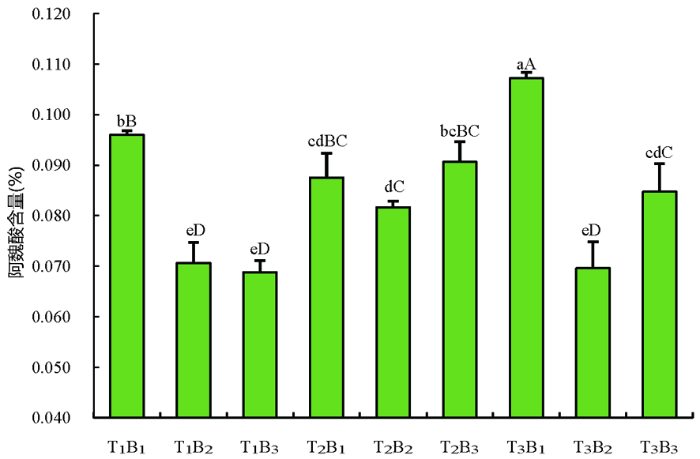
研究表明,不同处理下播期和播种量对熟地育成当归苗移栽后阿魏酸含量影响显著。阿魏酸含量最高的处理为T3B1,达0.107%,且与其他处理间差异极显著(P<0.01)。阿魏酸含量最低的处理为T1B3,仅0.068%。图2
图2
2.6 当归苗单根重及成药各指标的相关性
研究表明,种苗单根鲜重与早期抽薹率间呈显著正相关关系(r=0.770),种苗单根重越高越容易抽薹。产量与成活率、株高均呈显著正相关关系(r=0.717、r=0.667),成活率越高产量越高,且地上部分的生长与地下产量的增加相一致。阿魏酸含量与单根鲜重、早期抽薹率、叶片数和根粗间呈正相关关系(r=0.251、r=0.164、r=0.200、r=0.167);与成活率、株高、单根重、根长及产量间呈负相关关系(r=-0.133、r=-0.333、r=-0.283、r=-0.067、r=-0.200、r=-0.567)。表5
表5 当归种苗单根鲜重与成药的相关性
Table 5
| 性状指标 indicators | X1 | X2 | X3 | X4 | X5 | X6 | X7 | X8 | X9 | X10 | X11 |
|---|---|---|---|---|---|---|---|---|---|---|---|
| X1-单根鲜重 X1-Single weight | 1.000 | ||||||||||
| X2-早期抽薹率 X2-Earlier-bolting rate | 0.770* | 1.000 | |||||||||
| X3-成活率 X3-transplant rate | 0.151 | 0.000 | 1.000 | ||||||||
| X4-株高 X4-Plant height | -0.360 | -0.073 | 0.500 | 1.000 | |||||||
| X5-株幅 X5-Plant length | 0.000 | 0.037 | -0.167 | 0.217 | 1.000 | ||||||
| X6-叶片数 X6-Leaf number | -0.435 | -0.347 | -0.683* | -0.233 | 0.550 | 1.000 | |||||
| X7-单根重 X7-Single weight | 0.452 | 0.566 | 0.433 | 0.467 | 0.483 | -0.250 | 1.000 | ||||
| X8-根长 X8-Root length | -0.527 | -0.183 | -0.100 | 0.633 | 0.583 | 0.483 | 0.100 | 1.000 | |||
| X9-根粗 X9-Root diameter | 0.134 | 0.456 | -0.267 | -0.283 | 0.117 | 0.217 | 0.300 | -0.167 | 1.000 | ||
| X10-产量 X10-Yield | -0.126 | -0.128 | 0.717* | 0.667* | 0.033 | -0.533 | 0.483 | 0.017 | -0.267 | 1.000 | |
| X11-阿魏酸含量 X11-Comparison of FA | 0.251 | 0.164 | -0.133 | -0.333 | -0.283 | 0.200 | -0.067 | -0.200 | 0.167 | -0.567 | 1.000 |
注:*P<0.05
Notes: * indicated P<0.05.
3 讨论
播期不同,对应的育苗期环境因子及生长期均不同,育成当归种苗的质量及产量也不同。目前,生产上多用单根重0.4~0.8 g、根粗3~5 mm的当归种苗。研究发现,小种苗抽薹率低但生活力弱、产量低,大种苗生活力强但抽薹率高,故在实际生产中唯中等苗最有价值[23]。研究中,第1播期和第2播期育成当归苗均符合生产要求,而第3播期育成当归苗则因后期温度降低、生长期缩短,导致种苗过小。而播期对当归苗产量的影响主要表现在影响生长期,播期早的当归苗生长时间长,苗子单根重增加,产量增加。但研究发现,苗子产量明显低于实际生产,可能为育苗地前茬作物为柴胡,与当归均属伞形科,有连作障碍,
影响了出苗及根系发育状况,影响了当归苗产量。当归熟地育苗在6月下旬进行,且应避免当归、柴胡等伞形科茬口。除播期和播种量外,当归熟地育苗还受产地气候因子、土壤因子、肥料、茬口等因素的影响,有关不同产区及环境因子对当归熟地育苗的影响,还需进一步研究。
4 结论
播期和播种量对当归苗的影响较大,且最终会影响药材的产量和质量。播期过早,育成当归种苗较大、早期抽薹率高,导致产量降低;播期过迟,所得种苗移栽后虽有效降低了早期抽薹率,但成活率较低。在当归主产区,选择海拔2 400 m左右的地区进行当归熟地育苗,在6月下旬播种,播种量控制在5~6 kg/667m2,苗龄控制在110 d,获得的当归苗较为符合生产需求。
参考文献
甘肃中部当归生态气候分析及适生种植区划
[J].
Angelica ecological climmate analysis and being suitable to planting regionalization
[J].
甘肃岷县野生当归资源分布特点及其与栽培当归生长特性的比较研究
[J].
Comparative study on distributed feature of wild Angelica sinensis resources and the difference in growth characteristics with its cultivars native to Min County of Gansu
[J].
当归苗根直径大小对提前抽薹率及产量的影响
[J].
Effect of root diameter on early bolting rate and yield in seedling of Angelica sinensis
[J].
种苗大小对当归成药期早期抽薹和生理变化的影响
[J].
Effect of Seedling size on Moss-pulling and Physiological changes of Angelica sinensis in early Stage
[J].
种苗大小和外源激素对当归抽薹及产量构成的影响
[J].
Effect of seedling size and exogenous hormones on bolting and yield components of Angelica sinensis
[J].
当归种苗等级与植株生物量积累及药材质量的关系
[J].
Relationship between plant biomass accumulation and quality of Angelica sinensis
[J].
To research the relationship between the seedling grade of angelica and the biomass accumulation, output and quality of product, so as to provide base for establishing seedling standard.Thirty seedlings of Angelica were collected from the main production area in Gansu province, such as Minxian, Zahngxian, Dangchang and Weiyuan county, all the samples were measured with weigh of single seedling and the seedling were divided into three grade by the clustering analysis results, the grade were made to treatment to do field test and laboratory experiment.The weigh of dry root, above ground and the whole plant in growth period of treatment 2 (the weigh of single seedling between 0.74-1.38 g) were all superior to other treatments and the ck. The treatment 2 had low bolting percentage, the weigh of single root was higher and the yield was the highest. The characters of product from the treatment 2 was well and the content of ferulic acid was higher than the standard of Chinese pharmacopoeia (2010 year part 1).The plant from the grade 2 seedling with larger growth increment, higher output and better quality, which can be the best seedling in production.
不同育苗方式对当归生长发育及产量的影响
[J].
The growth and yield of Angelica seedling effected by different plant methods
[J].
岷县生荒地和熟地育成当归苗抗逆生理特性的差异
[J].
Differences in physiological resistance traits of Angelica sinensis seedlings from uncultivated and cultivated fields in Min County
[J].
岷县当归育苗的调查与思考
[J].
The investigation and thoughts on Angelica sinensis seedling in Min County
[J].
高寒阴湿区阴坡耕地当归育苗技术
[J].
Seedling raising technology of Angelica sinensis in the shade sloping farmland in cold and damp areas
[J].
当归熟地育苗试验研究
[J].
Study on Angelica seedling in replanted field
[J].
日光温室冬季育苗抑制当归早期抽薹的效应研究
[J].
Inhibitory Effect of Winter seedling in solar greenhouse on early Lichen extraction of Angelica sinensis
[J].
当归日光温室冬季育苗技术
[J].
Seedling raising technology of Angelica sinensis solar greenhouse in winter
[J].
在不同茬口土地上的当归育苗研究
[J].
Study on the seedling of Angelica sinensis on soil from different stubbles
[J].
药用作物茬口对当归苗栽生理生化特性的影响
[J].
Effects of Medicinal Crop Stubbles on Physiological and Biochemical Characteristics of Angelica sinensis Seedlings
[J].
Regulated effects of preceding crop on soil property and cultivating seedlings for Angelica sinensis on cultivated farmland
[J].
高寒区农茬口对当归田杂草群落特征的影响
[J].
Effects of crop stubble on weed community characteristics in Angelica sinensis fields in an alpine cold region
[J].
岷县不同茬口对当归苗栽生长及抗病性的影响
[J].
Effect of various crop residues on growth and disease resistance of Angelica sinensis seedlings in Min County
[J].
黄土高原带状植被土壤理化性质空间分异特征
[J].
The spatial differentiation of soil properties under banded vegetation systems on the Loess Plateau
[J].
混合盐碱对紫花苜蓿苗期根系特征的影响
[J].
Alfalfa seedling root characteristics under complex saline-alkali stress
[J].
Permanent raised beds improved soil structure andyield of spring wheat in arid northwestern China
[J].
种苗大小对当归综合农艺性状及抽苔率的影响
[J].
Effect of seedling size on the comprehensive agricultural characteristics and bolting rate of Angelica sinensis
[J].


