

0 引言
【研究意义】种子萌发期是作物生育周期的首要阶段[1-2],影响种子萌发因素很多,在水分和氧气保证的情况下,温度就是保证种子能够正常发芽的重要外界因素[3]。作物萌发阶段如遭遇低温冷害,轻则延迟种子萌发,重则导致种子胚芽死亡、霉烂,导致出苗不齐、影响产量[4]。新疆属温带大陆性气候,春季低温冷害和倒春寒天气会影响农业生产,藜麦营养价值全面和遗传多样性丰富且生态适应性广泛和抗逆性较强,不同藜麦品种,受遗传和产地因素影响种子的发芽能力及抗逆能力[5],保证藜麦产量提高前提条件是种子能够快速萌发,保证苗全、苗齐、苗壮[6-7]。早熟藜麦品种可能是物质积累量不足,产量不及中晚熟品种,但是藜麦种子没有休眠期,中晚熟品种成熟期如遇上秋季多雨容易影响穗发芽、产量和品质。选择萌发期和苗期耐低温品种,适时早播,缩短藜麦生育期是保证藜麦产量和品质的关键。【前人研究进展】Jacobsen等[8]研究了不同的藜麦基因型在霜冻温度下的表现,发现来自高海拔地区的藜麦品种较低海拔地区的品种抗寒性基因变现突出。Geerts S等[9]对于藜麦的抗性机理的研究显示,藜麦对低温的应激反应主要是积累碳水化合物以及酶的改变。Jacobsen等[10]利用秘鲁高原品种和安第斯谷地品种做对比,发现秘鲁高原品种能在-8℃存活4 h,抗冻性明显优于安第斯谷地品种。温日宇等[11]以红藜、白藜、黑藜3种不同藜麦为材料,对藜麦幼苗进行人工模拟低温(4℃)胁迫,研究表明有利脯氨酸含量越高的品种抗逆性越好,POD、SOD活性越强,越能增强藜麦的抗寒性。沈菊等[12]为了分析霜冻、低温冻害等因素对藜麦在播种期至幼苗期的影响,通过人工模拟环境试验和自然环境试验相结合,分析了青藜1号在-10℃,且低于0℃以下14 h藜麦进入休眠期,在-14℃,且低于0℃以下15 h藜麦幼苗枯萎。孟军萍等[13]利用4个玉米自交系品种,在玉米发芽期间,分别用-4、0、4和8℃处理0、4、8和12 h,研究其对玉米的影响,结果表明低温对玉米幼苗干鲜重影响显著。沈忱[14]利用不同苜蓿品种对其种子进行低温胁迫,通过比较其种子萌发期耐寒性,并筛选出耐寒性强的苜蓿品种。【本研究切入点】目前国内研究主要围绕藜麦的生态适应性及营养物质利用等,对于种子抗逆性萌发多集中在抗旱、耐盐上,耐寒性的研究也主要集中在藜麦苗期,而不同藜麦品种种子萌发期对低温胁迫的响应未见报道。需研究藜麦萌发期对低温胁迫的响应。【拟解决的关键问题】选择6个藜麦品种,以1、5、10、15和20℃处理进行发芽试验,分析不同萌发温度条件下的多个萌发指标,筛选出低温胁迫下藜麦萌发期主要耐寒性鉴定指标和抗寒性较好的品种。
1 材料与方法
1.1 材料
选用6个品种全部来源于伊犁州农科所近几年从中国农科院作物科学研究所引进、筛选出的适合当地种植的藜麦品种(系),品种编号为YN1、YN2、YN3、YN4、YN5和YN6。
1.2 方法
1.2.1 试验设计
每个品种选择籽粒饱满、大小均匀的藜麦种子冲洗干净,经75%酒精浸泡消毒1 min后用无菌水冲洗3遍备用,每品种选择150粒种子放置于直径12 cm、底部放置2层滤纸培养皿中,每皿50粒,各处理重复3次,浸透蒸馏水,盖上皿盖,置于1、5、10、15和20℃的LRH-50L/CA型号的低温培养箱中进行发芽试验,每天记录各处理种子萌发数,定时定量滴加蒸馏水,第3 d计算发芽势,第7 d计算发芽率并从各处理样品中随机选取10株,用直尺测量其芽长,再用万分之一天平测定芽鲜重,计算发芽指数和活力指数。
1.2.2 指标测定
发芽势(GE)=(第3 d发芽种子数/供试种子数)×100%;
相对发芽势(RGE)=(胁迫处理的发芽势/对照的发芽势)×100%;
发芽率(GR)=(正常发芽种子数/供试种子数)×100%;
相对发芽率(RGR)=(胁迫处理的发芽率/对照的发芽率)×100%;
发芽指数(GI)=∑(Gt/Dt)(Gt为时间t日的发芽数,Dt为相应的发芽天数);
相对发芽指数(RGI)=(胁迫处理的发芽指数/对照的发芽指数)×100%;
活力指数(VI)=芽鲜重×GI;
相对活力指数(RVI)=(胁迫处理的活力指数/对照的活力指数)×100%;
相对芽长(RBL)=(胁迫处理的芽长/对照的芽长)×100%;
相对芽鲜重(RBFW)=(胁迫处理的芽鲜重/对照的芽鲜重)×100%。
1.3 数据处理
运用多因素方差分析比较6个藜麦品种在不同低温胁迫条件下时各发芽指标的差异性;选择相对萌发指标运用相关分析法及主成分分析法分析6个藜麦品种萌发之间的相关性及萌发代表性的主成分指标,运用隶属函数法对6个藜麦品种种子萌发抗寒性进行综合评价,公式为X(u)=(X-Xmin)/(Xmax-Xmin), X(u)为某品种某一指标的测定值,Xmin和Xmax为该指标中的最小值和最大值,并求出综合评价指标D值对6个藜麦品种的耐冷性进行综合排序。所得数据利用Exce2007软件和DPS15.10软件进行分析。
2 结果与分析
2.1 6个藜麦品种萌发指标对不同低温的响应
2.1.1 不同温度对6个藜麦品种发芽率的影响
研究表明,藜麦的发芽率受温度影响相比于其他指标影响较小,变异系数为27.622%,在10和20℃时YN2为最高(0.993%),1℃时YN3为最低(0.007%)。6个藜麦品种在1~20℃的平均发芽率呈上升趋势,随着温度的升高,种子的发芽能力也随之升高,10~20℃时,发芽率趋于稳定,在这个温度区间内都不会影响6个藜麦品种的发芽率;YN1和YN3在1、5、10和15℃与其他4个品种的发芽率都存在极显著差异,YN2、YN4和YN5品种在1~20℃区间内差异不显著,一直保持较高的发芽率,低温对其发芽率影响较小,YN6在1℃时与其他温度差异极显著,低于5℃其发芽率明显受到影响。表1
表1 不同温度下藜麦品种萌发指标的差异性比较
Tab.1
| 处理 Treatments | 发芽率 GR | 发芽势 GE | 发芽指数 GI | 活力指数 VI | 芽鲜重 BFW | 芽长 BL |
|---|---|---|---|---|---|---|
| A1B1 | 0.133I | 0.000H | 0.000L | 0.000L | 0.000M | 0.000J |
| A1B2 | 0.88ABCDE | 0.207FG | 11.934J | 1.048JKL | 0.088L | 3.988IJ |
| A1B3 | 0.007J | 0.000H | 0.083L | 0.000L | 0.000M | 0.000J |
| A1B4 | 0.913ABCD | 0.207FG | 11.445J | 1.16JKL | 0.101JKL | 4.922IJ |
| A1B5 | 0.847CDE | 0.187G | 10.936J | 1.136JKL | 0.104JKL | 6.132HIJ |
| A1B6 | 0.720FG | 0.187G | 10.095JK | 0.987JKL | 0.098JKL | 5.789HIJ |
| A2B1 | 0.607GH | 0.267EFG | 11.206J | 1.227JKL | 0.109HIJKL | 11.913GHI |
| A2B2 | 0.980A | 0.953AB | 28.744DEFG | 3.691FGH | 0.129EFGHIJK | 16.097FGH |
| A2B3 | 0.560H | 0.013H | 5.891K | 0.681KL | 0.116GHIJKL | 7.144HIJ |
| A2B4 | 0.933ABCD | 0.860ABCD | 28.144EFG | 4.222DEFGH | 0.149DEFGH | 19.649CDEFG |
| A2B5 | 0.880ABCDE | 0.780D | 25.539G | 3.138GHI | 0.123FGHIJKL | 16.003FGH |
| A2B6 | 0.9ABCD | 0.787CD | 26.617FG | 3.137GHI | 0.118FGHIJKL | 17.908EFG |
| A3B1 | 0.847CDE | 0.327EFG | 18.428H | 2.231IJ | 0.121FGHIJKL | 14.5FGHI |
| A3B2 | 0.993A | 0.973A | 33.511BCD | 3.216GHI | 0.096JKL | 14.086FGHI |
| A3B3 | 0.773EF | 0.24EFG | 12.939IJ | 1.221JKL | 0.094KL | 12.64GHI |
| A3B4 | 0.980A | 0.967A | 29CDEFG | 5.172CDE | 0.168DE | 20.682CDEFG |
| A3B5 | 0.960ABC | 0.827ABCD | 30.967BCDEF | 4.179EFGH | 0.135DEFGHIJ | 18.428DEFG |
| A3B6 | 0.940ABCD | 0.853ABCD | 29.922CDEFG | 4.332DEFG | 0.145DEFGHI | 18.662DEFG |
| A4B1 | 0.853BCDE | 0.393E | 20.689H | 3.074HI | 0.151DEFG | 28.841CD |
| A4B2 | 0.987A | 0.967A | 33.733ABC | 3.666FGH | 0.109IJKL | 27.001CDE |
| A4B3 | 0.827DEF | 0.367EF | 17.081HI | 1.68JK | 0.098JKL | 20.303CDEFG |
| A4B4 | 0.973AB | 0.96A | 32.244BCDE | 5.473CD | 0.17D | 29.751C |
| A4B5 | 0.987A | 0.793BCD | 31.95BCDE | 4.843CDEF | 0.152DEFG | 26.971CDE |
| A4B6 | 0.947ABCD | 0.873ABCD | 31.906BCDE | 4.136EFGH | 0.129EFGHIJK | 23.755CDEF |
| A5B1 | 0.933ABCD | 0.887ABCD | 30.422CDEF | 5.137CDE | 0.17D | 68.32AB |
| A5B2 | 0.993A | 0.980A | 35.5AB | 5.616C | 0.158DEF | 62.064B |
| A5B3 | 0.933ABCD | 0.847ABCD | 26.3FG | 4.581CDEF | 0.174CD | 70.878AB |
| A5B4 | 0.98A | 0.967A | 38.389A | 9.463A | 0.247AB | 75.816A |
| A5B5 | 0.953ABC | 0.947ABC | 32.583BCDE | 8.328A | 0.255A | 73.335A |
| A5B6 | 0.947ABCD | 0.887ABCD | 32.439BCDE | 6.931B | 0.214BC | 76.954A |
| A因素间 Between factors A | 368.620 | 813.270 | 979.447 | 250.550 910 6 | 126.758 | 522.762 495 |
| B因素间 Between factors B | 300.873 | 395.074 | 414.385 | 74.063 526 02 | 33.035 | 5.768 949 4 |
| A×B | 61.639 | 34.231 | 13.057 | 3.854 595 109 | 5.128 | 1.107 945 076 |
| 变异系数 Coeffcient of variation | 27.622 | 58.460 | 48.223 | 68.201 | 42.186 | 91.688 |
注:A1、A2、A3、A4、A5分别代
Note::A1,A2,A3,A4,A5 represent 1,5,10,15,20 degrees O Celsius;respectively B1,B2,B3,B4,B5,B6respectively representing YN1,YN2,YN3,YN4,YN5,YN6 varieties,ANOUA capital letters represent significant at the 0.01 level,the same as below
2.1.2 不同温度对6个藜麦品种发芽势的影响
研究表明,6个藜麦品种的发芽势总变异系数为58.460%,在20℃时YN2为最高(0.980),1℃时YN1、YN2为最低(0.00)。6个藜麦品种1~20℃的平均发芽势呈持续上升趋势,从1~5℃时上升速度较快,5~15℃时上升较平缓,20℃达到最高值,引发种子发芽的温度越高,种子发芽速度越快;1、5、10和15℃时YN1和YN2与其他4个品种均达到极显著水平,且1℃时这2个品种发芽势均为0,低温会降低其发芽速率;YN2、YN4品种从5℃开始就表现出较高的发芽势,其耐低温能力强,第3 d开始达到发芽峰值。
2.1.3 不同温度对6个藜麦品种发芽指数影响
研究表明,6个藜麦品种的发芽势总变异系数为48.223%,20℃时YN4为最高(38.389%),1℃时YN1为最低(0.00%)。1~15℃时YN1、YN2与其他品种均达及显著水平,发芽指数随着温度升高呈上升趋势,YN2和YN4从5℃开始发芽指数就保持较高的水平,但是YN2从10℃开始发芽指数水平就趋于平稳,10℃为该品种适宜发芽温度,YN4发芽指数从1~20℃成持续上升趋势,20℃到达峰值,温度越高该品种发芽指数越高;YN5、YN6从10℃开始发芽指数趋于稳定,10~20℃是2个品种适宜发芽温度。
2.1.4 不同温度对6个藜麦品种活力指数影响
研究表明,温度对6个藜麦品种活力指数影响相比于其他萌发指数影响较大,变异系数达到68.201%,20℃时YN4为最高(9.463%),1℃时YN1、YN3为最低(0.00%)。活力指数与芽鲜重相关,1℃时YN1、YN3未有种子发芽,1℃时活力指数为0;随着温度升高,6个藜麦品种的活力指数也持续升高,品种间在不同温度下达极显著差异,YN2 1~20℃活力指数均高于其他品种,YN5、YN6品种在1~15℃时活力指数差异都不显著,10~15℃时数值趋于平稳,20℃时却达到极显著水平,YN6活力指数明显低于YN5,温度达到10℃之后对YN6的活力指数影响不明显;相较于其他品种,YN31~15℃活力指数值一直较低,20℃时明显升高,该品种对温度及其敏感。
2.1.5 不同温度对6个藜麦品种芽长和芽鲜重的影响
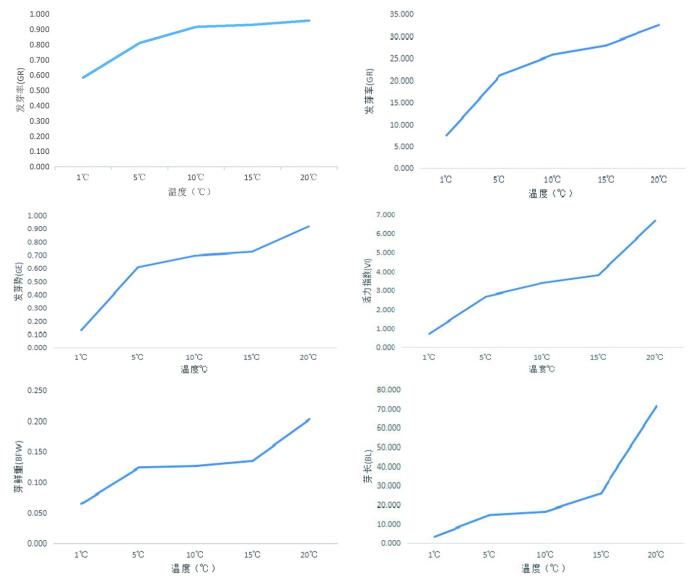
研究表明,6个藜麦品种的芽长与芽鲜重成正比,且温度对于这两个因素影响较大,变异系数分别为91.688%和42.186%,芽长和芽鲜重分别以20℃时YN6(76.954 mm)YN5(0.255 mg)最高,以1℃时YN1(0 mm)、YN3(0 mg)最低;各品种1和20℃时都与5~15℃时差异达到显著,温度直接影响6个藜麦品种的芽长和芽鲜重。5~15℃时平均芽长上升幅度较慢,20℃时所有品种芽长成倍增长,20℃能使藜麦快速生长,但是20℃时芽鲜重数值没有明显增加,在此温度下有可能致使幼芽徒长,物质积累不协调易造成幼苗纤弱。图1
图1
2.2 6个藜麦品种萌发指标相对值之间相关性
研究表明,种子萌发各相对指标之间既独立又存在相关性,相对发芽率、相对发芽势、相对发芽指数、相对活力指数、相对芽鲜重、相对芽长对不同温度的响应及响应程度都存在不同的差异性且都达到了极显著水平,其中相对发芽率与相对发芽指数(0.816**)、相对发芽势与相对发芽指数(0.952**)、相对发芽指数与相对活力指数(0.896**)、相对活力指数与相对芽长(0.930**),均存在显著差异性或极显著差异性。表2
表2 不同温度下各相对萌发指标的相关系数
Tab.2
| 项目 Items | 相对发芽率 RGR | 相对发芽势 RGI | 相对发芽指数 RGI | 相对活力指数 RVI | 相对芽鲜重 RBFW | 相对芽长 RBL |
|---|---|---|---|---|---|---|
| 相对发芽率(RGR) | 1.000 | |||||
| 相对发芽势(RGI) | 0.734** | 1.000 | ||||
| 相对发芽指数(RGI) | 0.816** | 0.952** | 1.000 | |||
| 相对活力指数(RVI) | 0.653** | 0.850** | 0.896** | 1.000 | ||
| 相对芽鲜重(RBFW) | 0.727** | 0.661** | 0.756** | 0.883** | 1.000 | |
| 相对芽长(RBL) | 0.465** | 0.651** | 0.709** | 0.930** | 0.832** | 1.000 |
注:**表示0.01水平下的显著差异
Note:**means difference at 0.01 level
2.3 6个藜麦品种萌发指标相对值之间主成分
研究表明,在不同温度培养下6个藜麦品种种子萌发各指标间差异极显著,因子1的特征值为4.855,占总信息量的80.924%,其他主成分因子特征值均小于1,且权重因子为0.809,因子1(相对发芽率)可以用作6个藜麦品种低温萌发指标。表3
表3 不同温度下各相对萌发指标的主成分
Tab.3
| 项目 Items | 因子1 Factor 1 | 因子2 Factor 2 | 因子3 Factor 3 | 因子4 Factor 4 | 因子5 Factor 5 | 因子6 Factor 6 |
|---|---|---|---|---|---|---|
| 相对发芽率(RGR) | 0.368 | 0.585 | 0.524 | 0.442 | 0.176 | -0.147 |
| 相对发芽势(RGI) | 0.409 | 0.299 | -0.546 | -0.286 | 0.591 | 0.118 |
| 相对发芽指数(RGI) | 0.432 | 0.262 | -0.274 | 0.028 | -0.740 | 0.348 |
| 相对活力指数(RVI) | 0.440 | -0.262 | -0.152 | -0.046 | -0.170 | -0.827 |
| 相对芽鲜重(RBFW) | 0.409 | -0.244 | 0.572 | -0.630 | 0.020 | 0.220 |
| 相对芽长(RBL) | 0.387 | -0.610 | -0.046 | 0.568 | 0.206 | 0.334 |
| 特征值Eigenralue | 4.855 | 0.661 | 0.372 | 0.071 | 0.033 | 0.008 |
| 百分率Percentage(%) | 80.924 | 11.024 | 6.195 | 1.185 | 0.543 | 0.128 |
| 累计百分率Cumulative percentage(%) | 80.924 | 91.948 | 98.143 | 99.329 | 99.872 | 100.000 |
| 权重=因子1/100 Weight=Factor 1/100 | 0.809 | 0.110 | 0.062 | 0.012 | 0.005 | 0.001 |
2.4 6个藜麦品种萌发指标相对值之间的综合评价
研究表明,提取主成分系统矩阵,公式为D=X1×0.809+X2×0.11+X3×0.062+X4×0.012+X5×0.005+X6×0.001,D值越大该品种在此温度下萌发响应越好。1℃时YN4表现最好,得分0.774,而YN3表现最差,得分为0。5℃时YN2表现最好,得分0.940,得分最低的依然是YN3,与YN2相差0.453分,排名2~4的YN6、YN4、YN5两两分数差距较小。10℃时,YN2依然排名第1,得分0.959,YN5、YN6排在第2、3位。15℃时,YN5、YN6排在第1、2位,6个藜麦品种D值差距不大。20℃时,6个藜麦品种D值没有差异。YN4品种1℃低温胁迫条件下,表现突出,耐寒性最强,属极耐低温品种;YN2、YN5、YN6品种1~15℃低温条件下D值相差不显著且表现稳定,属耐低温品种;YN1、YN3品种1~15℃低温条件下一直排在最后2位,2个品种耐低温性较差,属低温敏感品种。表4
表4 不同温度下各相对萌发指标的综合评价
Tab.4
| 处理 Treatments | 相对发芽率 RGR | 相对发芽势 RGI | 相对发芽指数 RGI | 相对活力指数 RVI | 相对芽鲜重 RBFW | 相对芽长 RBL | D值 | 综合排名 Comprehensive ranking |
|---|---|---|---|---|---|---|---|---|
| A1B1 | 0.130 | 0.000 | 0.000 | 0.000 | 0.000 | 0.000 | 0.107 | 5 |
| A1B2 | 0.850 | 0.210 | 0.340 | 0.190 | 0.560 | 0.070 | 0.741 | 2 |
| A1B3 | 0.000 | 0.000 | 0.000 | 0.000 | 0.000 | 0.000 | 0.000 | 6 |
| A1B4 | 0.900 | 0.210 | 0.300 | 0.120 | 0.410 | 0.070 | 0.774 | 1 |
| A1B5 | 0.860 | 0.200 | 0.340 | 0.140 | 0.410 | 0.080 | 0.740 | 3 |
| A1B6 | 0.730 | 0.210 | 0.310 | 0.140 | 0.470 | 0.080 | 0.639 | 4 |
| A2B1 | 0.630 | 0.300 | 0.370 | 0.240 | 0.640 | 0.180 | 0.568 | 5 |
| A2B2 | 0.950 | 0.970 | 0.810 | 0.660 | 0.830 | 0.260 | 0.940 | 1 |
| A2B3 | 0.580 | 0.020 | 0.220 | 0.150 | 0.680 | 0.100 | 0.487 | 6 |
| A2B4 | 0.920 | 0.890 | 0.730 | 0.450 | 0.610 | 0.260 | 0.896 | 3 |
| A2B5 | 0.890 | 0.820 | 0.780 | 0.390 | 0.490 | 0.220 | 0.867 | 4 |
| A2B6 | 0.920 | 0.890 | 0.820 | 0.460 | 0.560 | 0.230 | 0.900 | 2 |
| A3B1 | 0.880 | 0.370 | 0.610 | 0.440 | 0.720 | 0.220 | 0.795 | 5 |
| A3B2 | 0.970 | 0.990 | 0.940 | 0.580 | 0.610 | 0.230 | 0.959 | 1 |
| A3B3 | 0.800 | 0.290 | 0.490 | 0.280 | 0.560 | 0.180 | 0.714 | 6 |
| A3B4 | 0.970 | 1.000 | 0.760 | 0.510 | 0.680 | 0.270 | 0.948 | 4 |
| A3B5 | 0.970 | 0.870 | 0.950 | 0.510 | 0.530 | 0.250 | 0.951 | 2 |
| A3B6 | 0.960 | 0.960 | 0.920 | 0.630 | 0.690 | 0.250 | 0.950 | 3 |
| A4B1 | 0.880 | 0.450 | 0.690 | 0.600 | 0.890 | 0.430 | 0.818 | 5 |
| A4B2 | 0.960 | 0.990 | 0.950 | 0.660 | 0.690 | 0.440 | 0.955 | 3 |
| A4B3 | 0.850 | 0.430 | 0.650 | 0.370 | 0.580 | 0.290 | 0.787 | 6 |
| A4B4 | 0.960 | 0.990 | 0.840 | 0.580 | 0.690 | 0.390 | 0.948 | 4 |
| A4B5 | 1.000 | 0.840 | 0.980 | 0.590 | 0.600 | 0.370 | 0.972 | 1 |
| A4B6 | 0.970 | 0.990 | 0.980 | 0.600 | 0.610 | 0.320 | 0.961 | 2 |
| A5B1 | 0.970 | 1.000 | 1.000 | 1.000 | 1.000 | 1.000 | 0.971 | 1 |
| A5B2 | 0.970 | 1.000 | 1.000 | 1.000 | 1.000 | 1.000 | 0.971 | 1 |
| A5B3 | 0.970 | 1.000 | 1.000 | 1.000 | 1.000 | 1.000 | 0.971 | 1 |
| A5B4 | 0.970 | 1.000 | 1.000 | 1.000 | 1.000 | 1.000 | 0.971 | 1 |
| A5B5 | 0.970 | 1.000 | 1.000 | 1.000 | 1.000 | 1.000 | 0.971 | 1 |
| A5B6 | 0.970 | 1.000 | 1.000 | 1.000 | 1.000 | 1.000 | 0.971 | 1 |
| 权重 Weight | 0.800 | 0.120 | 0.060 | 0.010 | 0.010 | 0.000 | — |
3 讨论
采用主成分分析法将不同温度下萌发指标的相对值降维[15],累计贡献率大于80%的原则[16],种子的萌发既受外部环境的影响又取决于自身遗传基因的控制[17],而外部影响因子中温度又是促进种子快速萌发的关键因素[18],不同温度条件下,作物的萌发指标也存在差异[19]。藜麦对于干旱、盐碱、高寒等逆境环境均有较好的耐受性[20-21],在低温胁迫条件下,不同藜麦品种在种子萌发期的表现存在显著差异,1℃条件下,YN1、YN3品种发芽势均为0,与其他4个品种均达极显著差异,品种遗传基因的差异决定其种子萌发期耐冷性[22]。朱宗文等[23]通过在不同低温条件下茄子自交系材料的细胞过程、代谢过程、生物调节过程与单有机体存在较多的差异表达基因。
选择多个萌发指标综合评价品种间的耐低温能力更具优势[27]。赵阳佳等[28]采用模糊隶属函数法对7个绿肥作物的耐低温萌发能力做出综合评价;徐小萌等[29]对不同颜色紫云英种子低温萌发指标进行相关性分析,并利用模糊隶属函数法综合评价不同颜色紫云英种子的活力。研究选择1、5、10、15和20℃,5个温度区间,将发芽率、发芽势、发芽指数、活力指数、芽长、芽鲜重的相对值进行相关性分析,6个相对萌发指标差异性都达到了极显著水平;选取6个萌发指标相对值对6个藜麦品种在5个温度区间下进行主成分分析,通过对多项指标的降维处理,得到相对发芽势、相对发芽指数、相对活力指数可作为藜麦萌发期耐低温特性的主要鉴定指标。基于主成分分析,利用模糊隶属函数法对6个藜麦品种在5个温度区间内进行综合评价,筛选出极耐低温品种1个、耐低温品种3个及低温敏感品种2个。如要将筛选出的耐低温品种应用于实际生产,尚需进一步进行田间试验来验证。
4 结论
YN1、YN3品种在萌发期对低温最敏感,不适合早播;YN2、YN5、YN6品种在不同温度下,各方面指标表现稳定,在低温条件下虽然发芽速度较慢,但是发芽率较高,耐低温性较强,属于耐低温品种;YN4品种在低温条件下表现最突出,属于极耐低温品种。
参考文献
盐胁迫和干旱盐胁迫对小叶茼蒿种子萌发的影响
[J].
Effects of salt stress and drought stress on seed germination of chrysanthemum coronarium
[J].
低温胁迫和赤霉素对花生种子萌发和幼苗生理响应的影响
[J].
Effects of low temperature stress and gibberellin on seed germination and seedling physiological response of peanut
[J].
8个油菜品种的耐低温萌发特性及其春播试验
[J].
Low temperature germination tolerance of eight Rapeseed varieties and their spring sowing experiment
[J].
Genetic Analysis of Seedling Growth under Cold Temperature Stress in Grain Sorghum
[J].
低温冷害对玉米生长影响及相关研究
[J].
Effects of chilling injury on maize growth and its correlation
[J].
国内外玉米自交系耐低温萌发能力综合评价
[J].
【目的】 选用来自美国、德国、前南斯拉夫、加拿大和中国的玉米种质,研究耐低温萌发能力,筛选耐低温萌发能力强的种质,为耐低温种质改良和新品种选育提供材料基础和技术支撑。【方法】 以74份玉米自交系为材料,运用田间直接鉴定法和室内鉴定法,调查测定标准发芽率(SGR)、冷浸发芽率(CIGR)、田间常温出苗势(NFEP)、田间常温出苗率(NFER)、田间低温出苗势(LFEP)、田间低温出苗率(LFER)、田间常温发芽指数(NFGI)、田间常温活力指数(NFVI)、田间低温发芽指数(LFGI)和田间低温活力指数(LFVI)等10个指标,运用隶属函数法和多元统计方法分析对玉米种子耐低温萌发能力,并综合评价。【结果】 参试玉米自交系耐低温萌发能力存在丰富的遗传变异,10个鉴定指标的遗传变异系数在10.10%~145.47%,累计贡献率为73.554%,回归建立了玉米自交系种子耐低温萌发能力综合评价数学模型Y<sub>耐低温</sub>=0.162+0.250X<sub>NFGI</sub>+0.246X<sub>LFGI</sub>,预测结果与隶属函数值(L)法的评价结果基本一致。最后基于耐低温萌发能力综合评价值,将74份自交系分为5个等级,筛选出耐低温萌发能力极强自交系1份,耐低温萌发能力较强的自交系12份,耐低温萌发能力中等的自交系45份,耐低温萌发能力较弱的自交系13份,耐低温萌发能力极弱的自交系3份。【结论】 筛选出的耐低温萌发能力极弱自交系Shen137、D3M、JSH2402和耐低温萌发能力极强的自交系Xinzi3113,将应用于耐低温QTL定位,种质创新及新品种选育研究中。常温田间发芽指数和低温田间发芽指数可作为评价自交系耐低温能力的主要指标。
Comprehensive evaluation of low temperature germination tolerance of maize inbred lines at home and abroad
[J].<b>【Objective】</b> In recent years, extreme weather such as low temperature chilling injury occurred frequently during the sowing and emergence of maize in the northern spring maize region, resulting in slow emergence and poor uniformity of seeds, which ultimately affected the quality and yield of maize. In this study, maize germplasm from the United States, Germany, former Yugoslavia, Canada and China were selected for the identification of low temperature germination resistance, and the germplasm with strong low temperature germination resistance was selected to provide material basis and technical support for the improvement of low temperature resistant germplasm and the breeding of new varieties.<b>【Methods】</b> 74 maize inbred lines were taken as materials, the field survey direct method and indoor assay method were applied, through the investigation, to determine the 10 indexes such as the standard germination rate (SGR), cold immerse germination rate (CIGR), normal field emergence potential (NFEP), normal field emergence rate (NFER), low field emergence potential (LFEP), low field emergence rate (LFER), normal Field germination index (NFGI), normal field vigor index (NFVI), low field germination index (LFGI) and low field vigor index (LFVI). The ability of maize seeds to germinate under low temperature was evaluated by the method of membership function and multivariate statistical analysis. And also, the ability of maize seeds to resist low temperature germination was evaluated by using membership function and multivariate statistical analysis.<b>【Results】</b> There were abundant genetic variations in the low temperature germination tolerance of maize inbred lines tested.10 appraisal index of genetic variation coefficient were between 10.10%-145.47%, and the cumulative contribution rate was 73.554%, maize inbred lines was established by stepwise regression seed germination ability at low temperature resistance comprehensive evaluation mathematics model of low temperature resistant <i>Y</i><sub>LTR</sub>=0.162+0.250<i>X</i><sub>NFGI</sub>+0.246<i>X</i><sub>LFGI</sub>.The predicted results with the method of subordinate function value (L) the evaluation results are basically identical.Finally, 74 inbred lines were divided into 5 grades based on the comprehensive evaluation value of low-temperature germination tolerance: one inbred line with very strong low-temperature germination tolerance, 12 inbred lines with rather strong low-temperature germination resistance, 45 inbred lines with moderate low-temperature germination resistance,13 inbred lines with weak low-temperature germination resistance and 3 inbred lines with extremely weak low-temperature germination resistance.<b>【Conclusion】</b> The selected inbred lines Shen137, D3M and JSH2402 with very weak germination resistance at low temperature and Xinzi3113 with strong germination resistance at low temperature will be applied in the research of low-temperature QTL mapping, germplasm innovation and new variety selection.Field germination index at room temperature and field germination index at low temperature can be used as main indexes to evaluate the low temperature tolerance of inbred lines.
Plant responses of quinoa (Chenopodium quinoa Willd.) to frost at various phenological stages
[J].
Crop water use indicators toquantify the flexible phenology of quinoa (Chenopodium quinoa Willd.) in response to drought stress
[J].
The Resistance of Quinoa ( Chenopodium quinoa Willd.) to Adverse Abiotic Factors
[J].
低温胁迫对不同藜麦幼苗生理生化特性的影响
[J].
Effects of low temperature stress on physiological and biochemical characteristics of different quinoa seedlings
[J].
高原藜麦幼苗期抗寒性分析
[J].
Analysis of cold resistance of Quinoa quinoa in seedling stage
[J].
低温对不同玉米自交系幼苗生长的影响
[J].
Effects of low temperature on seedling growth of maize inbred lines
[J].
紫花苜蓿低温萌发特性及指标筛选
[J].
Germination characteristics and index screening of alfalfa at low temperature
[J].
高粱种子对萌发温度的响应分析与耐低温萌发能力鉴定
[J].萌发期的低温是限制种子萌发的一个重要非生物胁迫因子, 高粱种子耐低温萌发能力是保证高粱出苗整齐、建立良好群体的基础, 因此研究高粱品种对不同萌发温度的响应特征具有重要的理论和应用价值。本试验用来源于不同地区的30份高粱品种, 在25℃、20℃、16℃和12℃人工气候箱中进行萌发试验, 测定不同温度下高粱品种的发芽势、发芽率、芽长、根长、芽重、根重等萌发指标, 分析不同高粱品种的萌发差异; 通过主成分分析和聚类分析, 对不同高粱品种萌发期耐低温特性鉴定和分类, 结果表明, 随着萌发温度的降低, 高粱芽和根的生长均受到抑制, 但根与芽的重量和长度比均增加, 说明萌发过程中芽比根对低温更加敏感。30个高粱品种的6个萌发指标相对值之间存在一定相关性。主成分分析表明, 相对芽长、相对根长和相对发芽率分别在3个主成分中载荷较大, 可作为高粱萌发期耐低温的主要鉴定指标。30个高粱品种按萌发期耐低温能力可分为四大类, 辽粘3号极不耐低温, 济粱1号等18个品种对低温敏感, 冀酿1号等5个品种对低温不敏感, 赤杂101等6个品种对萌发期低温具有较强的耐性。
Response analysis of sorghum seeds to germination temperature and identification of germination tolerance under low temperature
[J].Low temperature during germination is an important abiotic stress factor limiting seed germination. Sorghum seeds with high germination capacity at low temperature are conducive to the emergence and establishment of a good population. Therefore, studying the response characteristics of sorghum hybrids to different germination temperatures is of great theoretical and practical value. Thirty sorghum hybrids from different regions of China were germinated in the artificial climate chamber, at 25°C, 20°C, 16°C, or 12°C to measure germination potential, germination percent, bud length, root length, bud weight and root weight. Sorghum hybrids were identified and classified according to low temperature resistance during the germination based on principal component analysis (PCA) and clustering analysis. With a decrease in germination temperature, the growth of both buds and roots were inhibited, but the ratio of roots to buds in both weight and length increased, indicating that buds were more sensitive to low temperature during germination than roots. The relative values of six germination indicators of the thirty sorghum hybrids were correlated between each other. The PCA results showed that relative bud length, relative root length and relative germination percent could be used to evaluate the sorghum germination capacity under low temperatures because these indicators had the largest loads in the three principal components, respectively. According to the low temperature tolerance ability of the 30 sorghum hybrids were divided into four categories: Liaonian 3 was extremely sensitive to low temperature; eighteen hybrids, such as Jiliang 1, were sensitive to low temperature; five hybrids, such as Jiniang 1, were insensitive to low temperature, and six hybrids, such as Chiza 101 had a strong low temperature tolerance during the germination.
低温胁迫对西瓜种子萌发的影响
[J].【目的】研究低温对不同西瓜材料萌发期各指标的影响,筛选西瓜耐低温种质材料,为西瓜耐低温品种选育提供理论参考。【方法】以39个西瓜品种(系)、组合为试验材料,利用培养箱模拟不同低温胁迫(15/10 ℃、15 ℃和17 ℃),分析低温胁迫对西瓜种子发芽势、发芽率、胚根长、活力指数、冷害指数和恢复能力的影响,采用极点排序法对不同西瓜材料的耐低温性进行综合评价。【结果】低温胁迫下,西瓜种子的发芽势、相对发芽率、相对胚根长和相对活力指数均降低,且胁迫温度越低,抑制越明显。西瓜种子发芽势、相对发芽率、相对胚根长和相对活力指数均与耐低温综合评价得分极显著相关,且相对活力指数与综合评价得分相关性最高(r=0.949)。不同西瓜材料萌芽期耐低温能力不同,17 ℃下,发芽势、相对发芽率、相对胚根长、相对活力指数 4 项指标在不同西瓜材料间差异显著。选用上述4个指标和冷害指数指标,采用极点排序法得出各西瓜材料的综合评价得分,170-1综合得分大于5,为耐低温材料;迁丽4号、苏蜜1667、迁丽1号、迁丽4号反交、迁美1号、135-2、161-5、17A-81×17A-82综合得分小于2,为低温敏感材料;其余材料为中度耐低温材料。【结论】低温抑制了西瓜种子的萌发,17 ℃可作为鉴定不同西瓜材料萌芽期耐低温性的适宜温度,不同低温耐受性的西瓜材料可为西瓜耐低温品种选育和基础理论研究提供试验材料。
Effects of low temperature stress on watermelon seed germination
[J].
基于主成分分析的不同棉花品种低温萌发关键期研究
[J].
Study on key Germination Period of Different Cotton Varieties at low temperature based on Principal Component Analysis
[J].
低温胁迫对北疆棉花种子萌发的影响及其耐冷性差异评价
[J].
Effects of low temperature stress on seed germination and differential evaluation of cold tolerance of cotton in northern Xinjiang
[J].
渗NaCl和PEG胁迫及复水处理对藜麦种子萌发及幼苗生长的影响
[J].
Effects of NaCl and PEG osmotic stress and rehydration treatment on seed germination and seedling growth of Quinoa sativa
[J].
PEG模拟干旱胁迫下藜麦萌发期抗旱性评价
[J].【目的】研究与评价PEG模拟干旱胁迫下10个藜麦品种的萌芽期抗旱性。【方法】采用5%~30%不同浓度PEG-6000溶液模拟干旱胁迫条件。【结果】低浓度PEG-6000对藜麦种子萌发及根长具有促进作用,对茎长有一定的抑制作用。随着PEG-6000浓度增大,所有抗旱指标均下降。【结论】利用隶属函数分析得出,10个藜麦品种萌发期抗旱性强弱顺序为:YL2>YL1>YL7>YL3>YL9>YL5>YL10>YL6>YL8>YL4。为较好的反映藜麦品种在不同胁迫程度的耐受能力,将10个藜麦品种划分为三个抗旱级别:YL1、YL2、YL7为强耐旱品种; YL3、YL9为中等耐旱品种;YL4、YL5、YL6、YL8、YL10为弱耐旱品种。
Evaluation of drought resistance of quinoa japonica under PEG simulated drought stress
[J].【Objective】 Study the drought resistance of 10 quinoa varieties in germination stage. 【Method】In this experiment, PEG-6000 solution with different concentrations of 5%-30% were used to simulate drought stress conditions.【Result】 The results showed that the low concentrations of PEG-6000 promoted seed germination and root length of quinoa and inhibited stem length. 【Conclusion】 According to the analysis of membership function, drought resistance of 10 quinoa varieties at germination stage was: YL2>YL1>YL7>YL3>YL9>YL5>YL10>YL6>YL8>YL4. The quinoa varieties were divided into three drought resistance levels: YL1, YL2 and YL7 were drought-tolerant varieties,YL3 and YL9 were medium drought-tolerant varieties,YL4, YL5, YL6, YL8 and YL10 were weak drought-tolerant varieties.
陆地棉种子萌发期对低温胁迫的响应及耐冷性鉴定
[J].【目的】研究棉花种子吸胀萌发期对低温胁迫的响应,多指标鉴定和综合评价萌发期供试品种(系)耐冷性,分析耐冷材料和冷敏感材料萌发期的生理生化特性,为进一步解析棉花耐冷性机理提供依据。【方法】以53份陆地棉品种(系)为试验材料,测定其在种子吸胀阶段的低温吸胀速率和低温相对吸胀速率,以及低温胁迫下萌发期的发芽指数、活力指数、平均发芽时间、平均发芽速度、发芽势、发芽率、萌发指数、芽鲜重、芽干重、胚鲜重、胚干重、物质效率和物质增长率等指标。利用相关分析、主成分分析、隶属函数分析和聚类分析等方法对吸胀萌发期的15项形态指标进行耐冷性综合评价。同时测定低温胁迫下不同耐冷性材料的抗氧化物酶活性、渗透调节物质浓度的变化以及抗氧化物酶基因的表达规律。【结果】低温胁迫下,棉花种子萌发期的相对吸水量和吸水速率呈下降趋势,53份材料萌发期的各个指标均呈现显著差异。相关分析表明,吸胀阶段的两项指标相关性较强,它们与萌发阶段指标间的相关性不显著或负相关;芽鲜重、芽干重、活力指数、平均发芽速度和平均发芽时间能较好地反映各个材料萌发期的耐冷性强弱。主成分分析表明,15项耐冷指标通过简化可得到3个主成分,其贡献率分别为55.17%、18.27%和8.79%。隶属函数和聚类分析结果表明,53份材料根据萌发期耐冷综合评价指标可划分为4类:强耐冷(5份)、耐冷(13份)、不耐冷(26份)和冷敏感(9份),其中新陆中4号为耐冷性最强的材料。耐冷材料种胚内的SOD、POD和CAT酶活性能够在短时间内恢复至接近对照水平或超过对照,可溶性蛋白浓度始终显著高于冷敏感材料。抗氧化物酶基因的表达分析表明,POD酶基因和SOD酶基因的表达量变化与酶活力测定值变化结果基本一致。【结论】陆地棉萌发期鉴定指标呈多元化,胚芽鲜/干重、活力指数可作为萌发期耐冷性鉴定的正向指标,而平均发芽时间和平均发芽速度可作为萌发期耐冷性鉴定的负向指标。POD、SOD和CAT酶活力及可溶性蛋白浓度可作为棉花萌发期耐冷性鉴定的生理指标。
Identification of response and cold tolerance of Upland cotton seeds during germination to low temperature stress
[J].
茄子耐低温性差异材料的筛选及其转录组分析
[J].
Screening and transcriptome analysis of different materials for low temperature tolerance in eggplant
[J].
干旱胁迫下大豆抗旱性鉴定
[J].
Identification of drought resistance of soybean under drought stress
[J].
PEG模拟干旱胁迫对罗布麻种子萌发及生理特性的影响
[J].
Effects of PEG drought stress on seed germination and physiological characteristics of apocynum venetum
[J].
不同温度处理对扁蓿豆种子萌发的影响
[J].
Effects of different temperature treatments on seed germination of medicago ruthenica
[J].
不同储存年份高粱种子活力变化研究
[J].
Changes of sorghum seed vigor in different storage years
[J].
7种绿肥作物种子萌发期耐低温性的研究
[J].
Study on low temperature tolerance of seeds of seven green fertilizer crops at germination stage
[J].
利用低温萌发试验评价不同颜色紫云英种子的活力
[J].
Evaluation of seed viability of Chinese milk Vex with different color by low temperature germination test
[J].


