

0 引言
【研究意义】大豆富含丰富的油脂、蛋白质、矿物质和维生素等多种生物活性物质,是粮、油、饲兼用作物和多种加工业的重要原料来源[1]。大豆及其制品用途广泛,同小麦混合使用可做主食,改善主食的风味和营养价值[2]。籽粒营养高,刚收的芽豆可做蔬菜[3]。豆类可以充分利用资源,不和其他作物争地,是较为优异的养地农作物之一[4]。与豆类根部共生的根瘤菌可以进行固氮作用,而收获后的剩余根、茎和叶对于土壤而言也是优良的有机肥,其对培养土壤肥力,改良土壤微生物结构[5]。大豆及其制品在粮食安全生产和农产品贸易中占有重要地位[6]。而优质稳产的大豆品种较少、大豆品种实际收获产量低、综合抗病虫害和抗逆能力差、较高的种植成本,需选育优良大豆品种[7]。新疆属灌溉农业,年日照总时数长,能够充分的满足大豆生长对光热的需求[8⇓⇓⇓⇓-13]。【前人研究进展】吴海军等[14]将17个日本大豆种质资源引至四川对引种前后的籽粒品质进行分析,得到可以进行杂交育种亲本和可以应用在豆制品的开发的原材料。李长亮[15]对引进21份高产大豆进行筛选,选出5个适合套种的适宜当地环境的新高产品种。董敬超等[16]以引进的吉林大豆品种进行比较试验,得到吉育506这一综合性较好的品种。赵朝森等[17]采用方差分析与相关性分析研究了长江流域高产优质春大豆新品种的重要农艺性状、产量及其品质性状的遗传变化规律与相互关系。李强等[18]对北方春大豆中熟组区域试验的10个大豆新品种(系)的农艺性状和产量指标进行比较与相关性分析。【本研究切入点】新疆南疆地区大豆种植品种较单一,大豆品种更新换代缓慢,生产中亟需早熟、高产、优质、耐密植、抗旱耐盐及适宜机械化收获的大豆新品种。需加强收集引进国内外大豆新品种,在新疆开展鉴定评价,筛选适宜新疆生态条件及种植模式的大豆新品种。【拟解决的关键问题】试验在新疆南疆喀什市泽普县对引进大豆品种进行田间表型鉴定评价,分析不同大豆品种的农艺性状与其产量和品质的关系,筛选出高产稳产、综合农艺性状优良、抗旱、耐盐、耐密植、优质且适宜当地生态条件和种植模式的大豆新品种,为大豆生产适宜品种和自主选育大豆新品种提供亲本资源。
1 材料与方法
1.1 材料
试验地点位于新疆喀什市泽普县脱绒厂,E 76°52'0″,N 37°57',海拔为1 200 m,试验地前茬作物为冬小麦,试验地肥力中等均匀,地势平坦。
供试材料共计27份,其中中国26份,包括合农77、合农71、合农133、齐农12、绥农51、合农78、合农80、合农135、齐农10号、绥农56、中黄30(CK,对照)、冀豆22、陇中黄601、JO14、KF12、JO39、冀nf37、东生108、陇豆277、KF10、佳豆8、H15、花农39、H13、H12、H91;日本1份,SC15-11。表1
表1 27 份大豆种质资源名称及来源
Tab.1
| 名称 Name | 来源 Origin | 名称 Name | 来源 Origin | 名称 Name | 来源 Origin | 名称 Name | 来源 Origin |
|---|---|---|---|---|---|---|---|
| 合农77 Henong77 | 中国黑龙江 | 中黄30 Zhonghuang30 | 中国北京 | 齐农10号 Qinong10hao | 中国黑龙江 | JO39 | 中国广东 |
| 合农71 Henong71 | 中国黑龙江 | 冀豆22 Jidou22 | 中国河北 | 绥农56 Suinong56 | 中国黑龙江 | KF10 | 中国广东 |
| 齐农12 Qinong12 | 中国黑龙江 | 冀nf37 Ji nf37 | 中国河北 | 佳豆8 Jiadou8 | 中国黑龙江 | H15 | 中国广东 |
| 绥农5 Suinong5 | 中国黑龙江 | 陇中黄601 Longzhonghuang601 | 中国甘肃 | 花农39 Huanong39 | 中国黑龙江 | H13 | 中国广东 |
| 合农78 Henong78 | 中国黑龙江 | 陇豆277 Longdou277 | 中国甘肃 | 合农133 Henong133 | 中国黑龙江 | H12 | 中国广东 |
| 合农80 Henong80 | 中国黑龙江 | JO14 | 中国广东 | 东生108 Dongsheng108 | 中国吉林 | H91 | 中国广东 |
| 合农135 Henong135 | 中国黑龙江 | KF12 | 中国广东 | SC15-11 | 日本 |
1.2 方法
1.2.1 试验设计
采用随机区组排列法,重复3次。小区行长7 m,宽3 m,行距(15+35) cm宽窄行,面积21 m2,保苗株数2.8×10⁴~3.0×10⁴株/667m2,人工点播,足墒播种,常规田间管理,在整个大豆生育期间调查与观测田间表型性状数据。大豆收获时每个重复取连续10株室内考种。
1.2.2 测定指标
收获前每个处理小区随机取样10株,参照《大豆种质资源描述规范和数据标准》方法[19],测定株高、底荚高度、有效分枝数、单株有效荚数、单株无效荚数;收获晾晒后,调查百粒重、单株粒数、单株产量;各品种全区单独收获晒干脱粒计产。
1.3 数据处理
用Microsoft Excel 2007进行试验数据处理,并绘制图表,选用SPSS 21.0数据处理系统进行方差分析、聚类分析、主成分分析和相关统计分析。
2 结果与分析
2.1 农艺性状表型
研究表明,各品种百粒重为16.277~24.850 g,除JO14、KF12、JO39、冀nf37、合农77和东生108外,其余各品种均与对照品种差异显著;其中,冀豆22与对照差异最大为2.957 g。各品种株高为35.517~108.667 cm,除KF12、KF10、佳豆8、SC15-11、合农71、合农133、合农77、齐农12和合农78外,其余各品种均与对照差异显著,H15与对照差异最大为37.667 cm。各品种底荚高度为5.500~11.400 cm,除合农71、绥农51和JO39外,其余各品种均与对照差异不显著。各品种有效分枝为0.000~4.333个,H91、SC15-11、花农39、合农133、H13和陇中黄601与对照差异显著,其余各品种均有对照差异不显著,H91与对照差异最大为4个。各品种单株有效荚数为19.7~57.500个,KF12、花农39、陇中黄601、SC15-11、KF10、陇豆277和JO39与对照差异显著,其余各品种均与对照差异不显著,KF12与对照差异最大为31.833个。各品种单株无效荚数为0.333~7.000个,H13、H15、H91、KF12和H12与对照差异显著,其余各品种均与对照差异不显著,H13与对照差异最大为5.7个。各品种单株粒数为63.300~125.000粒,H12、花农39、SC15-11、H91、KF10和合农133与对照差异显著,其余各品种均与对照差异不显著,H12与对照差异最大为56.2粒。表2
表2 大豆农艺性状与产量的方差
Tab.2
| 品种 名称 Name | 百粒重 100-seed weight (g) | 株高 Plant height (cm) | 底荚高度 Pod height at bottom (cm) | 有效分枝 Effective branch number | 单株有效荚数 Number of effective pods per plant | 单株无效荚数 Number of invalid pods per plantper plant | 单株粒数 Seed number per plant |
|---|---|---|---|---|---|---|---|
| 合农77 Henong77 | 21.390cd | 55.100de | 10.567ab | 0.100c | 25.400cd | 0.733c | 73.767c |
| 合农71 Henong71 | 16.277g | 57.600de | 5.933b | 1.000c | 34.133bc | 1.607bc | 83.833bc |
| 合农133 Henong133 | 18.891e | 56.333de | 10.133ab | 3.133ab | 40.100bc | 1.900bc | 101.500b |
| 齐农12 Qinong12 | 24.185a | 53.750de | 7.835ab | 0.450c | 28.200cd | 0.500c | 76.900c |
| 绥农51 Suinong51 | 17.480f | 38.400e | 6.067b | 0.333c | 26.867cd | 1.167c | 80.733c |
| 合农78 Henong78 | 22.927b | 50.250de | 9.275ab | 0.250c | 21.350d | 0.500c | 63.300c |
| 合农80 Henong80 | 17.576f | 44.975e | 11.400a | 0.000c | 19.700d | 0.850c | 64.300c |
| 合农135 Henong135 | 17.290f | 35.517e | 6.400b | 0.600c | 35.067bc | 2.000bc | 84.200bc |
| 齐农10号 Qinong10hao | 17.545f | 41.000e | 7.600b | 0.433c | 26.767cd | 1.267c | 76.833c |
| 绥农56 Suinong56 | 20.817d | 46.533e | 6.633b | 1.533bc | 30.600cd | 1.467c | 75.133c |
| 中黄30(对照) Zhonghuang30(CK) | 21.893c | 71.000cd | 9.500ab | 0.333c | 25.667cd | 1.300c | 68.800c |
| 冀豆22 Jidou22 | 24.850a | 96.000b | 7.500b | 0.500c | 41.000bc | 1.500bc | 88.375bc |
| 陇中黄601 Longzhonghuang601 | 24.255a | 76.500c | 10.500ab | 2.450b | 48.400ab | 2.100bc | 88.717bc |
| JO14 | 22.747bc | 73.000c | 9.667ab | 1.000c | 43.000bc | 0.667c | 97.667bc |
| KF12 | 22.450bc | 70.000cd | 10.000ab | 1.000c | 57.500a | 3.500b | 89.900bc |
| JO39 | 22.231bc | 76.000c | 5.500b | 1.500bc | 44.500b | 1.500bc | 90.500bc |
| 冀nf37 Ji nf37 | 21.981c | 89.330b | 10.333ab | 1.000c | 30.667cd | 0.333c | 85.667bc |
| 东生108 Dongsheng108 | 21.738c | 78.000c | 9.333ab | 0.000c | 36.667bc | 0.333c | 90.667bc |
| 陇豆277 Longdou277 | 20.340d | 93.500b | 6.500b | 1.500bc | 46.000ab | 1.500bc | 77.775c |
| KF10 | 18.603e | 68.500cd | 9.500ab | 1.000c | 47.000ab | 2.000bc | 103.450ab |
| 佳豆8 Jiadou8 | 18.738e | 61.000d | 7.00b | 0.000c | 34.667bc | 0.667c | 95.333bc |
| SC15-11 | 18.548e | 58.667d | 9.000ab | 4.000a | 47.000ab | 2.333bc | 120.000ab |
| H15 | 18.492e | 108.667a | 7.333b | 1.667bc | 39.000bc | 6.333a | 95.333bc |
| 花农39 Huanong39 | 17.405f | 74.333c | 9.000ab | 3.667ab | 49.667ab | 1.333c | 124.000a |
| H13 | 17.270fg | 94.333b | 8.000ab | 2.667b | 31.667cd | 7.000a | 86.667bc |
| H12 | 17.009fg | 87.333bc | 7.667b | 0.667c | 35.333bc | 3.333b | 125.000a |
| H91 | 16.460g | 103.000ab | 9.667ab | 4.333a | 33.667c | 6.000a | 117.000ab |
注:表中小写字母表示差异显著(P<0.05),下同
Note:Minsculu in the table represent significant differences(P<0.05),the same as below
2.2 农艺性状表型变异
研究表明,供试材料农艺性状的变异系数从大到小依次为有效分枝>单株无效荚数>株高>单株有效荚数>底荚高度>单株粒数>百粒重。各大豆品种变异系数为 13.060%~95.721%,各性状品种间变异较大。其中,有效分枝和单株无效荚数数的变异系数分别为95.721%和88.553%,参试品种的这2 个性状具有丰富的遗传变异,育种中可选择的空间较大。表3
表3 大豆主要农艺性状的变异系数
Tab.3
| 性状 Trait | 百粒重 100-seed weight (g) | 株高 Plant height (cm) | 底荚高度 Pod height at bottom (cm) | 有效分枝 Effective branch number (个) | 有效荚数 Number of effective pods per plant | 单株无效荚数 Number of invalid pods per plantper plant | 单株粒数 Seed number per plant |
|---|---|---|---|---|---|---|---|
| 均值Mean | 19.978 | 68.838 | 8.437 | 1.301 | 36.281 | 1.990 | 89.828 |
| 最小值Min. | 16.277 | 35.517 | 5.500 | 0.000 | 19.700 | 0.333 | 63.300 |
| 最大值Max. | 24.850 | 108.667 | 11.400 | 4.333 | 57.500 | 7.000 | 125.000 |
| 标准差SD | 2.609 | 20.044 | 1.628 | 1.245 | 9.295 | 1.762 | 16.591 |
| 变异系数CV(%) | 13.060 | 29.117 | 19.200 | 95.721 | 25.619 | 88.553 | 18.470 |
2.3 各参试品种产量
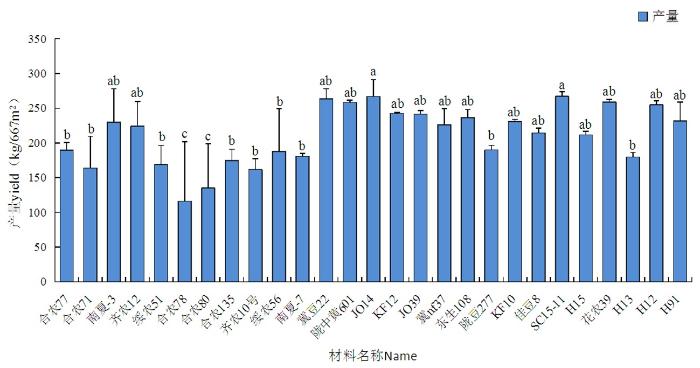
研究表明,中黄30(CK)产量为180.558 kg/667m2 ,参试品种中有9个比中黄30(CK)增产30%以上,产量由高到低分别为SC15-11、JO14、冀豆22、花农39、陇中黄601、H12、KF12、JO39和东生108,其中SC15-11产量居第1位,为266.995 kg/667m2,比对照增产47.872%;JO14产量居第2位,为266.891 kg/667m2,比对照增产47.815%;东生108产量居第9位,为236.499 kg/667m2,比对照增产30.982%。图1
图1
2.4 各农艺性状相关性
研究表明,不同大豆品种产量与单株粒数呈极显著正相关(P<0.01),相关系数为0.746与单株有效荚数呈极显著正相关(P<0.01),相关系数为0.745;与有效分枝显著正相关(P<0.05),相关系数为0.429;与株高呈极显著正相关(P<0.01),相关系数为0.495。单株粒数与单株有效荚数呈极显著正相关(P<0.01),提高单株有效荚数可提高单株粒数增加产量。表4
表4 大豆农艺性状与产量的相关性
Tab.4
| 性状 Trait | 百粒重 100-seed weight (g) | 株高 Plant height (cm) | 底荚高度 Pod height at bottom (cm) | 有效分枝 Effective branch number (个) | 单株有 效荚数 Number of effective pods per plant | 单株无 效荚数 Number of invalid pods per plantper plant | 单株粒数 Seed number per plant | 折合单产 Yield (kg/667m2) |
|---|---|---|---|---|---|---|---|---|
| 百粒重 100-seed weight(g) | 1.000 | |||||||
| 株高 Plant height (cm) | 0.115 | 1.000 | ||||||
| 底荚高度 Pod height at bottom(cm) | 0.224 | 0.071 | 1.000 | |||||
| 有效分枝 Effective branch number(个) | -0.288 | 0.358 | 0.133 | 1.000 | ||||
| 单株有效荚数 Number of effective pods per plant | 0.138 | 0.385* | -0.009 | 0.465* | 1.000 | |||
| 单株无效荚数 Number of invalid pods per plantper plant | -.409* | 0.566** | -0.065 | 0.532** | 0.200 | 1.000 | ||
| 单株粒数 Seed number per plant | -0.362 | 0.414* | 0.036 | 0.645** | 0.593** | 0.373 | 1.000 | |
| 折合单产 Yield (kg/667m2) | 0.276 | 0.495** | 0.146 | 0.429* | 0.745** | 0.106 | 0.746** | 1.000 |
注:*和**分别表示在 0.05和 0.01水平上显著相关
Note:* and ** indicate a significant correlation at the 0. 05 and 0. 01 levels, respectively
2.5 各农艺性状主成分
研究表明,3个特征值大于1 的主成分因子,分别命名为 MF1 、MF2和MF3,其累计总方差贡献率达到76.485%,MF1方差贡献率最大,为42.635%,MF2方差贡献率为21.226%,MF3方差贡献率为12.623%。表5
表5 主成分因子的方差贡献率
Tab.5
| 主成分 Principal component | 初始特征值 Initial eigenvalue | 提取平方和载入 Extract the sum of squares and load | ||||||||
|---|---|---|---|---|---|---|---|---|---|---|
| 特征值 Eigenvalue | 方差百分比 Percentage of variance(%) | 累积总方差贡献率 Cumulative total variance contribution rate(%) | 特征值 Eigenvalue | 方差百分比 Percentage of variance(%) | 累积总方差贡献率 Cumulative total variance contribution rate(%) | |||||
| 1(MF1) | 3.411 | 42.635 | 42.635 | 3.411 | 42.635 | 42.635 | ||||
| 2(MF2) | 1.698 | 21.226 | 63.862 | 1.698 | 21.226 | 63.862 | ||||
| 3(MF3) | 1.010 | 12.623 | 76.485 | 1.010 | 12.623 | 76.485 | ||||
| 4 | 0.925 | 11.558 | 88.043 | |||||||
| 5 | 0.442 | 5.528 | 93.571 | |||||||
| 6 | 0.296 | 3.706 | 97.276 | |||||||
| 7 | 0.181 | 2.257 | 99.534 | |||||||
| 8 | 0.037 | 0.466 | 100 | |||||||
单株粒数、折合单产、有效分枝和单株有效荚数在MF1上有较高的载荷,MF1主要是反映出单株粒数、折合单产、有效分枝和单株有效荚数这4个性状的信息,MF1可以作为产量因子。百粒重在MF2上有较高的载荷MF2可以作为粒重因子。底荚高度在MF3上有较高的载荷,MF3可以作为高度因子。表6
表6 初始因子载荷矩阵
Tab.6
| 性状因子 Trait factor | 主成分 Principal component | ||
|---|---|---|---|
| MF1 | MF2 | MF3 | |
| 百粒重 100-seed weight(g) | -0.147 | 0.888 | 0.093 |
| 株高 Plant height(cm) | 0.682 | 0.080 | 0.307 |
| 底荚高度 Pod height at bottom(cm) | 0.092 | 0.393 | 0.770 |
| 有效分枝 Effective branch number(个) | 0.775 | -0.246 | 0.143 |
| 单株有效荚数 Number of effective pods per plant | 0.759 | 0.334 | -0.328 |
| 单株无效荚数 Number of invalid pods per plantper plant | 0.587 | -0.563 | 0.334 |
| 单株粒数 Seed number per plant | 0.872 | -0.104 | -0.194 |
| 折合单产Yield (kg/667m2) | 0.797 | 0.499 | -0.195 |
2.6 各农艺性状聚类
研究表明,在欧式距离为5.00时可将所有材料分为 3个类群。图2
图2
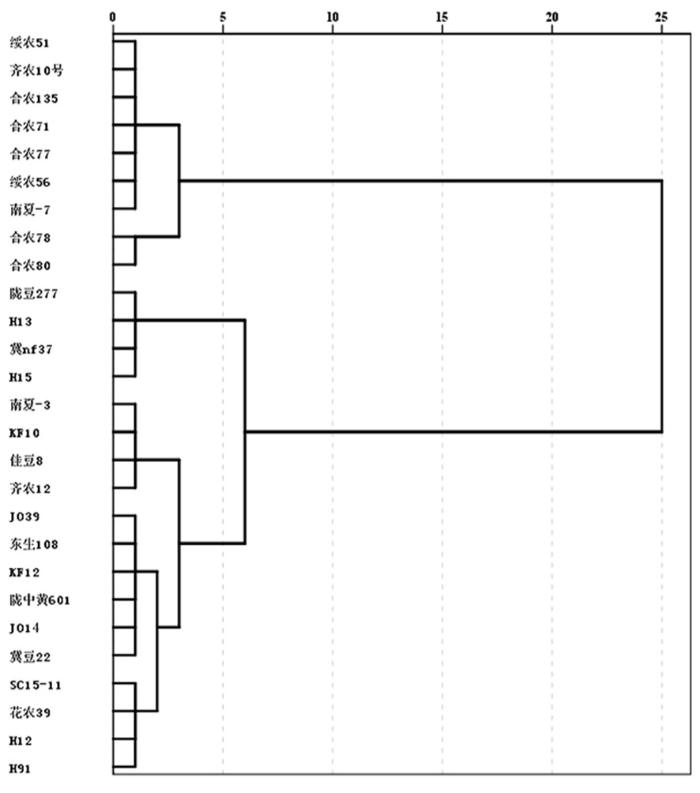
第一类群百粒重平均值为19.244 g,株高平均值为48.931 cm,底荚高度平均值为8.153 cm,有效分枝平均值为0.509个,单株有效荚数平均值为27.283个,单株无效荚数平均值为1.210个,单株粒数平均值为74.544粒,折合单产平均值为164.230 kg/667m2。该类群单株有效荚数较少,单株粒重较小,影响最终产量,属于低产品种。第二类群百粒重平均值为20.580 g,株高平均值为73.744 cm,底荚高度平均值为8.736 cm,有效分枝平均值为1.693个,单株有效荚数平均值为41.907个,单株无效荚数平均值为1.976个,单株粒数平均值为100.644粒,折合单产平均值为244.340 kg/667m2。该类群百粒重较高,结荚量较多,单株粒重较大,产量较高,属于高产品种。第三类群百粒重平均值为19.521 g,株高平均值为96.458 cm,底荚高度平均值为8.041 cm,有效分枝平均值为1.709个,单株有效荚数平均值为36.833个,单株无效荚数平均值为3.792个,单株粒数平均值为86.361粒,折合单产平均值为201.785 kg/667m2。该类群各项指标相对值比较居中,属于中产品种。表7
表7 参试品种资源各类群的性状特征
Tab.7
| 性状 Trait | 第一 类群(9) The first group (9) | 第二 类群(14) The second group (14) | 第三 类群(4) The third group (4) |
|---|---|---|---|
| 百粒重 100-seed weight(g) | 19.244 | 20.580 | 19.521 |
| 株高 Plant height(cm) | 48.931 | 73.744 | 96.458 |
| 底荚高度 Pod height at bottom (cm) | 8.153 | 8.736 | 8.041 |
| 有效分枝 Effective branch number(个) | 0.509 | 1.693 | 1.709 |
| 单株有效荚数 Number of effective pods per plant | 27.283 | 41.907 | 36.833 |
| 单株无效荚数 Number of invalid pods per plantper plant | 1.210 | 1.976 | 3.792 |
| 单株粒数 Seed number per plant | 74.544 | 100.644 | 86.361 |
| 折合单产 Yield (kg/667m2) | 164.230 | 244.340 | 201.785 |
3 讨论
3.1 夏播大豆表型变异及产量
参试大豆品种中SC15-11、JO14、冀豆22、花农39、陇中黄601、H12、KF12、JO39和东生108均比对照品种增产20%以上,增产幅度在24.078%~47.872%,产量性状表现较突出,品种单株粒数、单株有效荚数和百粒重均高于其他品种,可以当地夏播正常生长并且达到较好的产量,可以通过增加单株粒数和百粒重的方法来更好的提高大豆产量,与谢红英等[20]的结果较为一致。有效分枝和单株无效荚数数的变异系数分别为95.721%和88.553%,参试品种的这2 个性状有很大的改进潜力,具有丰富的遗传变异,也可以作为育种选择的性状,与韩秉进等[21]的结果相似。研究与李灿东[22]的结果均表明对大豆品种进行产量性状相关分析,单株有效荚数与单株粒数之间具有较强的正相关性,可以通过增加单株有效荚数来达到增加单株粒数的目的。单株有效荚数与株高和有效分枝呈显著正相关,与姜磊等[23]的结果较为一致。单株粒数和单株有效荚数与折合单产极显著正相关,与陈红等[24]的结果相似。通过对材料的性状进行相关分析,发现单株粒数、单株有效荚数等性状与产量相关性较大,在育种是可以参考这些性状来选择亲本。
3.2 夏播大豆品种比较
通过主成分分析将8个产量相关性状转化为3个独立综合指标,能够代表8个产量性状信息量的76.485%,大豆品种产量受这几个关键产量性状控制,第一主成分关键产量性状为单株粒数、折合单产、有效分枝和单株有效荚数,这4个性状对大豆产量至关重要,产量累计贡献率为42.635%,与李强等[25]的结果相似。第二主成分关键产量性状为百粒重,对产量具有促进作用,产量累计贡献率21.226%,与罗珊等[26]的结果一致。第三主成分关键产量性状为底荚高度,有利于提高单株产量,对产量具有促进作用,产量累计贡献率为12.623%,与谭千军等[27]的结果较为相似。该主成分对产量性状的影响,可以作为亲本选育的条件,更好的提高大豆产量[28]。对大豆品种进行聚类分析,单株产量较高的主要集中在第二类群和第三类群,两个类群的特点主要表现为单株有效荚数、单株粒数、株高和有效分枝数这 4个指标的其中几个值较高,研究与符小发等[29]的聚类结果都反映了品种来源。聚类分析的结果可以更加准确的评价大豆品种的适应性以及选种的科学性等问题,与张玉革等[30]的结果相似。
4 结论
新疆南疆地区主要适宜种植高度适中、单株生产力强、单株荚数和单粒数多、百粒重相对较大的大豆品种。SC15-11、JO14和冀豆22等品种综合性状表现突出,可在新疆南疆地区试验种植,其产量分别为266.995、266.891和263.649 kg/667m2。
参考文献
21世纪的维生素——大豆功能性食品
[J].
Vitamins in the 21st Century—Soy Functional Food
[J].
Nutritional and Sensory Analysis of Soya Bean and Wheat Flour Composite Cake
[J].
大豆传统产区种植结构变化及影响因素的定量化评价——以黑龙江省嫩江县为例
[J].
东北地区,特别是黑龙江省是中国传统的大豆产区,其近年的种植结构变化导致国内大豆产量大幅度减少,而进口量持续增加,并已成为全球第一大豆进口国。为探究大豆传统产区种植结构变化现状及主要影响因素,论文以黑龙江省嫩江县为研究区,解译遥感影像分析其种植结构的演变过程,并以农户大豆种植意愿为因变量,对影响因素进行定量化评价。研究结果表明:1)2000年以来,研究区种植结构发生了较大调整,2000—2007年间,第四积温带大豆种植面积大幅度增加;2007—2014年第四、五积温带玉米种植面积大幅度增加,达到17.4×10<sup>4</sup> hm<sup>2</sup>,且有继续北扩趋势,而大豆北扩东移,2014年在粮食作物总播种面积中的比重较2000年减少27个百分点;2)目标价格政策对农户大豆种植意愿的影响度最大,达18.89%,其次大豆市场价格和轮作种植的影响度均达18.54%,大豆总投入的影响度为13.82%,其他因素影响度均在10%以下。国产大豆的竞争优势在于“非转基因”和“食用蛋白豆”,国家除了在政策上扶持大豆生产外,更重要的是要鼓励相关企业生产多样化的“非转基因”大豆制品,并严控转基因大豆进入食品领域,使加工企业和豆农获得合理溢价,通过市场机制提高大豆传统产区豆农的生产积极性。
Quantitative evaluation of changes in planting structure and influencing factors in traditional soybean production areas:Taking Nenjiang County, Heilongjiang Province as an example
[J].<p>Northeast China, especially Heilongjiang Province, is a traditional soybean producing areas, where planting structure changes have resulted in decline in domestic soybean production. However, imports of soybean continued to rise in China, and China has become the world’s first soybean importer. To explore the planting structure changes and the main influencing factors in traditional soybean producing areas, this paper selected Nenjiang County as the study area. Firstly, interpreting TM/OLI images gave the changes of planting structure in this area; secondly, quantitative evaluation on the influence factors was made by taking soybean farmers’ willingness as dependent variable. The results show that: 1) The planting structure in the study area has greatly changed since 2000. Soybean acreage increased dramatically in the fourth accumulated temperature zone during 2000-2007. Maize planting area increased in the fourth and fifth accumulated temperature zones during 2000-2014, and has a tendency to continuously expand northward. Although soybean planting area expanded northward and eastward, its areal proportion in the total grain sown area decreased by 27% in 2014 compared to 2000. 2) The target price policy has the maximum influence on the willingness of farmers’ planting soybeans, accounting for 18.86%, followed by soybean price and crop rotation, which take 18.52%, and the impact of total investment of soybean accounts for 13.81%. The influences of other factors all count for less than 10%. The competitive advantages of domestic soybeans are “non-GMO” and “edible protein”. In addition to the policies for supporting soybean production, the country should take more important strategies to encourage the relevant enterprises to diversify the non-GMO soybean products, and strictly control the transgenic soybean in the field of food. These strategies enable reasonable premium for processing enterprises and soybean farmers and improve farmers’ production enthusiasm in traditional soybean producing area through market mechanism.</p>
Sistemas de custeio para firmas agroalimentares:o caso dos laticínios e empresas processadoras de soja no Brasil Cost management systems for agrifood firms:the case of the dairy industry and soya bean industry
[J].
中国食用豆产业和种业发展现状与未来展望
[J].食用豆在中国粮食组成、人类健康、土壤改良中占有重要地位,尤其是在贫困地区作为蛋白质的主要来源。随着食用豆基因组相继被破译,推动了食用豆分子遗传基础和分子育种研究。国家食用豆产业技术体系成立以来,育成了一批高产、优质、抗病虫、耐逆、适宜机械化收获的食用豆新品种,集成了一批适合不同产区的栽培技术,病虫害绿色防控技术的研发与应用取得了良好的防治效果,生产机械与技术研究初显成效,产后加工技术提升与产品创新研究促进产业提质增效。随着食用豆新品种新技术的示范与推广,食用豆总产和单产水平显著提高,特别是在过去十年内蚕豆、豌豆由干籽粒生产转变为鲜食菜用生产,食用豆种植面积提高了21.1%,单产提高了3.9%,总产提高了36.8%。随着食用豆产业规模不断扩大,越来越多的食用豆种被列为国家农产品地理标志产品,正在形成一批农业企业品牌。在食用豆产业的带动下,品种权保护与转让数量逐渐增多,食用豆种业开始起步发展。随着人们健康意识的提高,国内外市场需求快速上升,国家乡村振兴战略的实施和农业供给侧结构性改革的推进,大力培育壮大贫困地区特色优势产业,给食用豆生产和种业带来了新的机遇;但是中国食用豆生产和种业也面临生产成本较高、生产效率低、科研平台建设有待加强、缺乏突破性大品种、品种权保护力度不够等诸多挑战。本文在总结中国食用豆产业和种业的现状与问题的基础上,讨论了其未来的发展方向。
Development status and future prospects of China's edible bean industry and seed industry
[J].
Tripartite legume-rhizobia-mycorrhizae relationship is influenced by light and soil nitrogen in Neotropical canopy gaps
[J].
播期及密度对不同大豆品种农艺性状及产量的影响
[J].
The effect of sowing date and density on agronomic characteristics and yield of different soybean varieties
[J].
中美贸易争端背景下中国大豆产业发展研究
[J].
Research on the development of China's soybean industry in the context of Sino-US trade disputes
[J].
全球大豆贸易格局变化对我国大豆产业的影响及对策选择
[J].
The impact of changes in the global soybean trade pattern on my country's soybean industry and countermeasures
[J].
我国大豆产业发展现状及振兴策略
[J].
Development status and revitalization strategy of my country's soybean industry
[J].
中国大豆种质资源遗传多样性研究进展
[J].
Research progress on genetic diversity of soybean germplasm resources in China
[J].
新疆绿洲灌区农业生态环境问题及对策
[J].
Problems and Countermeasures of Agricultural Ecological Environment in Xinjiang Oasis Irrigation District
[J].
新疆地区发展大豆生产的可行性和初步建议
[J].大豆(Glycine max)是重要的粮油作物。近年来, 我国大豆需求量和进口量不断增加。扩大种植面积和提高单产是增加大豆总产量的主要途径, 西北地区尤其是新疆在扩大大豆种植面积和提高单产方面具有一定的潜力。该文从新疆大豆生产的自然气候条件、大豆在新疆的种植情况及新疆发展大豆生产的优势和局限性等方面分析了新疆地区发展大豆生产的可行性; 并围绕大豆生产政策扶持、机械化水平提升、加快科技创新培育优良品种和加强大豆生产示范等措施, 提出新疆发展大豆生产的初步建议。
Feasibility and preliminary suggestions for developing soybean production in Xinjiang
[J].Soybean is one of the most important crops for food and oil. With the increasing demand in recent years, China has imported more and more soybean from abroad. Enlarging the planting area and improving the yield per hectare are effective ways to increase the soybean production. Northwest of China, especially Xinjiang has the potential of enlarging the planting area and improving the yield per hectare for soybean production in China. This paper analyzes the feasibility of developing soybean production in Xinjiang from the aspects of the natural climatic conditions of soybean production, the planting situation of soybean, and the advantages and limitations of developing soybean production in Xinjiang. Then, it provides suggestions for future development of soybean production in Xinjiang on policy support, improvement of mechanization level, accelerating scientific and technological innovation to cultivate elite varieties, and strengthening soybean production demonstration.
日本大豆引种四川盆地的品质评价研究
[J].将原产于日本的17个大豆种质资源引种至我国四川盆地栽培,并对其引种前后的籽粒品质性状进行分析评价,探究引种大豆在四川盆地的适应性,以期为丰富西南大豆种质资源提供参考。品质性状变异分析结果表明,大豆异黄酮的变异系数大,除苷元外均达到30%以上,而其余性状的变异系数也均大于10%。与引种前相比,各供试大豆的可溶性蛋白含量普遍升高,而脂肪酸、可溶性多糖和异黄酮含量普遍降低。基于引种大豆11个品质性状的主成分聚类分析,将供试的17份种质资源划分为五大类,其中,Ⅰ类大豆为高脂肪酸品种,其生育期适中,亚油酸含量大于55‰,可作为高油脂杂交育种亲本材料加以利用;Ⅲ类大豆为高蛋白型品种,可作为豆制品开发原材料加以利用;Ⅴ类大豆为高异黄酮型品种,可作为功能性成分原料来源加以利用。
Quality evaluation of Japanese soybean introduced in Sichuan Basin
[J].In this study 17 soybean genotypes were introduced from Japan to the Sichuan Basin with an aim to assess their adaptability. Comparison of quality traits showed that variation in isoflavone content was highest; the coefficient of variation values were generally greater than 30% (apart from aglycone), while the coefficient variation for other seed compounds was around 10%. The soluble protein contents of the tested soybean seeds were relatively high while fatty acids, soluble polysaccharides and isoflavone were low. Principal component analysis and cluster analysis divided the 17 germplasms into five groups. Individually, Group-Ⅰ comprised high-oil varieties, their linoleic acid content were>55‰, suggesting that they could be used to produce high-oil hybrid varieties. Group-Ⅲ comprised high-protein varieties, potentially useful for developing varieties to produce soy raw materials; Group-Ⅴ comprised high-isoflavone varieties, which could potentially be used to produce varieties useful for functional food or fodder.
大豆引种试验初报
[J].
Preliminary report on soybean introduction experiment
[J].
国家区试长江流域春大豆品种农艺、产量及品质性状的演变
[J].
The evolution of agronomic, yield and quality traits of spring soybean varieties in the Yangtze River Basin in the national regional trial
[J].
北方春大豆不同品种农艺性状及产量的比较研究
[J].【目的】筛选出适宜内蒙古中西部种植的优良大豆新品种,为今后该地区大豆育种提供理论依据。【方法】 对北方春大豆中熟组区域试验的10个大豆新品种(系)的农艺性状和产量指标进行比较与相关性分析。【结果】 各品种生育日数为118~126 d,均属北方春大豆中熟组品种;产量变化规律为中吉602>赤豆201>东农豆251>吉育491>吉农28>吉育306>吉育481>吉育86>龙黄1503>吉育494,其中,中吉602产量最高,为3 440 kg/hm<sup>2</sup>,比对照增产10.9%,增产极显著(P<0.01),其单株荚数也极显著高于其他品种(P<0.01);产量与单株粒重呈极显著正相关(P<0.01),与单株荚数、单株粒数、百粒重呈显著正相关(P<0.05),单株粒数与单株荚数、单株粒重、百粒重、产量均呈显著正相关(P<0.05)。【结论】 内蒙古中西部区适宜种植株高适中、单株生产力强、单株荚数和粒数多且百粒重相对较大的大豆品种,中吉602、吉育491和赤豆201综合性状突出,可进一步在该地区试验种植。
Comparative study on agronomic characters and yields of different varieties of northern spring soybeans
[J].
不同类型大豆品种广西南宁引种试验
[J].
Introduction trials of different types of soybean varieties in Nanning, Guangxi
[J].
大豆农艺及产量性状的主成分分析
[J].
Principal Component Analysis of Soybean Agronomic and Yield Characters
[J].
黑龙江省北部大豆主栽品种产量性状主成分分析
[J].
Principal component analysis of yield traits of main soybean varieties in northern Heilongjiang Province
[J].
宿州地区大豆新品种(系)比较试验
[J].
Comparative experiment of new soybean varieties (lines) in Suzhou area
[J].
大豆引种筛选鉴定研究
[J].
Research on the selection and identification of soybean introduction
[J].
大豆种质表型性状鉴定与分析
[J].
Identification and analysis of phenotypic traits of soybean germplasm
[J].
黑河地区55份大豆品种资源农艺性状和营养成分的聚类分析
[J].
Cluster analysis of agronomic traits and nutritional components of 55 soybean varieties in Heihe area
[J].
西南夏大豆种质资源的筛选与鉴定
[J].
Screening and identification of southwest summer soybean germplasm resources
[J].
Caracterización y selección agroproductiva de líneas de garbanzo (Cicer arietinum L.) introducidas en Cuba
[J].
南繁大豆农艺性状与产量的主成分和聚类分析
[J].
Principal component and cluster analysis of agronomic traits and yield of southern propagation soybean
[J].


