

0 引言
【研究意义】放线菌是农业生态系统中防治病虫害的重要微生物资源[1-2]。塔里木盆地在干旱极端环境下孕育着具有耐旱抗盐的荒漠植物。柽柳是新疆植被中的主要物种之一,主要分布在塔里木盆地,挖掘柽柳土壤微生物资源,对于新疆主要农牧业病害的防控及保护和利用新疆极端环境放线菌资源具有重要意义。【前人研究进展】张金辉等[3]从阿勒泰福海县周边柽柳根际土样中分离得到的噬盐糖多孢菌A-064对番茄早疫病菌等具有较强抑制作用。【本研究切入点】以柽柳根际土壤为材料,分离柽柳根际放线菌[4-5],以细菌金黄色葡萄球菌(Staphylococcus aureus)、铜绿假单胞菌(Pseudomonas aeruginosa)、大肠杆菌(Escherichia coli)、肺炎克雷伯菌(Klebsiella pneumonia)、解淀粉欧文氏菌(Erwinia amylohydrolytic)、伤寒沙门氏菌(Salmonella typhi),以及植物病原真菌白色念珠菌(Candida albicans)、链格孢(Alternaria tenuissima)、棉花黄萎病菌(Verticillium dahliae)、棉花枯萎病菌(Fusarium oxysporum)为靶标菌进行拮抗活性放线菌生物筛选。【拟解决的关键问题】选择新疆南疆地区10种柽柳根际土壤的放线菌资源,采用四种培养基,研究新疆塔里木盆地放线菌资源代谢产物的多样性,为农牧业病害防治提供更多药物先导化合物的生产菌株。
1 材料与方法
1.1 材料
1.1.1 土壤样品
采集新疆南疆地区10种不同地点的柽柳根际土壤样品于无菌样品盒子中,置于4℃保存,备用。表1
表1 土壤样品信息
Tab.1
| 土样编号 Soil sample number | 样品类型 Soil sample type | 取样位置 Sampling location | 纬度 Latitude (°) | 经度 Longitude (°) | 海拔 Altitude (m) |
|---|---|---|---|---|---|
| HT44 | 红柳根际土 | 塔中-民丰 | 38.412 | 83.205 | 1 164.9 |
| HT51 | 红柳根际土 | 萨勒吾则克乡 | 37.254 | 83.018 | 1 386.6 |
| HT53 | 红柳根际土 | 民丰-且末 | 37.688 | 83.959 | 1 341.1 |
| HT57 | 红柳根际土 | 塔提让乡 | 38.485 | 85.824 | 1 112.1 |
| HT61 | 红柳根际土 | 瓦石峡乡 | 38.819 | 87.743 | 885.2 |
| HT65 | 红柳根际土 | 若羌-库尔勒 | 39.889 | 88.399 | 814.3 |
| HT67 | 红柳根际土 | 大西海子水库 | 40.562 | 87.810 | 829.6 |
| HT71 | 红柳根际土 | 沙雅 | 41.137 | 82.446 | 957.8 |
| HT75 | 红柳根际土 | 二牧场-14团 | 40.660 | 81.943 | 975.1 |
| HT49 | 红柳根际土 | 民丰-于田 | 36.888 | 82.553 | 1 664.8 |
1.1.2 供试靶标菌
以革兰阳性细菌代表种S.aureus, E.coli, P.aeruginosa, K.pneumonia, E.amylohydrolytic, S.typhi, C.albicans, A.tenuissima, V.dahliae, F.oxysporum为靶标菌保存于新疆生产建设兵团塔里木盆地生物资源保护利用重点实验室。
1.1.3 培养基
(1)高氏一号培养基[6];(2)5号培养基:蛋白胨5 g,酵母提取物1 g,柠檬酸铁0.1 g,NaCl 19.45 g,MgCl2 5.9 g,Na2SO4 3.24 g,CaCl2 1.8 g,KCl 0.55 g,NaHCO3 0.16 g,KBr 0.08 g,SrCl2 34 mg,H3BO3 22mg,硅酸钠 4 mg,NaF 2.4 mg,NH4NO3 1.6 mg,Na2HPO4 8 mg,琼脂16 g,蒸馏水1 L,pH 7.0~7.5;(3)8号培养基:可溶性淀粉10 g,燕麦片10 g,(NH4)2SO4 2 g,K2HPO4 1 g,MgSO4 1 g,NaCl 1 g,CaCO3 2 g,微量元素溶液 1 mL,琼脂 16 g,蒸馏水 1 L,pH 7.2;(4)甘油精氨酸培养基[7];(5)TSB液体培养基[8];(6)MHA(MHB)培养基用于细菌的培养和拮抗活性筛选[9];采用SDA(SDB)培养基用于白色念珠菌的培养和拮抗活性筛选[9];(7)OA(OB)培养基用于链格孢的培养和拮抗活性筛选[10];(8)PDA(PDB)培养基用于棉花枯黄萎病菌的培养和拮抗活性筛选[11]。
1.1.4 主要仪器
PCR 仪:SENSO,德国;凝胶成像仪器ChemDoc XRS+:伯乐公司,美国;超净工作台SW-CJ-2F:博迅,上海;电泳仪DYCZ-26C:六一仪器厂,中国;电热恒温水浴锅DHP-9272:一恒,上海;离心机Centrifuge 5415 D:Eppendorf,德国。
1.2 方法
1.2.1 根际土壤放线菌的分离
1.2.2 柽柳根际土壤菌株的鉴定
采用CTAB法提取放线菌的基因组DNA,以基因组DNA为模板,以27F和1 492R为引物,引物序列27F(5'-AGAGTTTGATCCTGGCTCAG-3')和1 492R(5'-GGTTACCTTGTTACGACTT-3'),PCR扩增,送样测序。将测序后的16S rDNA序列提交到EzBiocloud(http://www.ezbiocloud.net),对16S rDNA 进行相似性比对搜索,判断菌株种类。选取相似序列,到NCBI的blast(Basic Local Alignment Search Tool,序列对比工具) 工具比对,分析菌株的相似性,使用MEGA 7.0[18],选择GenBank中与之同源性较高的模式菌株的16S rDNA基因序列,以塔里木大学菌株排序为编号构建菌株 Neighbor- Joining系统发育树进行系统发育分析。
1.2.3 拮抗活性筛选
分离的放线菌划线培养制成菌饼备用。(1)细菌活性筛选:将靶标菌接种至MHB液体培养基中,37℃,180 r/min摇床培养8 h,吸取菌液加入到 MHA培养基中,混匀倒板。将分离的放线菌菌饼分别接入,置于37℃培养箱中培养18 h。(2)真菌活性筛选:靶标菌为白色念珠菌,棉花黄萎,链格孢时分别用SDA,PDA,OA培养基培养,分别接种至液体培养基中,28℃,180 r/min摇床培养72 h,将靶标菌菌悬液涂布培养,接入菌饼,置于28℃培养箱中培养72 h。观察其抑菌活性及计算抑菌圈直径。
2 结果与分析
2.1 柽柳根际土壤菌株的分离
研究表明,共分离获得放线菌294株,不同地点的柽柳根际土壤样品分离的放线菌数量有明显不同,HT51柽柳根际土壤样品分离的菌株最多,共有118株;HT49柽柳根际土壤样品次之,共有89株;HT53柽柳根际土壤样品和HT65柽柳根际土壤样品最少,0株。
甘油精氨酸培养基分离出的菌株最多,共有119株;其次是高氏一号培养基,共有80株;5号培养基最少,共有33株。甘油精氨酸培养基和高氏一号培养基较适合分离其根际土壤放线菌。图1
图1
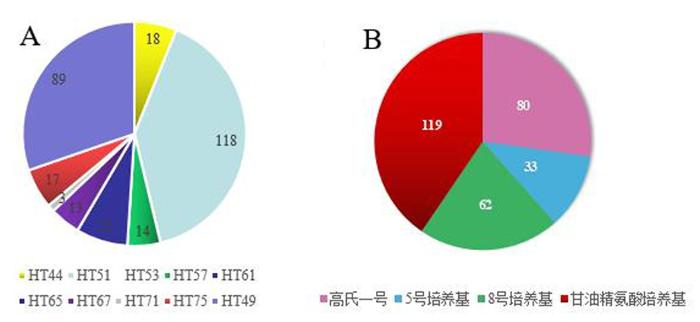
图1
柽柳根际土壤菌株的分离
注:A:不同土壤样品分离的菌株数量;B:不同培养基分离的菌株数量
Fig.1
Isolation of Tamarix ramosissima rhizosphere soil strains
Note:
2.2 柽柳根际土壤菌株的鉴定
研究表明,柽柳根际土壤菌株分属于7个纲12个目16科24个属,24个属分别是链霉菌属(Streptomyces)、小单胞菌属(Micromonospora)、芽孢杆菌属(Bacillus)、假单胞菌属(Pseudomonas)、农杆菌属(Agrobacterium)、微杆菌属 (Microbacterium)、无色杆菌属(Achromobacter)、根瘤菌属(Rhizobium)、产碱杆菌属 (Alcaligenes)、副根瘤菌 (Paramesorhizobium)、不动杆菌属(Acinetobacter)、沙门氏菌 (Salmonella enterica)、从毛单胞菌属(Comamonas)、布鲁氏菌属(Brucella)、葡萄球菌属(Staphylococcus)、新根瘤菌(Neorhizobium)、假诺卡氏菌属(Pseudonocardia)、纤维菌属(Cellulosimicrobium)、香味菌属(Myroides)、博代氏杆菌属(Bordetella)、叶状杆菌属(Phyllobacterium)、普罗维登斯菌属(Providencia)、居海绵粉色杆状菌(Roseivirga)、剑菌属(Ensifer)。除链霉菌以外的稀有放线菌包括小单孢菌,微杆菌和纤维菌属。图2
图2
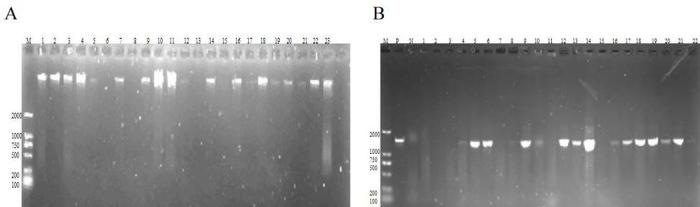
图2
柽柳根际土壤菌株的鉴定
注:A:16S rDNA电泳图 B:16S rDNA序列扩增电泳图(M:为maker,P为阳性,N为阴性)
Fig.2
Identification of strains in the rhizosphere soil of Tamarix ramosissima
Note:A: Agarose gel electrophoresis of total DNA from samples.M: DNA marker trans 2K; 1 to 23: genomic DNAs of samples 1 to 23,respectively.B: Agarose gel electrophoresis of PCR from samples.M: DNA marker trans 2K; 1 to 22:PCR of samples 1 to 22,respectively.(M: maker P: positive control N: negative control)
鉴定的150株菌株中,有9株相似度小于98.65%,为潜在新物种。将9个潜在新物种归属于3个属,分别是Paramesorhizobium,Streptomyces,Pseudonocardia等3个属的潜在新物种。其中TRM 76038与Paramesorhizobium deserti A-3-E相似性98.26%,为Paramesorhizobium;TRM 76037与Streptomyces coeruleorubidus ISP 5145相似性98.06%,为Streptomyces;TRM 76012与Paramesorhizobium deserti A-3-E相似性97.89%,为Paramesorhizobium;TRM 76006与Streptomyces albogriseolus NRRL B-1305相似性98.59%,为Streptomyces;TRM 76011与Streptomyces gossypiisoli TRM 44567相似性97.43%,为Streptomyces;TRM 76023与Streptomyces longispororuber NBRC 13488相似性98.64%,为Streptomyces;TRM 76246与Pseudonocardia zijingensis 6330相似性98.65%,为Pseudonocardia;TRM 76249与Streptomyces asenjonii KNN 35.1b相似性98.26%,为Streptomyces;TRM 76070与Streptomyces niveoruber NBRC 15428相似性98.51%,为Streptomyces。图3
图3
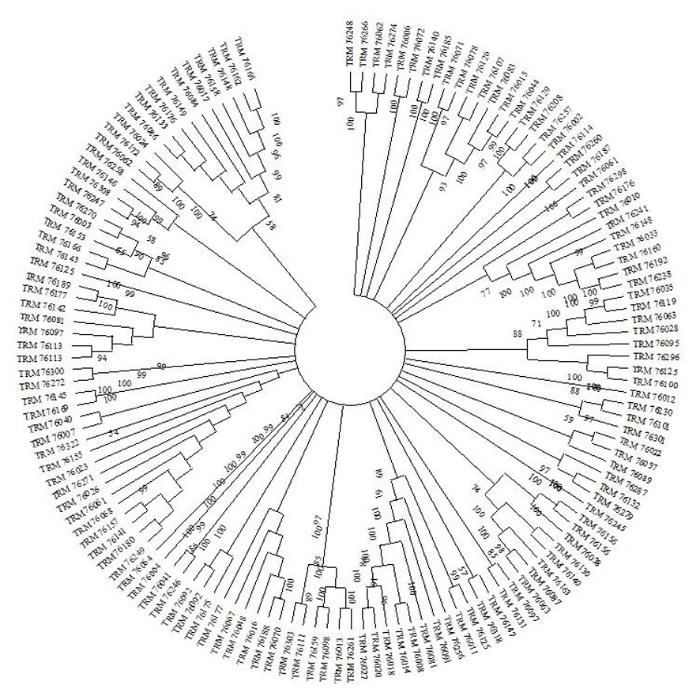
图3
基于16S rDNA序列构建柽柳根际放线菌的系统进化
Fig.3
Phylogenetic analysis of the rhizosphere actinomycetes constructed from 16S rDNA sequence of Tamarix ramosissima
2.3 柽柳根际土壤放线菌的拮抗活性筛选
研究表明,对E.coli有拮抗活性菌株有11株,TRM 76101对E.coli的抑菌作用最强,抑菌圈达到17 mm;对S.aureus有拮抗活性菌株有8株,TRM 76185和TRM 76130对S.aureus病原菌的抑制作用最强,抑菌圈直径达到18 mm;对P.aeruginosa有拮抗活性菌株有11株,TRM 76072对P.aeruginosa的抑制作用最强,抑菌圈直径达到20 mm;对K.pneumonia有拮抗活性菌株有11株,TRM 76101对K.pneumonia的抑制作用最强,抑菌圈达到16 mm;对E.amylohydrolytic有拮抗活性菌株有9株,TRM 76187对E.amylohydrolytic的抑菌作用最强,抑菌圈达到16 mm;对S.typhi有拮抗活性菌株有11株,TRM 76101对S.typhi的抑菌作用最强,抑菌圈达到16 mm;对C.albicans有拮抗活性菌株13株,TRM 76101对C.albicans的抑菌作用最强,抑菌圈达到22 mm;对A.tenuissima有拮抗活性菌株有47株,TRM 76177对A.tenuissima的抑菌作用最强,抑菌圈达到25 mm;对V.dahliae有拮抗活性菌株有16株,TRM 76156对V.dahliae的抑菌作用最强,抑菌圈达到30 mm;对F.oxysporu有拮抗活性菌株有12株,TRM 76159对F.oxysporu的抑菌作用最强,抑菌圈20 mm。筛选的150株柽柳根际土壤放线菌中,具有抗菌活性的放线菌有68株,约占鉴定总数的46%。表2
表2 对不同病原菌有较强活性的部分菌株
Tab.2
| 序号 | 菌株编号 | 相似菌株 | 相似性(%) | 抑菌圈直径类型(mm) | |||||||||
|---|---|---|---|---|---|---|---|---|---|---|---|---|---|
| S.a | P.a | E.c | K.p | E.a | S.t | C.a | A.t | V.d | F.o | ||||
| 1 | TRM 76131 | Cellulosimicrobium marinum RS-7-4 | 98.99 | — | — | + | — | + | + | ++ | — | +++ | + |
| 2 | TRM 76130 | Rhizobium tarimense PL-41 | 99.71 | ++ | — | + | — | — | + | +++ | +++ | ++ | |
| 3 | TRM 76129 | Salmonella enterica subsp.entericaL T2 | 99.23 | — | — | — | + | + | + | ++ | ++ | ++ | — |
| 4 | TRM 76146 | Rhizobium tarimense PL-41 | 99.05 | — | — | + | — | + | + | — | + | + | — |
| 5 | TRM 76147 | Microbacterium petrolearium LAM0410 | 98.56 | — | + | — | — | — | — | + | +++ | +++ | + |
| 6 | TRM 76156 | Rhizobium tarimense PL-41 | 98.84 | — | — | — | — | — | — | +++ | +++ | +++ | + |
| 7 | TRM 76174 | Neorhizobium alkalisol CCBAU 01393i | 98.84 | — | — | — | + | + | — | +++ | +++ | +++ | + |
| 8 | TRM 76175 | Rhizobium rosettiformans W3 | 99.06 | — | — | — | + | + | — | ++ | ++ | — | — |
| 9 | TRM 76101 | Pseudochrobactrum asaccharolyticum DSM 25619 | 99.18 | — | + | ++ | ++ | ++ | +++ | — | — | — | |
| 10 | TRM 76159 | Phyllobacterium myrsinacearum DSM 5892 | 99.41 | — | — | + | + | — | + | ++ | — | +++ | +++ |
| 11 | TRM 76062 | Bacillus rugosus SPB7 | 99.86 | — | — | — | + | + | + | — | — | — | — |
| 12 | TRM 76132 | Rhizobium tarimense PL-41 | 99.56 | — | + | — | — | — | — | + | +++ | ++ | ++ |
| 13 | TRM 76072 | Streptomyces tunisiensis CN-207 | 98.98 | ++ | +++ | — | — | — | — | — | — | — | — |
| 14 | TRM 76100 | Achromobacter marplatensis B2 | 99.71 | — | + | — | + | + | — | — | +++ | — | ++ |
| 15 | TRM 76153 | Bacillus cabrialesii TE3 | 99.79 | — | — | — | — | — | — | ++ | +++ | + | ++ |
注:“—”代表无活性。“+”表示抑菌圈直径为1~1.5 cm;“++”表示抑菌圈直径为1.5~2 cm;“+++”表示抑菌圈直径>2 cm
Note: "-" represents inactivity."+" means the diameter of the inhibition zone is 1-1.5cm; "++" means the diameter of the inhibition zone is 1.5-2 cm; "+++" denotes the inhibition zone diameter > 2 cm S.a:S.aureus, P.a:P.aeruginosa, E.c:E.coli, K.p:K.pneumonia, E.a:E.amylohydrolytic, S.t:S.typhi, C.a:C.albicans, A.t:A.tenuissima, V.d:V.dahliae, F.o:F.oxysporu
3 讨论
3.2 对于不同靶标菌的抑制,柽柳根际土壤的放线菌对A.tenuissima有抑制作用的数量最多,对V.dahliae病原菌有抑制作用的放线菌数量其次。菌株来源不同,对病原菌的抑制作用也会有不同,表现出土壤样品种类和地域方面的差异,与王婧等[21]所得结果相符合。TRM 76063和TRM 76033虽然16S rDNA基因序列相似性都是99.56%,但是其抑菌活性差异又很大,在拮抗活性筛选时,不同土壤样品的同一物种的菌株,活性也会不同,即为同一物种的菌株活性有差异。
4 结论
从采集的的柽柳根际土壤样品中分离并鉴定出150株土壤放线菌,其属于7个纲12个目16科24个属,另有9个潜在新种,以金黄色葡萄球菌,铜绿假单胞菌,大肠杆菌,肺炎克雷伯菌,解淀粉欧文氏菌,伤寒沙门氏菌,白色念珠菌,链格孢菌,棉花黄萎病菌,棉花枯萎病菌为靶标菌,筛选出68株活性放线菌。
参考文献
The 10 × '20 Initiative: Pursuing a Global Commitment to Develop 10 New Antibacterial Drugs by 2020
[J].
放线菌-微生物药物的重要资源
[J].
Actinomycetes, an important resource of microbiological drugs
[J].
新疆13种荒漠植物根内生放线菌多样性及其抗菌活性筛选
[J].
Biodiversity and antimicrobial activity of endophytic actinomycetes from roots of 13 desert plants in Xinjiang
[J].
西藏青稞根际土壤可培养放线菌的遗传多样性及其促生功能分析
[J].
Genetic diversity and growth promoting function of culturableactinomyces in rhizosphere Soil of highl and barley in Tibet
[J].
新疆盐碱土壤耐盐碱放线菌筛选初步鉴定
[J].
Preliminary identification of saline-alkali tolerant actinomycetes in saline-alkali soils in Xinjiang
[J].
阿克苏高盐咸水滩放线菌分离新策略及系统发育多样性
[J].
New strategy and phylogenetic diversity of actinomycetes isolated from Aksu salt water shoal
[J].
影响金黄色葡萄球菌杀白细胞素ED转录表达的培养条件
[J].
Staphylococcus aureus leucocidin ED transcriptional expression of culture conditions
[J].
猕猴桃软腐病主要病原菌的分离,鉴定及其生长特性研究
[J].
为探究猕猴桃果实采后软腐病害的主要病原菌及其生长特性,2017年9月于湖南凤凰县猕猴桃基地采集具有软腐病症状的100个果实病样,取患病猕猴桃病健交界处果肉,进行病原菌的分离纯化、菌株形态学观察、病原菌的分子生物学鉴定试验,同时分析不同培养基、碳源、氮源、温度和pH值对病原菌生长的影响。结果表明,菌种鉴定为葡萄座腔菌(Botryosphaeria dothidea)和间座壳菌(拟茎点霉菌有性态,Diaporthe phaseolorum)。两种菌在PSA、YPGA、PDA、SDA培养基的生长速度均较快,葡萄座腔菌和间座壳菌生长速率分别在16.1~18.6 mm·d<sup>-1</sup>和13.9~16.5 mm·d<sup>-1</sup>之间,且菌丝密度均较稠密。淀粉、蔗糖和麦芽糖作为碳源时,病原菌生长效果较好,葡萄座腔菌和间座壳菌生长速率分别在15.9~17.7 mm·d<sup>-1</sup>和12.4~16.4 mm·d<sup>-1</sup>之间。酵母粉、蛋白胨、甘氨酸作为氮源时,较适宜葡萄座腔菌和间座壳菌生长,两病原菌生长速率分别在11.0 mm·d<sup>-1</sup>左右和9.5 mm·d<sup>-1</sup>左右,但较未添加氮源培养基仅提高了7%左右。此外,葡萄座腔菌和间座壳菌的最适pH值为5~7,最适温度为25~30℃,菌种致死温度为85℃左右。本研究结果对猕猴桃软腐病病原菌的鉴定及对猕猴桃贮藏过程中软腐病害的绿色防控提供了参考。
Isolation, identification and growth characteristics of the main pathogen of kiwifruit soft rot
[J].To explore the main pathogens and its’ growth characteristics of postharvest soft rot of kiwifruit, In September 2017, 100 fruit samples with soft rot symptoms were collected at the kiwifruit base in Fenghuang County, Hunan Province. The flesh between the diseased and the good were taken out to isolate and purify the pathogens. Then the morphologies of strains were observed, and molecular biological of pathogens were identified. At the same time, the effects of media, carbon source, nitrogen source, temperature, and pH value on the growth of pathogenic bacteria were analyzed. The results showed that, the strains were identified as <em>Botryosphaeria dothidea</em> and <em>Diaporthe phaseolorum.</em> The growth rates of the two strains were faster in PSA, YPGA, PDA and SDA media. The growth rates of <em>Botryosphaeria dothidea</em> and <em>Diaporthe phaseolorum</em> were 16.1 to 18.6 mm·d<sup>-1</sup> and 13.9 to 16.5 mm·d<sup>-1</sup>, and the mycelial density was also very dense. The growth of pathogenic bacteria was better when starch, sucrose and maltose were used as carbon sources, the growth rates of <em>Botryosphaeria dothidea</em> and <em>Diaporthe phaseolorum</em> were 15.9 to 17.7 mm·d<sup>-1</sup> and 12.4 to 16.4 mm·d<sup>-1</sup>. Yeast powder, peptone and glycine used as nitrogen sources were more suitable for the growth of <em>Botryosphaeria dothidea</em> and <em>Diaporthe phaseolorum.</em> The growth rates of <em>Botryosphaeria dothidea</em> and <em>Diaporthe phaseolorum</em> were about 11.0 mm·d<sup>-1</sup> and 9.5 mm·d<sup>-1</sup>, However, the growth rate is only 7% higher than that with CA medium. Besides, the optimum pH value for <em>Botryosphaeria dothidea</em> and <em>Diaporthe phaseolorum</em> are 5 to 7, the optimum temperature are between 25℃ and 30℃, and the lethal temperature is about 85℃. The results of this study provide a reference for the identification of kiwifruit soft rot pathogens and the green control of soft rot diseases during kiwifruit storage.
引起西洋参锈腐病的Ilyonectria属4种病原菌的生物学特性及其对不同杀菌剂的敏感性
[J].
Biological characteristics of four pathogens of the genus Ilyonectria causing rust rot of American ginseng and their susceptibility to different fungicides
[J].
冻土链霉菌分离菌株多样性及其生理活性的研究
[J].以青藏高原腹地北部地区5个钻孔中采集的冻土样品为材料, 采用高氏1号琼脂和甘油精氨酸琼脂两种培养基, 分离得到54株可培养放线菌.经形态学初步鉴定并结合16S rDNA序列分析, 将分离菌株归入链霉菌属. 抑菌实验和生理生化特性研究发现, 24%的链霉菌对供试病原菌有抑菌活性, H<sub>2</sub>S、 有机酸、 H<sub>2</sub>O<sub>2</sub>酶、 脂酶Ⅰ(Tween-20)、 脂酶Ⅱ(Tween-40)、 脂酶Ⅲ(Tween-80)、 淀粉酶、 蛋白酶、 脲酶产生菌分别占分离菌株的56%、 28%、 93%、 22%、 67%、 41%、 43%、 61%、 57%. 结果显示, 青藏高原冻土蕴藏有丰富的放线菌资源, 其次级代谢产物的丰富性和多样性, 对开发研究放线菌资源具有重要价值.
Diversity and physiological activity of Streptomyces permafrost isolates
[J].
Three New Diketopiperazines from the Previously Uncultivable Marine Bacterium Gallaecimonasmangrovi HK-28 Cultivated by iChip
[J].
土壤中放线菌的分离与应用
[J].
Isolation and Application of Actinomycetes in Soil
[J].
贵州黄果树土壤放线菌的分离与纯化研究初报
[J].
Preliminary report on the isolation and purification of soil actinomycetes from fruit trees in Guizhou
[J].
广西北部湾放线菌的分离筛选及活性产物的鉴定
[J].
Isolation and screening of actinomycetes from Beibu Gulf of Guangxi and identification of their active products
[J].
生物学软件在核酸序列比对与系统发育分析中的应用
[J].
Application of biological software in nucleic acid sequence alignment and phylogenetic analysis
[J].
Proposed minimal standards for the use of genome data for the taxonomy of prokaryotes
[J].
金钗石斛根际土壤放线菌的分离及抑菌活性筛选
[J].
Isolation and antimicrobial activity screening of actinomycetes in rhizosphere soil of Dendrobium nobile
[J].
艾丁湖沉积物放线菌多样性
[J].
Diversity of actinomycetes in the sediments of Lake Aiding
[J].This study aims at investigating the diversity of actinobacteria in Aiding Lake, a hypersaline lake and the lowest land point in China.The diversity of actinobacteria in the sediment from Aiding Lake was investigated by culture--independent method based on phylogenetic analysis of 16S rRNA gene sequences and selective isolation. Specific primers were used to amplify the actinobacterial 16S rRNA gene, and corresponding clone libraries were constructed for the sediment samples. Different clones selected on the basis of Hae III digestion patterns were sequenced. Nine selective media with different salinities were used to isolate actinobacteria from the sediment samples.The analysis of 16S rRNA gene sequences showed that 273 clone sequences belonged to subclasses Actinobacteridae (208), Acidimicrobidae (13) and Rubrobacteridae (52). The dominant actinobacteria was genus Rothia, which accounted for 37% of total clones. The similarity between 45.8% of 273 detected sequences and published sequences were less than 97%, which might represent new taxa. Some sequences, which formed several distinct clades in phylogenetic tree may represent new taxonomical groups of actinobacteria. Fifty-five strains were isolated by different selective media. They belonged to six suborders of the order Actinomycetales, of which Streptomyces and Nocardiopsis were the dominant groups. Six potential new species were obtained.Aiding Lake harbors abundant actinobacteria, including large number of unknown actinobacterial groups.
西藏湖泊放线菌的分离鉴定及抗菌活性测定
[J].勘探西藏湖泊沉积物样品中放线菌资源并进行抗菌活性研究,以期发现可以产生新颖活性物质的药用放线菌资源。采用4种分离培养基,以稀释涂布法对西藏地区7个湖泊沉积物样品中的放线菌进行分离,通过分离菌株16S rRNA基因序列分析确定种属分类。采用纸片扩散法进行体外抗菌活性测定,以感染病原菌的秀丽隐杆线虫模型进行体内抗菌活性测定。结果显示,分离获得73株放线菌,分属于4个目5个科8个属,其中链霉菌属和小单孢菌属为优势菌属。至少对一种检定菌表现为阳性的菌株有55株,阳性率为75.3%。8株放线菌具有线虫体内抗菌活性,其中菌株PF188的体内外抗菌活性较好,其16S rRNA基因序列与最近有效菌株Nonomuraea guangzhouensis NEAU-ZJ3<sup>T</sup>的相似度为98.13%,为Nonomuraea属潜在新种。西藏湖泊沉积物含有丰富的放线菌资源,是新抗生素发现的潜在药源。
Isolation, identification and determination of antimicrobial activity of actinomycetes from lakes in Xizang
[J].To study the diversity and antimicrobial activity of actinobacteria isolated from the sediment samples of lakes in Tibet aims to discover the medical actinobacteria producing novel active materials. Seven sediment samples were collected from lakes in Tibet,and from which actinobacteria were isolated using dilution plating method with 4 different media and then identified by 16S rRNA sequence analysis. Antimicrobial in vitro activities of the isolates were tested by paper disk diffusion method. In vivo activities of the isolates were evaluated for their ability to rescue Caenorhabditis elegans infected with tested pathogens. Results showed that the 73 actinobacteria were distributed in 8 genera affiliated with 5 families of 4 orders,Streptomyces and Micromonospora of them were the dominant genera. The 55 of 73 strains demonstrated positive results in antimicrobial assay,and the positive rate was 75.3%. Eight isolates presented fine antibacterial activity in vivo based on C. elegans infected with pathogens. Strain PF188 showed favorable antimicrobial activity both in vivo and in vitro,and deserved further research. The 16S rRNA sequence similarity between strain PF188 and the nearest Nonomuraea guangzhouensis NEAU-ZJ3<sup>T</sup> was 98.13%,indicating that strain PF188 is a potential new species of Nonomuraea. The sediment samples from lakes in Tibet are rich in cultivable actinobacteria,which could be a potential source for the discovery of new antibiotics.


