

0 引言
【研究意义】土壤微生物群落是一个特别的生物群体,其数量和活性是土壤肥力的基础[1]。在农业生态系统中,土壤微生物不仅可以调节植物生长发育、抑制病原微生物的生长,还可以促进营养元素转化、土壤肥力的保持及能量转化和物质循环[2⇓-4]。土壤微生物的群落结构和多样性受土壤理化性质,农田耕作措施,种植类型,作物基因型和化感作用等因素影响[5⇓⇓⇓-9]。通过配施微生物肥料改善土壤生态环境,对减少化肥使用量、降低化肥用量有重要意义[10]。【前人研究进展】施用微生物肥可促进土壤中细菌、真菌、放线菌、固氮菌、磷细菌、钾细菌等各类菌群的增殖[11],有利于提高土壤供肥能力,增强根系活力,改善植物的营养,刺激植株生长,使作物增产[12],并对提高土壤微生物量碳、氮有显著效果。我国目前已在30多种作物上应用微生物肥料,并具有较好的效果[13]。【本研究切入点】目前设施蔬菜施用肥料以无机肥为主,针对设施种植中存在的土壤微生态菌群失衡等问题,需要研究增施微生物肥对土壤微生物群落结构和功能的影响。【拟解决的关键问题】选择黄瓜为试验作物,以土壤微生物为研究对象,以不施用微生物肥土壤为对照,采用16S rRNA和真菌ITS区测序,分析微生物肥对土壤群落结构和功能的影响,为微生物肥在设施蔬菜栽培中的应用提供理论依据。
1 材料与方法
1.1 材料
试验在新疆喀什地区疏勒县设施蔬菜示范基地进行,土壤类型为典型的沙土,温室内种植地面积为720 m2(长×宽=90 m×8 m)。试验设2个处理。H0:基肥(有机肥20方/棚、复合肥(18-18-18)80 kg/棚);生育期根据作物长势情况适时喷施叶面肥(磷酸二氢钾、硼肥、EM菌液);H1:在H0的基础上基肥增施微生物肥20 kg(枯草、苏云金芽孢杆菌≥6×10⁸/g、黄腐酸≥8%、腐殖酸≥25%、有机质≥50%),微生物肥为五易生牌“激活帝”微生物肥。
各设3次重复,随机排列。于盛果期分别采集不同处理黄瓜的根际土壤。每个处理随机选择5株,将作物连根拔起后,去除石子、根系等杂物,混匀后过筛。将样品装入EP管中,迅速放入液氮中保存,用于土壤微生物基因组DNA提取。
1.2 方法
1.2.1 DNA提取和PCR扩增
根据OMEGA试剂盒 E.Z.N.ATM Mag-Bind Soil DNA Kit说明书对土壤总DNA进行提取,DNA 浓度和纯度利用 NanoDrop2000 进行检测,利用 1%琼脂糖凝胶电泳检DNA质量。对真菌ITS1区域进行序列扩增,引物序列为F:GGAAGTAAAAGTCGTAACAAGG,R:GCTGCGTTCTTCATCGATGC。对细菌16SrRNA基因的V3-V4区域进行PCR扩增,引物序列为 :F:ACTCCTACGGGAGGCAGCA,R:GGACTACHVGGGTWTCTAAT。用2%琼脂糖凝胶回收PCR产物,利用AxyPrep DNA Gel Extraction Kit(Axygen Biosciences,Union City,CA,USA)进行纯化,Tris-HCl 洗脱,2%琼脂糖电泳检测。高通量测序文库的构建基于Illumina MiSeq 平台的测序,由上海派森诺生物科技股份有限公司完成,并使用Prinseq、Usearch、Qiime、RDP Classifier等分析软件对测序结果进行微生物多样性的分析。
1.2.2 生物信息学
对高通量测序得到原始数据进行拼接、过滤得到有效数据,基于有效数据进行序列去噪(QIIME2 (2019.4))或聚类(Vsearch (v2.13.4_linux_x86_64),cutadapt (v2.3)),并进行功能基因FrameBot校正(FrameBot(v1.2))。采用QIIME (2019.4)软件进行α-多样性分析。采用QIIME2 (2019.4)软件进行物种注释,获得物种分类信息,进而对物种组成、物种差异与标志物种等进行分析。参照已知的微生物基因组数据,进行菌群基因或功能单元组成的预测。
1.3 数据处理
数据整理采用WPS Office软件进行整理,采用SPSS 17.0 软件进行显著性分析(P<0.05)。
2 结果与分析
2.1 不同处理下土壤微生物有效序列数据量变化
研究表明,细菌多样性:在6个样品中共获得315 987条高质量序列,分配到11 174个OTU。样本间共有的有代表性的OTU有2 027个,不同样本的代表OTU数量不一,其中H0土壤的OTU数目为6 564个,H1土壤的OTU数目为6 637个。
真菌多样性:在6个样品中共获得522 535条高质量序列,分配到1 191个OTU。样本间共有的有代表性的OTU有243个,不同样本的代表OTU数量不一,其中H0土壤的OTU数目为718个,H1土壤的H1数目为716个。
2.2 不同处理下土壤微生物相对丰度变化
研究表明,细菌门类群主要集中在变形菌门(Proteobacteria,54.34%、52.47%),放线菌门(Actinobacteria,17.81%、15.55%),拟杆菌门(Bacteroidetes,7.02%、10.86%),绿弯菌门(Chloroflexi,4.57%、6.01%),芽单胞菌门(Gemmatimonadetes,6.03%、4.15%),酸杆菌门(Acidobacteria,4.10%、2.59%),厚壁菌门(Firmicutes,2.05%、3.30%)。真菌门类群只要集中在子囊菌门(Ascomycota,86.25%、76.16%),担子菌门(Basidiomycola,3.08%、8.24%),被孢霉门(Morellomycota,1.60%、1.45%)。图1
图1
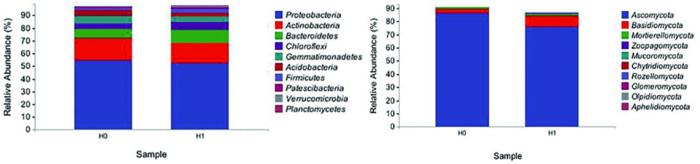
图1
不同样品土壤细菌门水平(左)和真菌门水平(右)相对丰度
Fig.1
The Relative abundance of bacteria at phylum level (left) and fungi at phylum level (right) in the different samples
假单胞菌属(Pseudomonas)、溶杆菌属(Lysobacter)、Subgroup_6、鞘氨醇单胞菌属(Sphingomonas)、S0134_terrestrial_group、藤黄色单胞菌属(Luteimonas)、分支杆菌属(Mycobacterium)、类固醇杆菌属(Steroidobacter)、MND1、马赛菌属(Massilia);H1处理的优势细菌属水平主要为假单胞菌属(Pseudomonas)、溶杆菌属(Lysobacter)、藤黄色单胞菌属(Luteimonas)、BIrii41、A4b、类固醇杆菌属(Steroidobacter)、Chryseolinea、R7C24、Subgroup_6、芽孢杆菌属(Bacillus)。H0处理的优势真菌属水平主要为枝葡萄孢属(Botryotrichum)、毛瓶毛壳属(Lophotrichus)、毛壳菌属(Chaetomium)、小鬼伞属(Coprinellus)、头束霉属(Cephalotrichum)、镰刀菌属(Fusarium)、被孢霉属(Mortierella)、闭小囊菌属(Kernia)、足放线病菌属(Scedosporium)、假裸囊菌属(Pseudogymnoascus);H1处理的优势真菌属水平主要为枝葡葡孢属(Botryotrichum)、多毛瓶毛壳属(Lophotrichus)、鬼伞属(Coprinellus)、被孢霉属(Mortierella)、Arthrographis、闭小囊菌属(Kernia)、镰刀菌属(Fusarium)、不甲白癣菌属(Pseudaleuria)、毛壳菌属(Chaetomium)、酵母属(Remersonia)。图2
图2
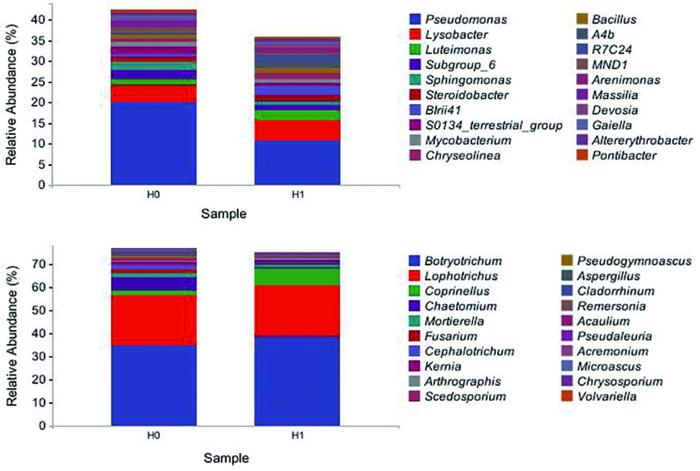
图2
不同样品土壤细菌类属水平(上)和真菌类属水平(下)相对丰度
Fig.2
The Relative abundance of bacteria at genus level (up) and fungi at genus level (down) in the different soil samples
2.3 不同处理下土壤微生物α多样性指数变化
研究表明,各样品的覆盖率均大于99%。在土壤细菌多样性方面,H1处理土样Shannon指数>H0处理,Simpson指数表现为H1>H0;真菌多样性H0处理土样Shannon指数>H1处理,Simpson指数表现为H0>H1。微生物群落均匀度H1处理土样细菌Pielou evenness指数>H0处理,真菌相反。H1处理的土壤细菌多样性较高,且均匀度较高;H0处理的土壤真菌多样性和均匀性较高。增施微生物肥能够增加土壤中的细菌多样性,降低真菌多样性,且能够增加土壤中微生物的均匀度。表1
表1 不同样品土壤细菌、真菌α多样性指数的变化
Tab.1
| 项目 Items | 处理 Treatments | 超1指数 Chao1 | 覆盖率 Ccoverage(%) | 皮耶罗均匀度 Pielou evenness | 香浓指数 Shannon index | 辛普森多样性指数 Simpson index |
|---|---|---|---|---|---|---|
| 细菌 | H0 | 3 120.763 3 | 99.13 | 0.804 6 | 9.272 3 | 0.964 5 |
| Bacteria | H1 | 3 146.606 7 | 99.15 | 0.852 5 | 9.861 7 | 0.990 0 |
| 真菌 | H0 | 337.959 3 | 99.997 | 0.573 8 | 4.817 3 | 0.868 6 |
| Fungi | H1 | 347.045 0 | 99.997 | 0.487 2 | 4.111 6 | 0.818 6 |
2.4 不同处理下土壤微生物物种的差异情况
研究表明, H0和H1的各样品各自聚类在一起,处理内真、细菌菌群的相似性较高,处理间单独聚为一簇,真菌、细菌群落组成差异较大。(LEfSe进化分支图由内至外辐射的圆圈代表了由门至种的分类级别,在不同分类级别上的每一个小圆圈代表该水平下的一个分类,小圆圈直径大小与相对丰度大小呈正比,着色原则为将无显著差异的物种统一着色为白色,其他差异物种按该物种所在丰度最高的分组进行着色。不同颜色表示不同分组,不同颜色的节点表示在该颜色所代表的分组中起到重要作用的微生物群,白色节点表示的是在不同分组中未起到重要作用的微生物类群)。图3
图3
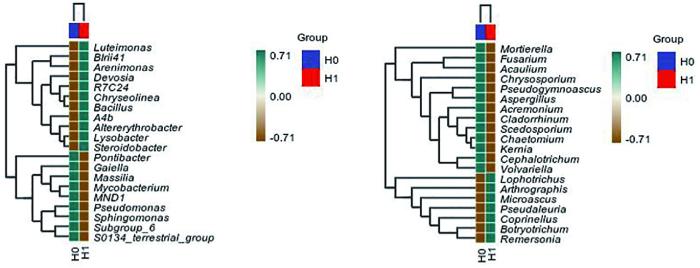
图3
不同样品土壤细菌和真菌组成热图
Fig.3
Heat-map of bacteria and fungi in the different soil samples
对照H0土壤中富集的细菌微生物有46个,主要包括酸杆菌门、Subgroup_6纲、Subgroup_6目、Subgroup_6科、Subgroup_6属,Dehalococcoidia纲,Gitt GS_136纲、Gitt_GS 136目、Gitt GS_136属,γ-变形菌门、S0134_terrestrial group纲、S0134_terrestrial group目、S0134_terrestrial group科、S0134_terrestrial group属,Rokubacteria门、NC10纲、Rokubacteriales目、Rokubacteriales科、Rokubacteriales属,嗜热油菌纲、盖勒氏菌目、Gaiellaceae科、Gaiella属、土壤红杆菌目、67_14科、67_14属、土壤红杆菌科,γ-变形菌纲、假单胞菌目、假单胞菌科、假单胞菌属、亚硝化单胞菌科、Massilia属、MND1属、Nitrosospira属,Actinomarinales科,丙酸杆菌目、类诺卡氏菌科,假诺卡氏目、假诺卡氏科,鞘脂杆菌目、鞘脂杆菌科,Tistrellales目、Geminicoccaceae科,bacteriap25科,鞘氨醇单胞菌属;处理H1土壤中富集的细菌微生物有54个,主要包括拟杆菌门、拟杆菌纲、噬几丁质菌目、噬几丁质菌科、噬纤维菌目、微颤蓝细菌科、Ohtaekwangia属和黄杆菌目、黄杆菌科、栖砂杆菌属,绿弯菌门、绿弯菌纲、厌氧绳菌纲、SBR1031目、A4b科、A4b属,异常球菌-栖热菌门、特吕珀菌属,厚壁菌门、杆菌纲、芽孢杆菌目、梭状芽胞杆菌纲、梭菌目,髌骨细菌门、Saccharimonadia纲、Saccharimonadales目、Saccharimonadales科、Saccharimonadales属,浮霉菌门,疣微菌门、疣微菌纲,δ-变形菌纲、粘球菌目、BIrii41科、BIrii41属、侏囊菌科、侏囊菌属,微单孢菌目、微单胞菌科,柄杆菌目,根瘤菌目、根瘤菌科,R7C24目、R7C24科,R7C24属,黄单孢菌目、藤黄杆菌科、孤岛杆菌属,黄单胞菌科、单胞菌属,Ilumatobacteraceae科,微杆菌科,Tardiphaga属,噬氢菌属。图4~6
图4
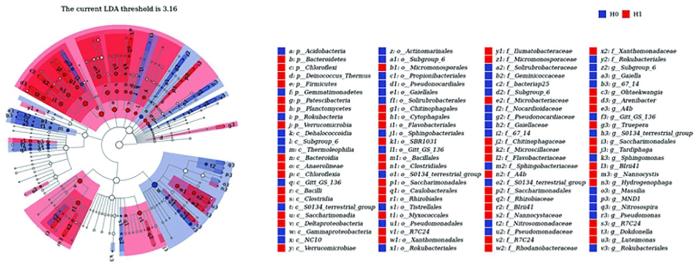
图4
不同样品土壤细菌LEfSe分析的进化分枝
Fig.4
Evolutionary branching diagram of bacterial community LEfSe analysis in the different soil samples
图5

图5
不同样品土壤细菌LEfSe分析的LDA值
Fig.5
LDA value of bacterial community LEfSe analysis in the different soil samples
图6
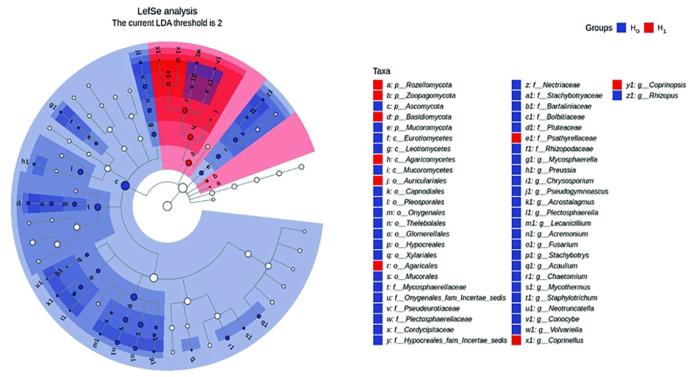
图6
不同样品土壤真菌LEfSe分析的进化分枝
Fig.6
Evolutionary branching diagram of fungi community LEfSe analysis in the different soil samples
对照H0土壤中富集的真菌微生物有43个,主要包括子囊菌门、散囊菌纲、爪甲团囊菌目、Onygenales_fam_Incertae_sedis科、金孢属;锤舌菌纲、Thelebolales目、假散囊菌科、假裸囊菌属、煤炱菌目、球腔菌科、球腔菌属、格孢腔菌目、光黑壳属,毛霉门、毛霉纲、毛霉目、根霉科、根霉属,炭角菌目、Bartaliniaceae科、Neotruncatella属,小丛壳目、小不整球壳科、笋顶孢霉属、织球壳属,肉座菌目、虫草菌科、蜡蚧菌属、肉座菌科、顶孢属、丛赤壳科、镰刀菌属、葡萄穗霉科、葡萄穗霉属,粪伞科、锥盖伞,光柄菇科、小包脚菇属,圆孢霉属,毛壳属,Mycothermus,无茎真菌属。处理H1土壤中富集的真菌微生物有9个,主要包括罗兹菌门,捕虫霉门,担子菌门、伞菌纲、木耳目、伞菌目、鬼伞科、小鬼伞属、墨头菌属。不同处理富集的微生物物种显著不同。与处理H0相比,增施微生物肥使土壤富集更多的细菌,且以有益细菌为主,并减少了致病真菌的丰度。图7
图7
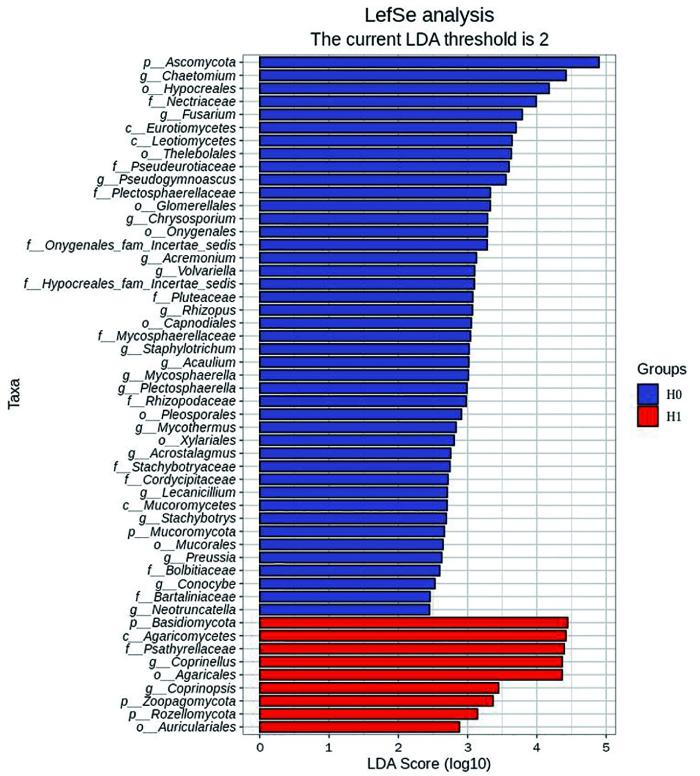
图7
不同样品土壤真菌LEfSe分析的LDA值
Fig.7
LDA value of fungi community LEfSe analysis in the different soil samples
2.5 不同处理土壤微生物代谢通路分析及功能潜能预测
研究表明,处理H0和H1土壤中的细菌微生物群落功能基因在代谢途径上的主要集中在细胞进程、环境信息处理、遗传信息处理、代谢四大类,细胞进程通路主要是细胞生长和死亡、细胞的能动性、细胞群落—原核生物、运输和分解代谢;环境信息处理通路主要包括膜运输、信号传导、信号分子和相互作用;遗传信息处理通路主要包括折叠、分类和降解、复制和修复、转录、翻译;代谢通路主要包括氨基酸代谢、其他次生代谢的生物合成、碳水化合物代谢、能量代谢、糖的生物合成和代谢、脂类代谢、辅助因子和维生素的代谢、其他氨基酸的代谢、萜类和多酮的代谢、核苷酸代谢、异种生物的降解和代谢。图8
图8
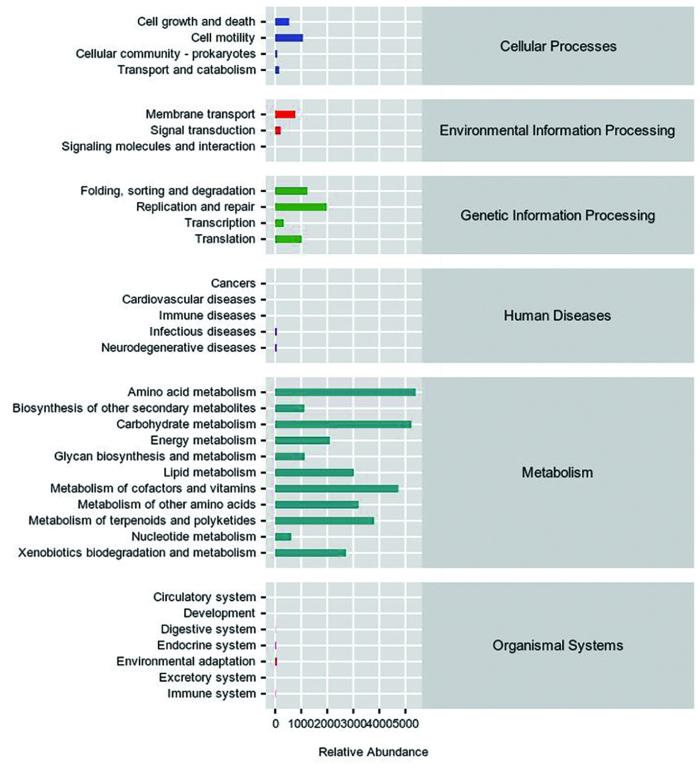
图8
不同样品土壤细菌KEGG代谢通路
Fig.8
KEGG metabolic pathways of bacterial in the different soil samples
处理H0和H1土壤中的真菌微生物群落功能基因在代谢途径上的主要集中在生物合成、降解/利用/同化、前体代谢物和能量的生成、聚糖通路、代谢簇,生物合成代谢途径主要包括氨基酸生物合成、氨基酸-tRNA合成、碳水化合物生物合成、辅助因子,假体,电子载体,维生素生物合成、脂肪酸和脂类生物合成、核苷和核苷酸生物合成、次生代谢物生物合成;降解/利用/同化途径主要包括氨基酸降解、C1复合利用与同化、碳水化合物降解、降解/利用/同化、脂肪酸与脂质降解、无机营养代谢、核苷和核苷酸降解;前体代谢物和能量的生成的代谢途径主要包括几丁质降解成为乙醇、电子转移、发酵、糖酵解、乙醛酸循环、甲基酮生物合成、戊糖磷酸途径、呼吸作用、TCA循环;聚糖通路主要是聚糖生物的合成;代谢簇的代谢途径主要包括磷脂酶代谢、嘧啶脱氧核糖核酸的磷酸基化CTP为底物合成嘧啶脱氧核糖核酸途径、嘧啶脱氧核糖核酸的生物合成、tRNA代谢。图9
图9
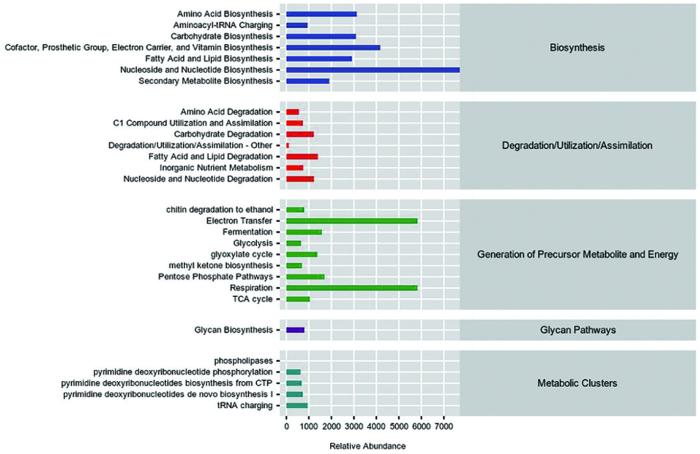
图9
不同样品土壤真菌MetaCyc代谢通路
Fig.9
MetaCyc metabolic pathways of fungi in the different soil samples
3 讨论
3.1 土壤中的微生物受种植模式、养分、水分等外界环境影响较大,其群落的多样性和结构组成的稳定性是土壤生态系统健康的重要指标之一[14-15]。施用微生物菌肥能够有效抑制连作对黄瓜生长的影响,改善土壤物理性状[16]。Wan等[17]研究发现,接种解淀粉芽孢杆菌SN16-1到番茄根际,造成变形菌门、酸杆菌门、放线菌门、芽单胞菌门和拟杆菌门丰度的提高。试验研究结果表明,增施微生物肥显著改变了黄瓜土壤根际土壤微生物群落结构和组成,具体表现为显著增加了黄瓜根际土壤中拟杆菌门、绿弯菌门、异常球菌-栖热菌门、厚壁菌门、髌骨细菌门、浮霉菌门、疣微菌门等细菌的丰度。农作物微生物组研究对作物有益的细菌主要包括变形菌门、放线菌门、拟杆菌门和厚壁菌门[18]。试验结果表明,施加芽孢杆菌微生物肥可显著提升土壤中芽孢杆菌目的丰度,且增加了Ohtaekwangia、栖砂杆菌属(Arenibacter)、A4b、特吕珀菌属(Truepera)、Saccharimonadales、Tardiphaga、 BIrii41、侏囊菌属(Nannocystis)、噬氢菌属(Hydrogenophaga)、R7C24、独岛菌属(Dokdonella)、藤黄色单胞菌属(Luteimonas)等细菌属水平的丰度。微生物肥对根际真菌群落影响的报道并不是很多。黎妍妍等[19]发现在烟草土壤接种解淀粉芽孢杆菌可以提高土壤子囊菌门、担子菌门和粪盘菌属的相对丰度,降低壶菌门和被孢霉门丰度,对烟株根际土壤真菌群落结构具有显著的积极影响。研究中,施加微生物肥显著增加了罗兹菌门、捕虫霉门、担子菌门、鬼伞属和墨汁鬼伞属等真菌的丰度,降低了子囊菌门和毛霉门等真菌的丰度,微生物覆盖率大于99%,测序数据可信,可能是由于施加微生物肥富集了某些有益真菌,拮抗作用抑制其他真菌生长,导致真菌种类均匀度偏低从而导致真菌群落多样性降低。
3.2 Chao1是衡量物种丰度的指数,Simpson和Shannon是用来估算样品中微生物多样性的指数,QIIME (2019.4)软件计算出的Shannon指数和Simpson指数值越大,样品的物种多样性越高。大部分文献均报道施加微生物菌剂可提高土壤细菌丰富度和多样性,如Han等[20]将解淀粉芽孢杆菌B1408施加在黄瓜土壤中,显著增加土壤细菌丰富度和多样性,促进黄瓜生长。张云霞等[21]研究发现,盆栽试验中高效解磷枯草芽孢杆菌JY-1可显著提高小麦土壤的微生物多样性。Zhao等[22]利用西瓜的盆栽发现接种解淀粉芽孢杆菌JDF35+有机肥的土壤真菌多样性低于有机肥处理组,与研究结果较为一致。
4 结论
4.1 增施微生物肥增加了黄瓜根际土壤中厚壁菌门丰度1.25%,作为根际土壤中核心菌属促进土壤中生物有机氮的转化,从而提高氮的利用率。拟杆菌门和绿弯菌门的丰度分别增加了3.84%、1.44%,促进了黄瓜根际土壤中糖酵解和3-羟基丙酸途径。土壤中真菌的多样性降低,有利于土壤生态环境的改善。施用微生物肥料可以改善土壤营养环境,为土壤微生物的生命活动提供充足的养分和能源,从而促进微生物生长繁殖,丰富种群,有效改善土壤微生物群落功能。
4.2 增施微生物肥能够增加黄瓜根际土壤中细菌拟杆菌门、绿弯菌门、厚壁菌门的丰度,降低真菌的多样性。
参考文献
Soil health through soil disease suppression: Which strategy from descriptors to indicators?
[J].
Multivariate analyses of Burkholderia species in soil: effect of crop and land use history
[J].
Long-term impact of fertilization on activity and composition of bacterial communities and metabolic guilds in agricultural soil
[J].
Effects of biodiversity on the functioning of trophic groups and ecosystems
[J].
三种土壤条件下紫茎泽兰根际的酶活性及细菌群落状况
[J].
Enzyme activities and bacterial community in the rhizosphere of Eupatorium adenophorum under different soil conditions
[J].
哈尼梯田生态系统土壤微生物量碳的影响因素
[J].
Factors affecting soil microbial biomass carbon in Hani terraced ecosystem
[J].
Signature fatty acids in phospholipids and lipopolysaccharides as indicators of microbial biomass and community structure in agricultural soils
[J].
Effects of different 3-year cropping systems on soil microbial communities and Rhizoctonia diseases of potato
[J].
Microbial biomass and community structure in a sequence of soils with increasing fertility and changing land use
[J].
The microbial biomass and community structure of eight Chinese red soils with different fertility and land use history was investigated. Two community based microbiological measurements, namely, community level physiological profiling (CLPP) using Biolog sole C source utilization tests and phospholipid fatty acid (PLFA) profiles, were used to investigate the microbial ecology of these soils and to determine how land use alters microbial community structure. Microbial biomass-C and total PLFAs were closely correlated to organic carbon and total nitrogen, indicating that these soil microbial measures are potentially good indices of soil fertility in these highly weathered soils. Metabolic quotients and C source utilization were not correlated with organic carbon or microbial biomass. Multivariate analysis of sole carbon source utilization patterns and PLFAs demonstrated that land use history and plant cover type had a significant impact on microbial community structure. PLFAs showed these differences more than CLPP methods. Consequently, PLFA analysis was a better method for assessing broad-spectrum community differences and at the same time attempting to correlate changes with soil fertility. Soils from tea orchards were particularly distinctive in their CLPP. A modified CLPP method, using absorbance readings at 405 nm and different culture media at pH values of 4.7 and 7.0, showed that the discrimination obtained can be influenced by the culture conditions. This method was used to show that the distinctive microbial community structure in tea orchard soils was not, however, due to differences in pH alone.
氮肥施用对生态系统的影响及措施的研究
[J].
Effects of nitrogen fertilization on ecosystem and countermeasures of improving the nitrogen use efficiency
[J].
不同氮素水平下生物菌肥施用效果研究
[J].
Application effect of biological fertilizer in different-level nitrogen
[J].
微生物菌肥的作用机理研究
[J].
The study of the bacteria manure’s role to the crop
[J].
我国微生物肥料的应用研究进展
[J].
A review of effects of biofertilizers on crop yield and quality
[J].
Effect of tillage and N fertilization on microbial physiological profile of soils cultivated with wheat
[J].
Predicting disease occurrence with high accuracy based on soil macroecological patterns of Fusarium wilt
[J].
几种微生物菌肥对连作黄瓜生长及土壤理化性状的影响
[J].
Effects of different microbial fertilizers on continuous cropping cucumber growth and soil physiochemical properties
[J].
Effect of biocontrol agent Bacillus amyloliquefaciens SN16-1 and plant pathogen Fusarium oxysporum on tomato rhizosphere bacterial community composition
[J].
农作物微生物组: 跨越转化临界点的现代生物技术
[J].
Crop microbiome: breakthrough technology for agriculture
[J].
解淀粉芽孢杆菌施用方式对烟株根际土壤真菌群落的影响
[J].
Promotion effects of three application methods of Bacillus amyloliquefaciens on fungal community in tobacco rhizosphere soil
[J].
Bacillus amyloliquefaciens B1408 suppresses Fusarium wilt in cucumber by regulating the rhizosphere microbial community
[J].
一株高效解磷菌Bacillus subtilis JT-1的筛选及其对土壤微生态和小麦生长的影响
[J].
Screening of a high-efficiency phosphate solubilizing bacterium Bacillus subtilis JT-1 and its effects on soil microecology and wheat growth
[J].
The rhizosphere microbial community response to a bio-organic fertilizer: finding the mechanisms behind the suppression of watermelon Fusarium wilt disease
[J].
芽胞杆菌组合BCL-8对番茄的促生防病效果及其促生机制初探
[J].
Growth-promotion and disease control effect of combination BCL-8 on tomato and growth-promotion mechanism
[J].
枯草芽胞杆菌QM3防治番茄早疫病和促进幼苗生长的研究
[J].
Studies on promoting tomato growth and controlling early blight using Bacillus subtilis QM3
[J].
Nitrogen-fixing bacteria with multiple plant growth-promoting activities enhance growth of tomato and red pepper
[J].As a suitable alternative to chemical fertilizers, the application of plant growth-promoting rhizobacteria has been increasing in recent years due to their potential to be used as biofertilizers. In the present work, 13 nitrogen-fixing bacterial strains belonging to 11 different genera were tested for their PGP attributes. All of the strains were positive for 1-aminocyclopropane-1-carboxylate deaminase (ACCD), indole-3-acetic acid (IAA), salicylic acid, and ammonia production while negative for cellulase, pectinase, and hydrocyanic acid production. The strains Pseudomonas sp. RFNB3 and Serratia sp. RFNB14 were the most effective in solubilizing both tri-calcium phosphate and zinc oxide. In addition, all strains except Pseudomonas sp. RFNB3 were able to oxidize sulfur, and six strains were positive for siderophore synthesis. Each strain tested in this study possesses at least four PGP properties in addition to nitrogen fixation. Nine strains were selected based on their multiple PGP potential, particularly ACCD and IAA production, and evaluated for their effects on early growth of tomato and red pepper under gnotobiotic conditions. Bacterial inoculation considerably influenced root and shoot length, seedling vigor, and dry biomass of the two crop plants. Three strains that demonstrated substantial effects on plant performance were further selected for greenhouse trials with red pepper, and among them Pseudomonas sp. RFNB3 resulted in significantly higher plant height (26%) and dry biomass (28%) compared to control. The highest rate of nitrogen fixation, as determined by acetylene reduction assay, occurred in Novosphingobium sp. RFNB21 inoculated red pepper root (49.6 nM of ethylene/h/g of dry root) and rhizosphere soil (41.3 nM of ethylene/h/g of dry soil). Inoculation with nitrogen-fixing bacteria significantly increased chlorophyll content, and the uptake of different macro- and micro-nutrient contents enhancing also in red pepper shoots, in comparison with uninoculated controls. The population estimation studies showed that nitrogen-fixing as well as total heterotrophic bacteria were also noticeably increased in soil and plant samples. The findings of this study suggest that certain nitrogen-fixing strains possessing multiple PGP traits could be applied in the development of biofertilizers. © 2013 WILEY-VCH Verlag GmbH & Co. KGaA, Weinheim.


