

0 引言
【研究意义】2020年新疆小麦种植面积106.9×10⁴ hm2,总产582.09×10⁴ t,单产5 445.18 kg/hm2,位居全国第6位[1]。关于土壤质地变化对小麦的影响[2⇓⇓-5],研究文献主要集中在土壤质地对小麦产量及品质的影响上,而对小麦生育期中的生理特性影响较少。基于apriori算法分析小麦各生理指标间的关联性,对分析新疆北疆小麦最宜种植制度有重要意义。【前人研究进展】微灌相较于普通灌溉方式有更明显的优点,滴灌条件下土壤蓄水保墒效果要高于传统灌溉方式[6],滴灌与微喷灌能够明显增加0~45 cm土层土壤水稳性团聚体的含量和大小,改善土壤微生物环境[7,8]。喷灌使作物根系产生明显的上移现象,更适合作物生长需要。微喷灌条件下冬小麦叶片光合速率高于漫灌处理[9]。残留在土壤中的地膜会直接影响农作物根系的自然生长,导致作物根系畸变,降低作物成活率,对作物造成不利影响。陈晶等[10]研究发现,土壤残膜量与茄子(Solanum melongena)、玉米(Zea mays)产量呈极显著负相关。马辉等[11,12]发现玉米茎粗和叶面积均随残膜量的增加呈现递减趋势。朱金儒等[13]发现试验区棉花氮主成铃数较对照组减少0.4~12个,落铃率增加3.9%~5.5%。 【本研究切入点】关联规则中的apriori算法在小麦上的应用相对较少。需利用apriori算法分析各生理指标间的关联性。【拟解决的关键问题】采用apriori算法,研究不同土质、灌溉方式、灌水定额、灌水次数和不同地膜残留量对春小麦的生长指标、水分利用效率及产量的影响,以探求最适宜的新疆北疆春小麦种植制度。
1 材料与方法
1.1 材料
试验于2021年试验在新疆农业大学水利学院(43°81'N,87°57'E)进行。试验选取春小麦品种新春52号为试验材料。
1.2 方法
1.2.1 试验设计
表1 试验因素与水平设计
Tab.1
| 水平 Level | 试验因素 Experimental factors | ||||
|---|---|---|---|---|---|
| 土壤质地 Soil texture | 灌溉方式 Irrigation methods | 灌水定额 Irrigation quota (m3/hm2) | 灌水次数 Number of times of irrigation | 土壤地膜残留 Soil mulch residues (kg/hm2) | |
| 1 | 砂土质 | 膜下滴灌 | 400 | 5 | 0 |
| 2 | 轻壤土 | 喷灌 | 500 | 6 | 250 |
| 3 | 中壤土 | 渗灌 | 700 | 7 | 450 |
| 4 | 粘壤土 | 畦灌 | 800 | 8 | 650 |
表2 正交试验
Tab.2
| 处理 Treatments | 土壤质地 Soil texture | 灌溉方式 Irrigation methods | 灌水定额 Irrigation quota (m3/hm2) | 灌水次数 Number of times of irrigation | 地膜残留 Mulch residues (kg/hm2) |
|---|---|---|---|---|---|
| T1 | 砂土质 | 膜下滴灌 | 400 | 5 | 0 |
| T2 | 砂土质 | 喷灌 | 500 | 6 | 250 |
| T3 | 砂土质 | 渗灌 | 700 | 7 | 450 |
| T4 | 砂土质 | 畦灌 | 800 | 8 | 650 |
| T5 | 轻壤土 | 膜下滴灌 | 500 | 7 | 650 |
| T6 | 轻壤土 | 喷灌 | 400 | 8 | 450 |
| T7 | 轻壤土 | 渗灌 | 800 | 5 | 250 |
| T8 | 轻壤土 | 畦灌 | 700 | 6 | 0 |
| T9 | 中壤土 | 膜下滴灌 | 700 | 8 | 250 |
| T10 | 中壤土 | 喷灌 | 800 | 7 | 0 |
| T11 | 中壤土 | 渗灌 | 400 | 6 | 650 |
| T12 | 中壤土 | 畦灌 | 500 | 5 | 450 |
| T13 | 粘壤土 | 膜下滴灌 | 800 | 6 | 450 |
| T14 | 粘壤土 | 喷灌 | 700 | 5 | 650 |
| T15 | 粘壤土 | 渗灌 | 500 | 8 | 0 |
| T16 | 粘壤土 | 畦灌 | 400 | 7 | 250 |
选择盆栽种植方式,每个试验处理2次重复,共32个。选取底面积(0.36×0.36) m2,高0.6 m盆栽种植小麦,盆栽间隔控制在1 m左右,试验于4月16日播种,每盆小麦播种30粒,播种深度4 cm。于小麦播种前各小区统一施尿素底肥,以250 kg/hm2折算为盆体用量,一次性于作物播种前施入盆栽体10~20 cm土壤。
灌溉用水采用常规自来水源,使用点源入渗,使用输液器代替滴灌带,渗灌将输液器的一定长度软管及出水口预埋于设计深度,顶端设有连接器,灌溉时利用输液器的流量控制器调节至设定流量后,与预埋输液器管连接。地表滴灌采用输液器调节好流量后,盆栽土体表面直接灌溉。畦灌则采取地表自由流的方式模拟田间畦灌环境;采用人工布设同等高度的洒水壶模拟田间喷灌环境。根据春小麦不同生育期需水特点选取最适宜的春麦灌水时期。将往年的旧地膜人工粉碎成不规则大小的碎片,折算为盆栽体地膜碎片数量,模仿田间地膜残留实际状态均匀的混合在试验盆栽土壤中。
1.2.2 测定指标
1.2.2.1 株高
随机选取测量对象,对每小区的小麦株高进行各生育期的分阶段(分蘖期、拔节期、抽穗期、灌浆期和成熟期)测量,采用分度值为0.1 cm的米尺测量盆栽土壤表面距小麦穗顶的高度。
1.2.2.2 叶片相对叶绿素含量
在小麦生长各生育期内,选取长势良好植株,取旗叶、倒二叶、倒四叶,利用SPAD-502 Plus叶绿素指数仪测定SPAD值。利用叶绿素指数仪测量时避开叶片叶脉部分,测量叶片尖部、中部以及根部SPAD值,取最终平均数用于试验分析。
1.2.2.3 土壤水分
测定土壤含水率时,在每个重复布设1根观测管,将土壤每10 cm为一层,共5层,每3~5 d测定一次含水率,若当天有灌水或降雨,则再加测一次。
作物耗水量通过水量平衡原理计算。
式中,ET为作物耗水量(mm);I为灌溉用水量(mm);P0为有效降雨量(mm);△W为全生育期土壤水分消耗,即始末土壤水分差(mm)。
式中,P为时段内实际降雨量(mm)。
1.2.2.4 春小麦产量及产量构成因素
于小麦成熟后测定春小麦产量,分别测算小麦有效穗数、千粒重、每穗粒数,单打单收。带回室内烘干称重,记录产量。
1.3 数据处理
研究关联规则的挖掘是通过apriori算法实现的,apriori算法遵循先验定理,即:频繁项集的所有非空子集也一定是频繁的。Apriori算法是根据数据情况首先设置最小支持度min-sup和最小置信度min-confi。对原始数据库进行迭代筛选,基于最小支持度进行剪枝,不断地得到候选项集和频繁项集。即得到所有关联规则,再根据支持度sup、置信度con和提升度lift从中筛选出有效规则。
支持度sup:相互关联的数据在原始数据集中出现次数占总数据集的比重。
式中,sup(X,Y)为X,Y两项对应的支持度,count(XY)为X,Y两项事务出现的次数,count(D)为原始数据集的数量大小。
置信度confi:置信度表示数据Y出现后,另一个数据X出现的概率,即数据的条件概率。
提升度lift:表示Y出现的条件下X出现的概率与X总体发生的概率之比。
提升度表示项集Y对项集X的影响程度,当提升度等于1时,X,Y两项集的出现是相互独立的,即关联规则X➝Y无意义;当提升度小于1时,X,Y两项集互斥,只有当提升度大于1时Y的出现会使X更频繁地出现,此时关联规则才有价值。
2 结果与分析
2.1 不同处理对春小麦生长指标的影响
2.1.1 不同处理对小麦株高的影响
研究表明,比较不同处理全生育期小麦株高变化,各处理小麦株高变化均呈不断增加的趋势。分蘖期—拔节期增高速率最大,之后逐渐变缓。T7与T15处理株高显著(P<0.05)高于其余处理,T11、T12处理株高显著较低(P<0.05)。其中T10处理拔节期到抽穗期株高增长速率最大,为1.17 cm/d,T10处理水分供应充沛,喷灌水分利用率相对较高,无地膜残留,最利于植株生长。T13处理抽穗期后株高持续增长,T13处理采用膜下滴灌,灌水定额较大,粘壤土持水能力强,地膜残留对植株生长的影响较小。T11处理拔节期至灌浆期增长较慢,当土质为壤土,灌溉方式为渗灌,灌水定额在500~700 m3/hm2,地膜残留为0~250 kg/hm2时,有利于小麦株高增长。表3
表3 不同生育期下春小麦株高的显著性的比较
Tab.3
| 处理 Treatments | 分蘖期 Tillering stage | 拔节期 Jointing stage | 抽穗期 Tasseling stage | 灌浆期 Grouting stage | 成熟期 Ripening stage |
|---|---|---|---|---|---|
| T1 | 7.52±0.78ab | 19.88±1.3bcde | 34.03±3.48efg | 37.33±2.72cde | 39.37±2.69cd |
| T2 | 7.58±0.7ab | 20.17±2.06cde | 33.78±2.37efg | 39.88±6.86e | 41.23±6.76d |
| T3 | 8.52±0.83abc | 20.37±2.77de | 35.42±2.23g | 39.12±2.09e | 40.37±2.03e |
| T4 | 8.47±0.5abc | 21.98±1.6e | 31.73±2.67def | 37.55±1.33cde | 39.12±0.97cd |
| T5 | 7.38±3.02ab | 21.48±1.42e | 35.1±3.07g | 40.1±1.19e | 41.78±1.58d |
| T6 | 9.2±0.99c | 20.38±2.36de | 31.4±2.75de | 35.45±1.38cde | 36.85±0.93bc |
| T7 | 11.3±0.64d | 27.65±1.4f | 46.73±2.46i | 54.9±1.6f | 55.15±1.74f |
| T8 | 7.95±0.86abc | 18.33±1.95abcd | 27.17±1.03bc | 33.52±2.2bc | 35.12±1.99b |
| T9 | 8.25±0.65abc | 17.05±1.54a | 34.77±2.71fg | 38.43±0.77de | 40.32±0.92d |
| T10 | 8.03±0.58abc | 18.57±1.11abcd | 34.05±2.43efg | 39.08±7.15e | 44.63±1.64e |
| T11 | 8.77±0.54bc | 18.73±1.38abcd | 21.92±2.26a | 28.03±1.03a | 29.87±0.87a |
| T12 | 8.53±0.54abc | 17.33±1.85a | 24.55±1.24ab | 30.37±1.96ab | 31.72±1.72a |
| T13 | 8.13±0.71abc | 17.67±1.3ab | 28.37±1.2c | 38.22±1.79de | 39.89±1.89d |
| T14 | 7.97±1abc | 18.05±1.2abc | 29.67±3.08cd | 36.3±8.28cde | 41.02±1.67d |
| T15 | 10.52±0.57d | 28.15±2.03f | 43.18±1.77h | 51.22±1.05f | 52.58±1.15f |
| T16 | 7.25±1.12a | 17.18±1.12a | 27.42±1.87bc | 33.77±1.37bcd | 35.13±1.08b |
注:不同小写字母表示差异显著(P<0.05)
Note:Different lowercase letters indicate significant differences(P<0.05)
2.1.2 不同处理对SPAD值的影响
研究表明,分蘖期T2SPAD值最高,较最低T6 处理高84.27%,其余各处理差异不显著;拔节期T2、T3 处理SPAD 值最高,T11 处理最低,其他各处理无显著性差异;抽穗期T11 处理叶绿素含量最低,T2、T3和T4处理较其他处理相比叶绿素含量较高,分别超过最低处理T11 63.12%、67.71%和73.70%;灌浆期与抽穗期相似,T2、T3和T4处理叶绿素值表现较好,分别高于最低处理T11 64.20%、68.64%和74.87%,T1处理叶绿素值最高,为29.99,T13 处理SPAD值最低,为16.15。
小麦全生育期内叶绿素值整体上呈单峰变化趋势,由分蘖期起SPAD值开始升高,直至抽穗期小麦叶片叶绿素值达到最大,其中T2处理SPAD值最大为61.4,超过T11处理 36%,从抽穗期到灌浆期SPAD值并无明显变化,灌浆期到成熟期叶片开始衰老,叶绿素降解,退绿黄化,SPAD值急速下降。表4
表4 春小麦不同生育期内 SPAD值的显著性
Tab.4
| 处理 Treatments | 分蘖期 Tillering stage | 拔节期 Jointing stage | 抽穗期 Tasseling stage | 灌浆期 Grouting stage | 成熟期 Ripening stage |
|---|---|---|---|---|---|
| T1 | 20.24±0.18ab | 32.31±1.23abc | 58.4±0.31a | 57.46±0.45a | 29.99±1.58a |
| T2 | 20.91±0.16a | 34.81±1.22a | 61.44±0.42a | 59.74±1.12a | 27.13±0.4ab |
| T3 | 20.83±1.3ab | 34.59±0.04a | 57.27±0.78a | 55.87±1.04a | 27.11±0.05ab |
| T4 | 20.72±1.34ab | 30.88±1.21abc | 52.62±1.13b | 51.22±1.41b | 20.76±0.49cde |
| T5 | 17.72±1.13ab | 30.43±2.21bc | 42.73±2cd | 42±1.69cd | 21.13±0.65cde |
| T6 | 17.62±2.42b | 33.6±3.86ab | 43.18±3.98cd | 42.35±4.95c | 20.93±1.91cde |
| T7 | 17.78±1.37ab | 32.97±1.41abc | 41.27±0.93d | 40.31±1.05cd | 19.81±0.08cde |
| T8 | 19.16±1.24ab | 32.56±2.1abc | 47.31±1.38bc | 46.56±1.55b | 22.32±0.05bcd |
| T9 | 18.61±0.04ab | 33.6±1.05ab | 45.9±0.7bc | 44.9±1.29bc | 18.85±0.19de |
| T10 | 18.79±1.16ab | 30.92±0.89abc | 46.15±0.45bc | 45.77±1.08bc | 25.05±8.57abc |
| T11 | 17.73±2.18ab | 29.4±0.17c | 38.78±0.66d | 38.35±0.1d | 19.7±0.04cde |
| T12 | 19.51±0.82ab | 33.63±0.28ab | 47.24±0.74bc | 46±0.75bc | 23.14±1.33bcd |
| T13 | 18.09±2.18ab | 32.71±0.16abc | 47.47±1.23bc | 46.6±1.42b | 16.15±0.35e |
| T14 | 18.49±1ab | 31.63±0.47abc | 45.62±1.26c | 44.83±1.32bc | 18.32±2.93de |
| T15 | 18.87±0.92ab | 31±2.35abc | 47.17±2.06bc | 47.51±0.65b | 22.92±0.28bcd |
| T16 | 18.65±0.36ab | 30.84±2.4abc | 49.4±1.94b | 48.64±1.98b | 18.22±1.48de |
2.2 不同处理对土壤水分变化、小麦耗水特性的影响
2.2.1 不同处理对土壤水分变化规律的影响
研究表明,各生育期内,随测定深度的增加,土壤含水率的变化趋势大致相同,从土壤深度10 cm处到土壤深度50 cm处,含水率呈先迅速增大、后缓慢减小的趋势,各生育期土壤含水率均在20 cm土层深处达到最大。
不同质地的土壤在试验过程中含水率变化各不相同,其中砂土质含水率最低,含水率变化最为明显,壤土含水率总体较大,保水性能好。当土壤地膜残量小于450 kg/ hm2时土壤含水量能够处于较高水平。地膜残留量大于450 kg/hm2时一部分处理的土壤含水量同样处于较高水平。图1
图1
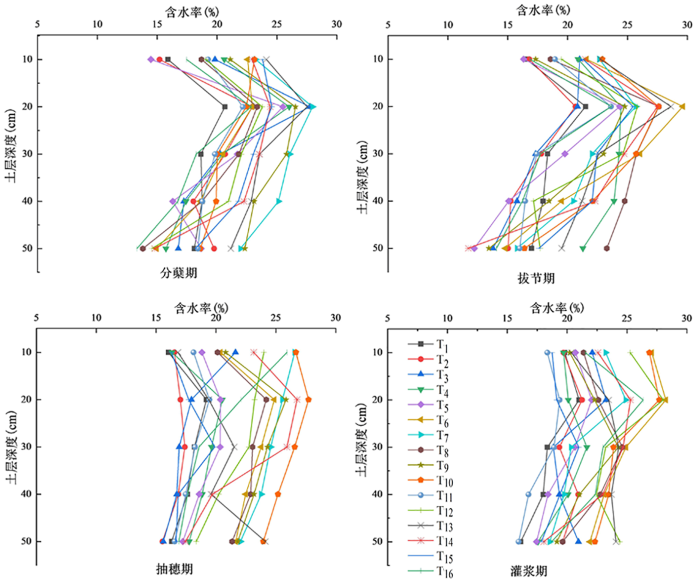
图1
不同处理下春小麦主要生育期土壤水分的变化
Fig.1
Changes of soil moisture during the main growth period of spring wheat under different treatments
2.2.2 不同处理对小麦耗水特性的影响
研究表明,不同处理下春小麦各阶段耗水强度变化趋势基本一致,各处理分蘖期小麦耗水强度波动幅度为0.67~2.91 mm/d,分蘖期到拔节期小麦耗水强度呈增加趋势,增至1.38~5.27 mm/d,自拔节期至抽穗期,日耗水量迅速增加,达到峰值7.99~10.58 mm/d,其中耗水强度最高的处理为T13处理,耗水强度为10.58 mm/d,抽穗期耗水强度最低为T5处理,耗水强度为7.99 mm/d。由抽穗期开始,小麦耗水量逐渐回落,灌浆期小麦耗水强度落至6.69~9.21 mm/d。直至成熟期结束,耗水强度降至最低,为0.81~3.59 mm/d。土壤含水率与土壤质地和灌水量有明显的相关性。图2
图2
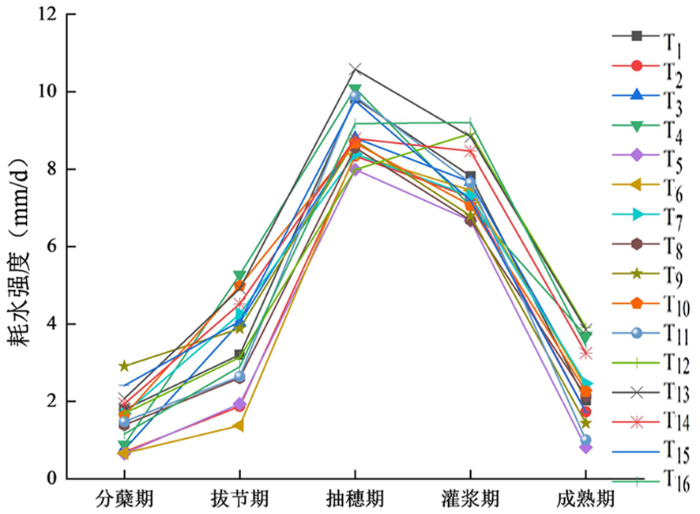
图2
不同处理下春小麦各阶段耗水强度
Fig.2
Water consumption intensity of spring wheat at different stages under different treatments
T13处理的耗水量最高为453.93 mm,高于T16处理35.3 mm,与其余各处理有显著性差异(P<0.05),T5处理耗水量最低,为270.89 mm。T5与T8处理WUE较高,与其他各处理有显著性差异(P<0.05)。T2与T1处理IWUE最高,T4、T10、T13处理灌溉水利用效率最低,与其他各处理由显著性差异(P<0.05),IWUE最高T2处理与最低组T13处理相差0.65(kg·hm2)/mm。
土壤质地与灌水模式对小麦耗水量影响大,对WUE和IWUE影响最大的试验因素均为灌水定额。当灌水定额设定为500~700 m3/hm2时水分利用效率最高,当灌水定额增加至800 m3/hm2时,WUE与IWUE有所降低,当灌水次数分别为5次、6次时,小麦WUE值与IWUE达到最佳水平。表5
表5 不同处理下春小麦全生育期耗水量与水分利用效率的变化
Tab.5
| 处理 Treatments | 耗水量 Water consumption (mm) | 水分利用效率 WUE (kg·hm2/mm) | 灌溉水利用效率 IWUE (kg·hm2/mm) |
|---|---|---|---|
| T1 | 185.03±17.45bc | 0.52±0.01d | 1.03±0.02a |
| T2 | 343.67±17.45c | 1.01±0.03ab | 1.1±0.03a |
| T3 | 354.37±17.45c | 0.9±0.03ab | 0.68±0.06c |
| T4 | 404.85±16.69b | 0.84±0.03b | 0.52±0.04d |
| T5 | 270.89±16.69d | 1.16±0.07a | 0.85±0bc |
| T6 | 303.49±16.69d | 0.71±0.08bc | 0.71±0.04c |
| T7 | 361.51±16.69c | 0.86±0.05ab | 0.76±0.08bc |
| T8 | 320.4±14.85cd | 1.06±0.19a | 0.83±0.11bc |
| T9 | 356.42±14.85c | 1.03±0.01ab | 0.68±0.03c |
| T10 | 369.11±14.85bc | 0.73±0.07bc | 0.46±0.03d |
| T11 | 211.35±19.37bc | 0.55±0.1cd | 0.9±0.12ab |
| T12 | 248.08±19.37bc | 0.42±0d | 0.62±0.03cd |
| T13 | 453.93±19.37a | 0.49±0.05d | 0.45±0.03d |
| T14 | 404.42±19.37b | 0.62±0.12cd | 0.74±0.11bc |
| T15 | 377.29±19.37bc | 0.98±0.16ab | 0.87±0.1b |
| T16 | 220.07±19.37ab | 0.41±0.02d | 0.66±0cd |
2.2.3 不同处理对小麦产量及产量构成因素的影响
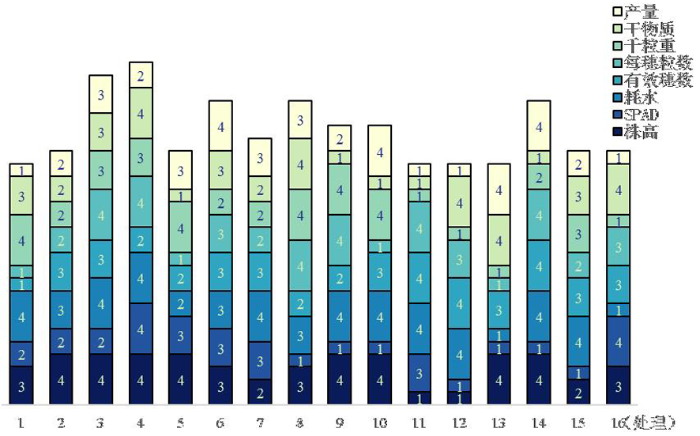
研究表明,T5处理小麦的有效穗数最高,还有T8、T9处理,高于其他处理并与其他处理的有效穗数具有显著性差异(P<0.05); T1处理有效穗数最少,约为28个。T15处理的穗粒数表现最好,与其余各处理间存在显著性差异(P<0.05),高于最低T16处理,为50.8%。T8处理千粒重与T4、T5和T9处理间无显著性差异,高于其余各处理。
灌水次数对最终有效穗数有着显著的影响,试验中灌水8次(灌浆期灌水3次)时春小麦有效穗数最多,在灌浆期适当增加灌水次数可提高小麦有效穗数、穗粒数、千粒重、干物质积累以及产量。
表6 不同处理下春小麦产量及产量构成因素的变化
Tab.6
| 处理 Treatments | 有效穗数 Effective number of spikes (个/盆) | 每穗粒数 Number of grains per spike (grains) | 千粒重 Thousand grain weight (g) | 干物质 Dry matter (g) | 产量(g/盆) Yield (g/pot) |
|---|---|---|---|---|---|
| T1 | 27.96±1.41e | 26±1.41bcd | 51.6±1.27b | 1.21±0.33abcde | 37.51±0.77e |
| T2 | 41.95±1.41bc | 32.5±2.12a | 49.45±0.35bc | 1.88±1.45ab | 67.41±1.65a |
| T3 | 41.5±0.71bc | 27.5±2.12abc | 54.65±0.64a | 1.29±0.24abcd | 68.37±5.14ab |
| T4 | 44.04±1.41ab | 28.5±0.71abc | 53.15±0.78ab | 0.53±0.05de | 66.70±4.77a |
| T5 | 47.49±0.71a | 24.5±0.71cd | 52.35±0.64ab | 0.87±0.05cde | 60.90±0.11ab |
| T6 | 38.48±2.12c | 22.5±0.71d | 48.3±1.41c | 1.27±0.48abcde | 41.81±2.21cde |
| T7 | 40.54±2.12bc | 31.5±2.12a | 47.65±0.64c | 2.12±0.41a | 60.84±6.46ab |
| T8 | 46.59±0.71a | 28±2.83abc | 50.45±0.92bc | 0.36±0.19de | 65.80±8.83a |
| T9 | 46.49±2.12a | 29.5±0.71ab | 52±0.99b | 0.74±0.45cde | 71.32±3.60a |
| T10 | 39.96±2.83bc | 25.5±0.71bcd | 51.25±2.05bc | 1.13±0.5bcde | 52.22±3.05bc |
| T11 | 30.56±2.12de | 29.5±2.12ab | 43.85±0.35d | 1.05±0.37bcde | 39.53±5.26de |
| T12 | 31.41±2.12de | 23.5±2.12cd | 43.1±0.85d | 0.34±0.03de | 31.81±1.35e |
| T13 | 38.46±2.12c | 27±1.41bc | 41.4±1.84d | 0.32±0.07e | 42.99±2.71cde |
| T14 | 32.61±2.12d | 30.5±2.12ab | 48.9±0.85c | 0.97±0.3bcde | 48.63±7.37cd |
| T15 | 41.08±1.41bc | 32.5±2.12a | 53.6±0.99ab | 1.59±0.65abc | 71.56±8.44a |
| T16 | 39.42±2.12c | 21±1.41d | 40.75±0.78d | 0.49±0.15de | 33.73±0.18e |
图3
2.2.4 关联规则
图4
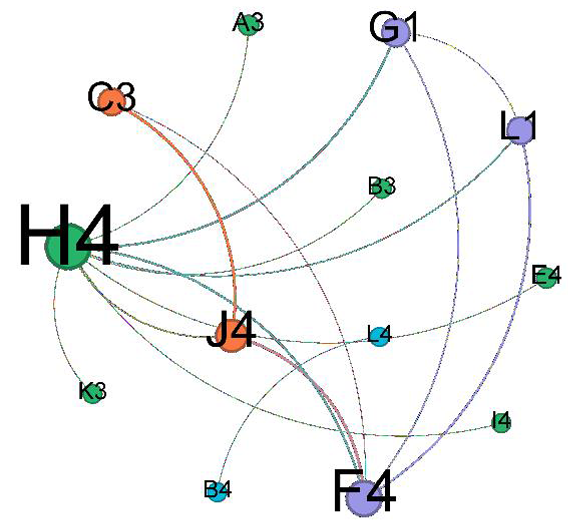
表7 关联规则
Tab.7
| 项目 Items | 关联规则 Correlation rule | 支持度 Sup | 置信度 Confi | 提升度 Lift |
|---|---|---|---|---|
| 耗水相关 Water consumption- related | J4->H4 | 0.312 5 | 0.833 3 | 1.333 3 |
| K3->H4 | 0.187 5 | 1 | 1.6 | |
| B3->H4 | 0.25 | 1 | 1.6 | |
| A3->H4 | 0.25 | 1 | 1.6 | |
| I4->H4 | 0.187 5 | 1 | 1.6 | |
| J4, E4->H4 | 0.187 5 | 1 | 2.667 | |
| A3, G1->H4 | 0.187 5 | 1 | 1.6 | |
| G1, L1->H4 | 0.187 5 | 1 | 1.6 | |
| C3, J4, F4->H4 | 0.187 5 | 1 | 1.6 | |
| G1, F4, L1->H4 | 0.187 5 | 1 | 1.6 | |
| 株高相关 Plant height- related | C3, H4->F4 | 0.187 5 | 1 | 2 |
| J4, H4->F4 | 0.25 | 0.8 | 1.6 | |
| G1, L1->F4 | 0.187 5 | 1 | 2 | |
| H4, G1, L1->F4 | 0.187 5 | 1 | 2 | |
| 干物质相关 Dry matter- related | B4->L4 | 0.25 | 1 | 3.2 |
| H4, G1, F4->L1 | 0.1875 | 1 | 2 | |
| 穗粒数相关 Number of grains- related | C3->J4 | 0.25 | 1 | 2.667 |
| C3, H4->J4 | 0.187 5 | 1 | 2.667 | |
| H4, F4->J4 | 0.25 | 0.8 | 2.133 3 | |
| C3, F4->J4 | 0.187 5 | 1 | 2.667 | |
| H4, E4->J4 | 0.187 5 | 1 | 2.666 7 | |
| C3, H4, F4->J4 | 0.187 5 | 1 | 2 | |
| 其他规则 Other rules | G1, L1->H4, F4 | 0.187 5 | 1 | 3.2 |
| G1, L1<->H4, F4 | 0.187 5 | 1 | 3.2 | |
| C3, H4<->F4, J4 | 0.187 5 | 1 | 4 | |
| C3, H4<->F4, J4 | 0.187 5 | 1 | 3.2 | |
| H4, F4, L1->G1 | 0.187 5 | 1 | 2.285 7 |
3 讨论
地膜残留量大,影响土壤水分入渗及根系生长和养分吸收[12,16]。通过采用一定的措施提高土壤肥力,能够显著的延缓小麦功能叶片的退绿黄化的衰老过程,维持较长的有效光合时间,增加干物质的积累,保障后期干物质转运效率[17,18]。为达到节水增产的目的,灌水量可适度增加,但需控制在一定范围之内,与杨晓亚等[19]的研究结果一致。灌浆期适度增加灌水次数可以提高灌溉水利用效率,是因为小麦的产量重要来源为灌浆期冠层叶[20],即在灌浆期适度增加灌水能够促进小麦旗叶生长,提高小麦叶片光合速率,达到增产效果。增加灌溉次数可以增加小麦的根长根重以及地上部生物累积量,从而提高产量和水分利用率[21]。赵世伟等[22]通过盆栽试验得到了相同的试验结果,即在灌浆—成熟期进行调亏处理会对穗粒数以及千粒重产生较大影响。试验所得结果与于振文等[23]得到的结果一致:灌水次数增加时,产量构成因素随之增加。
4 结论
4.1 灌水定额小于800 m3/hm2时,小麦株高随灌水定额的增加而增加,渗灌较其他灌溉方式更有利于小麦植株的生长。
4.2 提高土壤肥力可以减轻水分胁迫对小麦最终产量造成的不利影响。在灌浆期适度增加灌水次数能够促进小麦旗叶生长,提高小麦叶片光合速率,达到增产效果。
4.3 土质为壤土、灌水700 m3/hm2,灌溉7次时土壤含水率较高,保水性好;使用膜下滴灌可以进一步保持土壤水分。当地膜残留小于650 kg/hm2时土壤含水率能够保持在较高水平。
4.4 使用壤土种植能够有效的提高小麦水分利用效率与灌溉水利用效率,当灌水定额设定为500 m3/hm2,灌水次数为6次时水分利用效率最高。
4.5 当土质为粘壤土,灌溉方式为渗灌,灌水500 m3/hm2,灌溉次数为8,地膜残留量为0时春小麦产量达到最大值71.56 g/盆。
4.6 最高耗水量和最大穗粒数,最大有效穗数,最大株高具有强相关性;最高耗水量与最低干物质重、最低SPAD值有强关联性;最高株高与最低SPAD值呈强相关性。
参考文献
种业振兴背景下推进新疆小麦育种工作对策研究——以新疆农业科学院为例
[J].
Studies on countermeasures of promoting wheat breeding in Xinjiang under the background of seed industry revitalization, taking Xinjiang academy of agricultural sciences as an example
[J].
土壤质地对不同筋型冬小麦品种面团流变学特性的影响
[J].
Effects of soil texture on dough rheological characteristics of different gluten types of winter wheat
[J].
分期施钾对不同质地土壤麦田冬小麦干物质积累和产量的影响
[J].
为探明分期施钾对不同质地土壤麦田冬小麦产量形成的调节作用, 本研究以高产冬小麦品种太麦198为试验材料, 在沙壤土(S)和粉壤土(F)两种土壤质地试验田上, 设置不施钾肥(K0)、钾肥全部底施(100%于播种期底施, K1)和分期施钾(50%于播种期底施+50%于拔节期追施, K2) 3个处理。分析不同质地土壤条件下分期施钾对冬小麦旗叶光合特性、干物质积累与分配及籽粒产量的影响, 结果表明, 土壤质地和施钾方式互作显著影响了小麦穗粒数、花后同化干物质量和籽粒产量。在两种质地土壤条件下, 施钾显著提高冬小麦籽粒产量, 且以K2处理产量最高。与K1处理相比, K2处理穗粒数及开花后旗叶叶绿素相对含量、花后旗叶净光合速率、花后单茎干物质积累量和花后同化物向籽粒转运量均提高。在沙壤土条件下K2处理较K1处理两年度籽粒产量分别增加12.4%和10.4%, 在粉壤土条件下籽粒产量分别增加5.2%和5.4%, 说明在两种土壤质地条件下, 改钾肥全部底施为50%底施+50%拔节期追施均有显著增产作用, 但以沙壤土麦田小麦增产幅度较大。
Effects of applying potassium at different growth stages on dry matter accumulation and yield of winter wheat in different soil-texture fields
[J].To investigate the effects of potassium applying on the grain yield formation of winter wheat, the experiments were carried out on different soil textures with high-yield winter wheat variety Taimai 198. To analyze the effects of potassium application at different stages on winter wheat flag leaf photosynthetic characteristics, dry matter accumulation and distribution, and grain yield under different soil texture conditions, two soil texture test fields [sandy loam (S) and silty loam (F)] and three treatments [no potassium fertilizer (K0), potassium fertilizer base application (100% applicating at sowing, K1), and split application (50% applicating at sowing stage + 50% topdressing at the jointing stage, K2)] was arranged. The results showed that the interaction of soil texture and potassium application significantly affected the grain number per spike and dry matter assimilated after anthesis and grain yield. Under the two soil texture conditions, potassium application significantly increased the grain yield of winter wheat, and K2 treatment had the highest yield. Compared with K1 treatment, the grains number per ear, the SPAD and net photosynthetic rate of flag leaves after anthesis, the accumulation of dry matter per stem after anthesis, and the transfer of assimilation to the grain after anthesis were increased under K2 treatment. Under sandy loam conditions, grain yield of K2 treatment was by 12.4% and 10.4% higher than that of K1 treatment, respectively. Under silt loam conditions, grain yield was by 5.2% and 5.4% higher than that of K1 treatment. Those results indicated that wheat yield was significantly increased by changing potassium fertilizer base application to 50% base application with 50% topdressing at jointing stage, and the wheat yield was higher in sandy loam field.
引黄灌溉对土壤质地和小麦产量影响的试验研究
[J].
Study on the effect of irrigation from the Yellow River on soil texture and wheat yield
[J].
华北平原土壤剖面质地构型对小麦产量的影响研究
[J].
Impact of soil profile texture pattern(SPTP) on wheat yield in North China Plain
[J].
滴灌施肥对免耕冬小麦水分利用及产量的影响
[J].【目的】为解决黄淮海平原麦区冬小麦滴灌用水量和合理的水肥配合等问题,以山东省桓台县免耕农田为试验点,系统研究了滴灌施肥对土壤水分垂直运移、冬小麦产量及其构成因素、水分利用效率等的影响。【方法】采用测墒补灌和生育期滴灌施肥相结合的方法,以常规漫灌施肥处理为对照。设置65 mm(W1)、98 mm(W2)、130 mm(W3)、195 mm(W4)和260 mm(W5)5个滴灌梯度水平处理。在130 mm滴灌水平下,分别于冬小麦的分蘖期、拔节期、孕穗期、扬花期和灌浆期5个生育时期设置相应的氮磷钾肥料配比,采用氮磷钾3个因素,每个因素4个水平的二次饱和D-最优设计方法进行田间试验。氮、磷、钾4个水平分别为:0水平(0、0、0),1水平(94.5、42.4、59.2 kg•hm-2),2水平(189、84.7、118.3 kg•hm-2)和3水平(270、121、169 kg•hm-2)。【结果】测墒补灌试验结果表明,W1、W3和W5处理滴灌后土壤水分主要向下运移至60、80和100 cm以下土层。滴灌量越大,土壤水分垂直运移深度越大。滴灌量260 mm时存在灌溉水深层渗漏的风险;W1处理在整个生育期土壤含水量明显低于其他滴灌处理,滴灌量130 mm以上的处理,整个生育期0—80 cm土层的含水量为田间持水量的75%—80%;滴灌施肥处理与常规漫灌施肥处理相比显著增加了冬小麦的有效穗数,不同滴灌处理中灌溉量与穗粒数呈正相关关系,与千粒重呈负相关关系;滴灌量130 mm时,小麦籽粒产量最高;滴灌显著提高了冬小麦的水分利用效率,并以W3处理最高,达2.28 kg•m-3;对滴灌施肥试验的拟合结果表明,试验区冬小麦最佳N、P2O5和K2O施用量分别为206.63、86.72和88.07 kg•hm-2。【结论】在黄淮海平原地区免耕冬小麦采用测墒补灌和滴灌施肥相结合的方法可以显著提高水分利用效率和小麦籽粒产量,较常规对照分别提高了57.46%和21.13%。主要原因是滴灌后水分向下运移至作物根区内,减少了灌溉水深层渗漏的风险,促进了作物对随水施入肥料的吸收。合理的滴灌施肥配比下总体可节水51.85%,节约氮肥23.47%、磷肥28.33%和钾肥47.89%。
Effects of drip fertigation with No-tillage on water use efficiency and yield of winter wheat
[J].【Objective】On the issues of drip irrigation water consumption and rational application of water and fertilization in the winter wheat belt region of Huang-Huai-Hai Plain, no-tillage fields were chosen as experimental sites located in Huantai, Shandong Province to carry out a systematic study on the effects of drip fertigation on soil moisture vertical migration, winter wheat grain yield and its components and water use efficiency (WUE).【Method】The study adopted the methods of irrigation recharge by measuring soil moisture and drip fertigation in the main growth period compared with conventional flood irrigation and fertilization treatment. Five drip irrigation level treatments including 65 mm (W1), 98mm (W2), 130 mm (W3), 195 mm (W4) and 260 mm (W5) were designed. The corresponding NPK ratio was set up at tillering stage, joining stage, booting stage, young flowering and filling stages of winter wheat under the 130mm of irrigation treatment level and 3 factors of NPK and 4 levels quadratic saturation D-optimization design were adopted for field experiment. The 4 levels of N, P, K were that “0 level” with 0, 0, 0, “1 level” with 94.5, 42.4 and 59.2 kg•hm-2, “2 level” with 189, 84.7 and 118.3 kg•hm-2, “3 level” with 270, 121 and 169 kg•hm-2.【Result】The results of experiment showed that the more drip irrigation amount is, the deeper soil moisture vertical migration will be, the soil moisture vertical migration of W1, W3 and W5 treatments moved to 60, 80 and 100 cm, and could get risk of water percolation while drip irrigation level achieved 260 mm. Soil moisture content of W1 treatment was obviously lower than others, 130 mm and above drip irrigation treatment made soil moisture content at 0-80 cm soil layers over 75%-80% of the field moisture capacity during the growth period. Compared with conventional flood irrigation and fertilization treatment, the drip fertigation significantly increased the effective panicles of winter wheat. The drip irrigation amount had a positive correlation with grain number per spike and a negative correlation with 1000-grain weight in different drip irrigation treatments. The grain yield was the highest when irrigation amount was 130 mm. Drip irrigation apparently increased water use efficiency (WUE) and with the highest of W3 treatment that was 2.28 kg•m-3. Experimental fitting results indicated that the optimal fertilizer amount of N, P2O5 and K2O in pilot area was 206.63, 86.72 and 88.07 kg•hm-2. 【Conclusion】It was concluded that the winter wheat in no-tillage fields by irrigation recharge by measuring soil moisture and drip fertigation significantly increased, WUE and yield by 57.46% and 21.13% in Huang-Huai-Hai Plain, respectively, compared with conventional treatment. The main reason was that the water moved to crop roots area after drip irrigation that could reduce the risk of water percolation and promote fertilizer-absorbing with water. The rational ratio of drip fertigation could totally make water saving by 51.85%, N, P, K fertilizer saving, respectively, by 23.47%, 28.33% and 47.89%.
不同灌溉方式对保护地土壤水稳性团聚体的影响
[J].
Effect on soil water-stable aggregates of different irrigation methods in protected field
[J].
水分对小麦生长发育的影响
[J].
Effect of water on the growth and development of wheat
[J].
不同灌溉方式对冬小麦光合速率及产量的影响
[J].
Effects of different irrigation methods on photosynthetic rate and yield of winter wheat
[J].
残留地膜对农业环境影响的研究初报
[J].
A tentative report on the study of the impact on agriculture environment due to the remalinder plastic sheet covered the soils
[J].
残留地膜对玉米生长发育和产量影响研究
[J].
Effects of plastic film residue on growth and yield of maize
[J].
覆膜滴灌棉田地膜残留量对棉花生长的影响
[J].为了阐明覆膜滴灌棉田地膜残留对棉花生长的影响,结合绿洲覆膜滴灌棉田残膜累积特点,设计对应覆膜年限为5 a、10 a、15 a、20 a、25 a、30 a共6个不同残膜累积梯度,利用桶栽试验,分析了不同覆膜年限棉田中残膜累积对棉花生长和产量的影响。结果表明:残膜对棉花地上部株高和叶面积影响显著,随残膜量的增加株高和叶面积逐渐降低,当覆膜滴灌20 a时各时期株高和叶面积均显著减小。覆膜滴灌20 a时残膜量的增加开始显著降低棉花地下部根系指标,与CK相比,覆膜滴灌20 a的根长密度降低8.2%,根表面积密度降低10%,根体积降低7.2%,根系直径降低19.4%。残膜量与棉花干物质积累量和产量呈显著负相关,覆膜滴灌20 a后相比于CK,地上部干物质量降低20.3%,根部干物质量降低38.4%;棉花产量相比新疆近5 a地区平均单位面积产量降低10.96%。残膜量的增加对棉花的正常生长影响显著,当覆膜滴灌年限达到15~20 a时,棉花的生长与根系指标和产量显著降低。研究结果可为新疆滴灌棉田可持续发展提供理论依据。
Effect of film mulching residue on cotton growth in drip irrigation cotton field
[J].To clarify the influence of film residue on cotton growth in a field with film mulching under drip irrigation, we assessed the characteristics of residual film accumulation in an oasis drip irrigation cotton field. The design corresponds to 5 a, 10 a, 15 a, 20 a, 25 a, 30 a; a gradient of six residual film accumulations using a barrel-planting experiment. We analyzed the influence of residual film accumulation in cotton fields with different mulching years on cotton growth and yield. The residual film significantly affected cotton plant height and leaf area, which gradually decreased as the residual film amount increased. The plant height and leaf area were significantly reduced at each stage when the film was covered with drip irrigation for 20 years. Additionally, increases in the amount of residual film in drip irrigation for 20 years significantly reduced the cotton root index. Compared with the control treatment without residual film, the root length density in drip irrigation 20 a was reduced by 8.2%, the root surface area density was reduced by 10%, the root volume was reduced by 7.2%, and the root diameter decreased by 19.4%. The amount of residual film was significantly negatively correlated with cotton dry matter accumulation and yield. After 15 years of drip irrigation with film mulching, the cotton yield was lower than the average yield per unit area in Xinjiang in the past five years. After 20 years of drip irrigation with film mulching, the above-ground dry matter quality decreased by 20.3%, the root dry matter quality was reduced by 38.4%, and the output was 10.96% lower than the average output per unit area in Xinjiang in the past five years. In summary, increased amounts of residual film significantly impact the normal growth of cotton. When drip irrigation with film mulching continues for 15-20 years, yield, growth, and root indices of cotton are significantly reduced. The research results can provide a theoretical basis for the sustainable development of drip irrigation cotton fields in Xinjiang.
不同灌水定额对膜下滴灌玉米耗水及产量的影响
[J].
Effects of different irrigation quotas on water consumption and yield of maize under drip irrigation
[J].
耕作方式和水分处理对棉花生产及水分利用的影响
[J].
Effect of tillage methods and water treatment on production and water use of cotton
[J].
我国棉田残膜污染危害与治理措施研究进展
[J].地膜覆盖技术的应用为我国棉花产量提升做出重大贡献。但随着聚乙烯地膜的长期使用,土壤残膜污染问题日益突出,影响棉田土壤环境和棉花可持续发展。综述了我国棉田地膜残留现状、分布特征及其对棉花生长的危害,从土壤结构变化、水分迁移状况、有害物质释放、土壤物质代谢、微生物种群结构等方面系统总结了棉田残膜污染的危害机制,归纳了现阶段我国棉田残膜污染防控技术的研究进展及优势与不足,并对残膜污染防控策略及发展趋势进行了展望,为我国棉田残膜污染治理技术的研究提供科学参考。
Research progress on pollution hazards and prevention measures of residual film in cotton field in China
[J].
土壤肥力和灌水量组合对不同类型小麦光合特性及产量的影响
[J].旨在为小麦节水高产栽培提供理论依据。在池栽条件下,研究了不同土壤肥力和灌水量组合对中筋小麦‘济麦22’和强筋小麦‘济麦20’旗叶净光合速率(Pn)、叶绿素荧光参数及产量构成的影响。2种小麦开花后各生育时期旗叶的光合速率Pn 值、叶绿素荧光参数Fv/Fm 值(PSⅡ最大光化学量子产量)和ФPSⅡ 值(PSⅡ实际光化学量子产量)均随着土壤肥力和灌水量的增加而提高,但土壤肥力因素对上述光合特性指标的影响大于灌水方式因素。随着土壤肥力的提高,Pn 和ФPSⅡ 开始下降的时间逐渐向后延迟,提高土壤肥力有利于减轻环境胁迫对光合的抑制作用。对于2 种小麦的产量和产量构成的影响,土壤肥力和灌水方式之间具有补偿效应。在土壤肥力较高的条件下,2 种小麦限量灌溉和充分灌溉之间产量差异并不显著。培肥地力可以减缓小麦灌水不足导致的光合性能指标的下降,维持生育后期较高的光合产物积累水平。
Combination of soil fertility and irrigation: effect on photosynthetic characteristics and yield of different-type wheat
[J].The aim is to provide a basis for water saving and high yield cultivation of wheat. In the condition of pond culture, the effects of different combinations of soil fertility and irrigation on the photosynthetic rate (Pn), chlorophyll fluorescence parameters and yield of medium-gluten wheat‘Jimai 22’and strong-gluten wheat ‘Jimai20’were studied. The results showed that Pn, chlorophyll fluorescence parameters Fv/Fm (the maximum photochemical efficiency) andФ PSⅡ (actual photochemical efficiency) of flag leaf after anthesis were promoted with the increase of soil fertility and irrigation amount. The effect of fertility on photosynthetic characteristics was more significant than that of irrigation. With the increase of soil fertility, the starting time of Pn and ФPS Ⅱ declining delayed gradually. The improvement of soil fertility was useful to reduce the inhibition of photosynthesis by environmental stress. There was a compensation effect between soil fertility and irrigation for the influence on the yield and yield composition of the two wheat cultivars. Under high soil fertility, the yield differences of the two wheat cultivars were not significant between limited irrigation and fullirrigation conditions.Improving soil fertility could relief the declining photosynthetic character index due to insufficient irrigation, and sustain a higher level of photosynthetic product accumulation at later growth stage.
土壤肥力对高产小麦品种烟农1212旗叶叶绿素荧光特性和产量的影响
[J].
Effect of different soil fertility on chlorophyll fluorescence characteristics and yield in high-yielding wheat variety yannong 1212
[J].
灌水量和灌水时期对小麦耗水特性和氮素积累分配的影响
[J].
Effects of irrigation regimes on water consumption characteristics and nitrogen accumulation and allocation in wheat
[J].
限水灌溉对冬小麦旗叶某些光合特性的影响
[J].
Effects of limited irrigation on some photosynthetic functions of flag leaves i n winter wheat
[J].
不同时期干旱对强筋小麦产量与品质特性的影响
[J].
Effect of drought at different growing stages on yield and quality characteristics of strong-gluten wheat
[J].
不同生育期干旱对冬小麦产量及水分利用效率的影响
[J].
Effects of water deficits on yield and WUE in winter wheat
[J].
高产低定额灌溉对冬小麦旗叶衰老的影响
[J].
Effect on senescence of flag leaf in winter wheat under high yield-low norm irrigation conditions
[J].
喷灌与地面灌溉条件下冬小麦籽粒灌浆过程特性分析
[J].
Analysis on grain filling characteristics of winter wheat under sprinkler irrigation and surface irrigation conditions
[J].


