

0 引言
【研究意义】新疆冬小麦播期在10中旬到11月中旬[1-2]。近年来,超晚播小麦面积逐渐增大,而冬前叶龄低于3片叶的小麦,最晚播的小麦冬前甚至不出苗[3],所以需补足当年小麦播种面积[4]。新疆北疆塔额地区冬天降雪较大,超晚播冬麦可有效利用积雪融水,从而节约出苗水和越冬水[5]。但超晚播小麦相对于适播小麦出苗率较低[6],分蘖少,产量低[7]。灌水和施肥是调控作物生长和产量形成的重要因素[8],研究水肥配施对超晚播小麦影响具有重要意义。【前人研究进展】不同灌水量和施氮量对小麦群体动态均具有一定的调控效应,且灌水调控效应大于施氮效应[9]。适当调亏水分有利于小麦氮素利用[10],同样适量施肥可促进小麦根系对水分的吸收从而提高水分利用率[11]。合理的水肥运筹能够提高植株对养分的吸收和运输,有助于协调植株的生长,可构建合理群体提高产量[12]。【本研究切入点】目前,相关文献大多围绕品种、春麦冬播对超晚播冬小麦展开研究[13],而对于其最佳的水氮运筹模式研究较少。故需进一步对新疆北疆超晚播小麦水氮配施效应进行研究。【拟解决的关键问题】试验研究不同的水氮处理组合对超晚播小麦农艺性状、干物质积累、水分利用及产量的影响,筛选出最佳的水氮处理组合,为新疆北疆超晚播小麦高产高效栽培提供理论依据。
1 材料与方法
1.1 材料
试验于2022年10月~2023年7月在塔城地区农业科学研究所(46°21'N,82°41'E)进行,海拔高度415 m,土壤类型为沙壤土,前茬作物为玉米。试验前0~20 cm土层土壤基础养分为pH 8.36,有机质含量23.57 g/kg,全氮0.34 g/kg,碱解氮45.37 mg/kg,有效磷18.60 mg/kg,速效钾205.00 mg/kg。供试肥料为尿素,含氮量为46%。供试品种为当地主栽品种新冬18号。
1.2 方法
1.2.1 试验设计
表1 不同处理下冬小麦各生育时期灌水量
Tab.1
| 处理 Treatments | 起身期灌水量 Seedling stage | 拔节期灌水量 Jointing stage | 孕穗期灌水量 Booting stage | 开花期灌水量 Anthesis | 灌浆期灌水量 Filling stage | 总量 Total capacity |
|---|---|---|---|---|---|---|
| W1 | 250 | 750 | 750 | 500 | 500 | 2 750 |
| W2 | 350 | 1 000 | 1 000 | 700 | 700 | 3 750 |
| W3 | 450 | 1 250 | 1 250 | 900 | 900 | 4 750 |
表2 不同处理下冬小麦各时期追施尿素量
Tab.2
| 处理 Treat- ments | 起身期 施用量 Seedling stage | 拔节期 施用量 Jointing stage | 孕穗期 施用量 Booting stage | 总量 Total capacity |
|---|---|---|---|---|
| N0 | 0 | 0 | 0 | 0 |
| N1 | 30 | 90 | 60 | 180 |
| N2 | 90 | 150 | 120 | 360 |
| N3 | 120 | 240 | 180 | 540 |
1.2.2 测定指标
1.2.2.1 生育进程
调查并记录小麦的出苗期、拔节期、孕穗期、开花期和成熟期的时期,并记录小麦生育期的天数。
1.2.2.2 株高及叶面积指数
从拔节期开始,每个小区选取长势均匀一致的小麦 10 株测定其主茎高度,将每株植株绿叶取下后测量其长度和最宽处的宽度,相乘以后在乘以系数 0.83,取其平均值,根据群体茎数测定群体叶面积指数(LAI)等主要农艺性状参数。
1.2.2.3 干物质积累量
于冬小麦拔节期、孕穗期、开花期,灌浆前期、灌浆前期、成熟期,每小区取具有代表性的15株小麦,去根后将植株分为叶片、茎鞘、颖壳和穗轴、籽粒部分,分别称量鲜重后,放入105℃烘箱中杀青15 min,80℃烘至恒重后称干重,分别测定小麦植株各部分的干物质重量。
1.2.2.4 耗水量及水分利用率
土壤贮水量(mm)=土壤重量含水量(%)×土壤深度(cm)×土壤容重(g/cm3)×10;
耗水量(mm)=播前0~100 cm土壤贮水量(mm)+生育期间自然降水量(mm)+灌水量(mm)-收获期土壤贮水量(mm);
水分利用效率(kg/m3)=籽粒产量(kg/hm2)/小麦生育期间耗水量(mm)。
1.2.2.5 氮肥利用率
氮肥农学利用率(kg/kg)=(施氮区籽粒产量kg/hm2-未施氮区籽粒产量kg/hm2)/施氮量(kg/hm2);
氮肥偏生产力(kg/kg)=籽粒产量(kg/hm2)/施氮量(kg/hm2)。
1.2.2.6 产量及其构成因素
小麦成熟后,在各处理每个小区内长势一致的区域,取1 m2调查穗数收获脱粒计产。选取具有代表性的小麦10株考种室内,测量千粒重、单株穗数、穗粒数等指标。
1.3 数据处理
用Excel2021和DPS7.05统计软件进行数据处理和统计分析。
2 结果与分析
2.1 不同水氮处理对冬小麦生长指标的影响
2.1.1 对冬小麦生育时期的影响
研究表明,随着灌水量和施氮量增大冬小麦生育期延长,W2、W3处理较W1处理平均延长3、4.75 d,N0较N2、N3缩短3.34、4.34 d。其中,W3较W1处理,进入拔节期提前,进入孕穗期、开花期、灌浆期分别推迟。灌水量增大(W3处理)主要延长了拔节-孕穗、孕穗-开花的进程进而导致生育期延长,各处理差异显著,施氮量的增大同样导致生育期的延长,但N2、N3之间差异不显著。表3
表3 不同水氮条件下冬小麦各生育时期
Tab.3
| 处理 Treatments | 生育进程(月/日)Growth process(M/D) | 生育期 Growth period(d) | |||||
|---|---|---|---|---|---|---|---|
| 苗期 Seedling | 拔节期 Jointing | 孕穗期 Booting | 开花期 Flowing | 成熟期 Maturity | |||
| W1 | N0 | 3/12 | 5/3 | 5/12 | 5/24 | 7/4 | 113 |
| N1 | 3/12 | 5/3 | 5/13 | 5/26 | 7/4 | 113 | |
| N2 | 3/12 | 5/3 | 5/13 | 5/27 | 7/6 | 115 | |
| N3 | 3/12 | 5/3 | 5/14 | 5/27 | 7/6 | 115 | |
| W2 | N0 | 3/12 | 5/1 | 5/12 | 5/26 | 7/6 | 115 |
| N1 | 3/12 | 5/1 | 5/14 | 5/29 | 7/6 | 115 | |
| N2 | 3/12 | 4/30 | 5/15 | 5/31 | 7/10 | 119 | |
| N3 | 3/12 | 4/30 | 5/15 | 6/1 | 7/10 | 119 | |
| W3 | N0 | 3/12 | 4/28 | 5/14 | 5/26 | 7/6 | 115 |
| N1 | 3/12 | 4/28 | 5/14 | 5/31 | 7/8 | 117 | |
| N2 | 3/12 | 4/27 | 5/16 | 6/2 | 7/12 | 121 | |
| N3 | 3/12 | 4/27 | 5/16 | 6/3 | 7/13 | 122 | |
2.1.2 对冬小麦株高的影响
研究表明,随着灌水量的增加冬小麦株高呈先增大后减小的趋势。其中拔节期至孕穗期增长速率最快,且随着灌水量和施氮量的增加而增加,不同灌水处理下,N2、N3均显著高于N0、N1;开花到成熟期,施氮量增大,W1处理下株高呈增大趋势,而W2、W3处理则呈先增后降的趋势,N2达到最大,与N3无显著差异,但显著高于N1、N0。适量灌水量有利于冬小麦株高增长,施氮量在N2下,继续增施氮肥对株高无影响。其中W2N2株高达到87.11 cm,在此基础上持续增大灌水量和施氮量对冬小麦株高无显著性影响。图1
图1
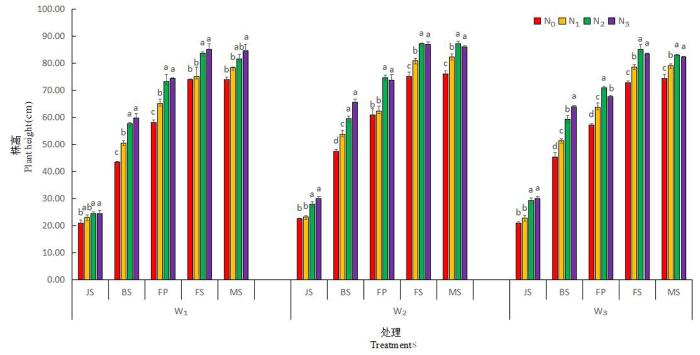
图1
不同水氮处理下冬小麦生育时期株高的变化
注:JS 拔节期; BS 孕穗期; FP 开花期; FS灌浆期; MS 成熟期
Fig.1
Changes of dynamic changes of plant height in different water and nitrogen treatments during winter wheat growth period
Notes: JS: Jionting stage; BS: Booting stage; FP: Flowering stage; FS: Filling stages;MS:Full ripe stage
2.1.3 对冬小麦叶面积指数的影响
研究表明,灌水量和施氮量均对冬小麦叶面积指数有显著影响,且在各生育时期变化趋势相同,随着生育进程的推移,呈先增后降的趋势,在孕穗期达到峰值。W1灌水量下,随着施氮量的增加,叶面积不断增加,且N2、N3显著高于N1、N0,W2、W3灌水下,表现为N2>N3>N1>N0,在W2N2(6.59 m2/m2)达到最大,但N2、N3无显著差异。在同一施氮量下,随着灌水量的增加,呈不断增加的趋势,W2显著高于W1,与W3无显著差异。增加灌水量可显著提高叶面积指数,同时增加灌水量和施氮量比单独增加差异更显著,所有处理以W2N2的叶面积指数最大。图2
图2
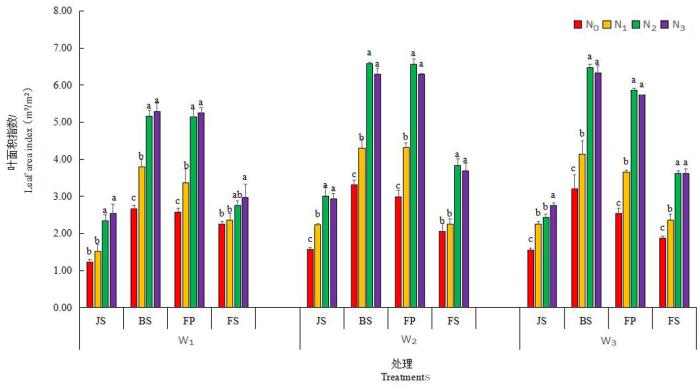
图2
不同水氮处理下冬小麦生育时期叶面积指数的变化
注:JS 拔节期; BS 孕穗期; FP 开花期; FS灌浆期
Fig.2
Changes of dynamic change of leaf area index in different water and nitrogen treatment during winter wheat growth period
Notes: JS: Jionting stage; BS: Booting stage; FP: Flowering stage; FS: Filling stages
2.2 不同水氮处理对小麦干物质积累的影响
研究表明,灌水量和施氮量均对小麦干物质积累有显著影响。在W1灌水处理下,增加施氮量,则干物质积累量显著增加,成熟期W1N3较W1N1、W1N2高19.84%、13.65%。W2、W3处理下,随着施氮量增加呈先增后减的趋势,在N2处理下达到最大,且显著高于N0、N1,与N3差异不显著。在N0、N1施氮处理下,干物质积累量随着灌水量的增加而增加,W2、W3显著高于W1处理,在N2、N3处理下,随灌水量的增加呈先增后减趋势,在W2处理下达到最大,W2N2较W1N2、W3N2高20.12%、8.38%,在灌水量较高的情况下增加施氮量不利于小麦干物质的积累,适当的灌水量和施氮量可保证小麦干物质的积累量,在W2N2达到最大。图3
图3
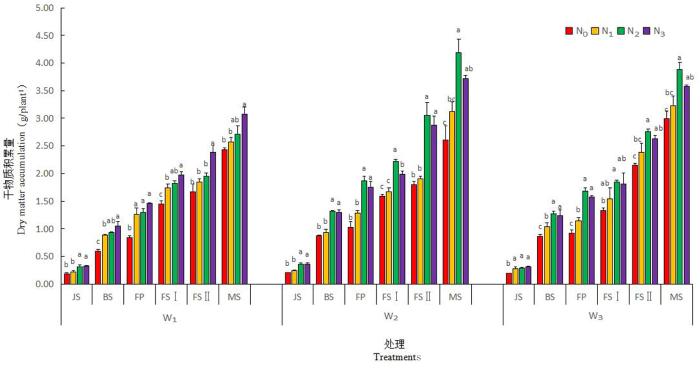
图3
不同水氮处理下冬小麦干物质积累量的变化
注:JS 拔节期; BS 孕穗期; FP 开花期; FSⅠ灌浆前期; FSⅡ灌浆后期; MS 成熟期
Fig.3
Changes of dry matter accumulation in different water and nitrogen treatment during winter wheat growth period
Notes: JS: Jionting stage; BS: Booting stage; FP: Flowering stage; FSⅠ: Early grain filling stage; FSⅡ: Mid grain Filling stage; MS:Full ripe stage
2.3 不同水氮处理对冬小麦水氮利用效率的影响
研究表明,冬小麦总耗水量随着灌水处理的升高而增加,灌水量和施氮量均对水分利用效率指标影响显著。同一施氮水平下,随着灌水量增加,土壤耗水量显著减少,而总耗水量增加,水分利用效率大均呈先增加后下降的趋势,并在W2N2处理下达到最高16.80 kg/hm2处,显著高于其它处理。W1水平下随着施氮量的增加,土壤耗水量增加,总耗水量增加,水分利用率显著增加。W2、W3水平下,除N0外土壤耗水量及水分利用率先增加后降低,有显著差异。W2、W3下氮肥农学利用效率、氮肥偏生产力均随施氮量的增加而降低,在N2处理下,W3(16.34 kg/kg)、W1(8.25 kg/kg)显著低于W2(26.38 kg/kg),氮肥偏生产力同样存在显著差异。过量的灌水不能使冬小麦对土壤水分进行充分的吸收,从而导致水分利用效率降低,适量的增施氮肥有利于提高冬小麦的水分利用效率。增加滴灌量可显著提高氮肥偏生产力,适宜的滴灌量和施氮量可有效提高氮肥农学利用效率。表4
表4 不同水氮条件下冬小麦耗水特性及水分利用率的变化
Tab.4
| 处理 Treat- ments | 总灌水量 Total irrigation (m3/hm2) | 降水量 Precipitation (m3/hm2) | 土壤耗水量 Soil water consumption (m3/hm2) | 总耗水量 Toal water consumption (m3/hm2) | 水分利用效率 Water use efficiency (kg/m3) | 氮肥农学 利用效率 Agronomic nitrogen useefficiency (kg/kg) | 氮肥偏生产力 Nitrogen Partial productivity (kg/kg) | |||||||||
|---|---|---|---|---|---|---|---|---|---|---|---|---|---|---|---|---|
| W1 | N0 | 2 750 | 627 | 1 930.00b | 5 307.00f | 10.00g | / | / | ||||||||
| N1 | 2 750 | 627 | 1 920.99b | 5 297.99e | 10.56g | 3.62e | 67.55c | |||||||||
| N2 | 2 750 | 627 | 2 170.12a | 5 547.12f | 12.03e | 8.25d | 40.21f | |||||||||
| N3 | 2 750 | 627 | 2 210.28a | 5 587.28de | 14.03b | 10.23cd | 31.62g | |||||||||
| W2 | N0 | 3 750 | 627 | 1 230.24d | 5 607.24de | 9.61h | / | / | ||||||||
| N1 | 3 750 | 627 | 1 310.60cd | 5 687.60cde | 12.00e | 17.70b | 82.32a | |||||||||
| N2 | 3 750 | 627 | 1 420.35c | 5 797.35c | 16.80a | 26.38a | 58.69d | |||||||||
| N3 | 3 750 | 627 | 1 330.62cd | 5 707.62cd | 14.38b | 11.50c | 33.13g | |||||||||
| W3 | N0 | 4 750 | 627 | 830.48e | 6 207.48a | 9.06i | / | / | ||||||||
| N1 | 4 750 | 627 | 580.73f | 5 957.73b | 10.61f | 8.38d | 76.21b | |||||||||
| N2 | 4 750 | 627 | 720.06ef | 6 097.06ab | 13.68c | 16.34b | 50.25e | |||||||||
| N3 | 4 750 | 627 | 610.25f | 5 987.25b | 13.32d | 9.46cd | 32.16g | |||||||||
注:不同小写字母表示在同一灌水水平下的不同处理间差异显著(P<0.05),下同
Notes: Different lowercase letters at the same time indicate significant differences among treatments at the same irrigation level(P<0.05),the same as below
2.4 不同水氮处理对冬小麦产量的影响
研究表明,随着施氮量和灌水量的增加,穗数除N0、N1处理外,各灌水量水平下差异并不显著;随着灌水量和施氮量的增加穗粒数显著增加;同一灌水量下千粒重随着施氮量的增加呈降低的趋势,但并不显著;灌水量施氮量对产量均有显著差异,在W1的处理下,随着施氮量的增加,产量持续增加的趋势在W1N3(8 009.70 kg/hm2)处理下产量达到最高。在W2、W3处理下,随着追氮量的增加,产量呈先增加后降低的趋势,在W2N2(9 743.01 kg/hm2)处理下产量达到最高。在同一施氮量处理下,随着灌水量的增加,产量均呈先增加后降低的趋势,均在W2灌水条件下产量达到最高。同时增加灌水量和追氮量,W2N2(9 743.01 kg/hm2)较W1N1(5 606.66 kg/hm2)增产了73.78%,W3N3(8 109.57 kg/hm2)较W2N2(9 743.01 kg/hm2)减产了16.77 %;水氮对冬小麦穗粒数有显著影响,水分对千粒重有显著影响,W3N3处理下冬小麦千粒重降低,从而导致产量降低。表5
表5 不同水氮条件下冬小麦产量及产量构成
Tab.5
| 处理 Treat- ments | 穗数 Spike (104/hm2) | 穗粒数 Grains per spike | 千粒重 1000-grain weight (g) | 产量 Yield (kg/hm2) | ||
|---|---|---|---|---|---|---|
| W1 | N0 | 601.24d | 28.67e | 41.93cde | 5 306.44d | |
| N1 | 606.24cd | 33.67cd | 41.07de | 5 606.66d | ||
| N2 | 636.62bcd | 35.33bc | 40.69de | 6 675.33c | ||
| N3 | 677.35ab | 38.53b | 40.51e | 7 842.79b | ||
| W2 | N0 | 610.92cd | 29.93de | 44.03a | 5 364.13d | |
| N1 | 679.02ab | 37.80b | 43.91a | 6 833.14c | ||
| N2 | 688.37a | 46.27a | 43.61ab | 9 743.01a | ||
| N3 | 684.70a | 44.20a | 42.96abc | 8 216.85b | ||
| W3 | N0 | 605.58cd | 32.13cd | 44.15a | 5 629.79d | |
| N1 | 608.25cd | 38.73b | 42.92abc | 6 325.64c | ||
| N2 | 672.01ab | 46.27a | 42.80abc | 8 342.04b | ||
| N3 | 649.98abc | 45.47a | 42.28bcd | 7 976.05b | ||
3 讨论
3.1 在小麦生产过程中,适宜的水氮运筹是小麦生产的重要目标,可在提高小麦产量的同时保证资源的高效利用[14,15]。水氮对作物生长发育的影响互不相同,小麦则是依靠水、氮的相互作用,共同的影响而形成的[16]。研究认为叶片是植株进行光合作用的主要器官,叶面积大小对小麦干物质形成有较大的影响[17],合理水氮有利于孕穗期叶面积指数的增大,从而提高开花至成熟期干物质积累量和成熟期生物产量[18]。干物质是衡量植物体内营养成分,有机物含量的指标[19],水分过少影响了小麦营养生长,导致干物质积累量下降,产量降低[20]。适宜的水分条件,干物质积累较快,成熟期生物量最大;水分过多导致前期营养生长过旺,营养物质向籽粒中的转运较低,成熟时生物量降低[21]。研究表明,在W1处理下,随着施氮量增加,冬小麦株高不断增加,而在W3处理下,随着施氮量的增加,冬小麦株高反而呈降低趋势,在灌水量较高的情况下,过多的投入氮肥则会对植株生长产生负效应,而在低灌水量条件下,适量条件下增施氮肥有利于冬小麦生长发育,与冉文星[22]所研究一致。随着生育时期不断推进,各处理叶面积指数均呈先增后减的趋势,均在孕穗至扬花期达到最大。W1N0限制了冬小麦叶面积指数的增长,从而影响冬小麦的光合作用。在W1灌水量下,冬小麦干物质随着施氮量的增加而增加,在W2、W3处理下,干物质的积累在达到一定量之后开始逐渐下降,表现为N2>N3>N1。在同一施氮量下,总体表现为N2处理大于N3处理,导致在W1灌水处理下,随着施氮量的增加,产量在W1N3时最高,在同一施氮量下,产量及各因子随着灌水量的增加呈上升趋势,在W2N2(9 743.01 kg/hm2)时达到最高,当继续增加灌水施肥时,降低了土壤通气性,表层养分相对匮乏,不利于冬小麦根系对土壤水分和养分的吸收及向地上部分的转运均会导致产量下降。可以看出,适宜冬小麦灌水和施氮量有利于小麦叶面积的形成,提高了光合的利用率,促进拔节至灌浆期干物质的积累,使植株能够充分吸收土壤水分和养分,提高后期蒸腾速率,使植株生育进程正常进行,保障穗粒数、千粒重的形成,从而使产量进一步提高。与曹宏鑫等[23]研究认为一致。试验可能由于在超晚播条件下进行,出苗较弱,导致各处理分蘖较少或无分蘖,从而导致穗数无明显变化。
3.2 合理的水肥管理有利于作物高产,而盲目的水肥管理不但对作物生长发育不利,还将导致水肥资源浪费和环境污染[24]。研究认为,植株吸收氮素的能力会受水分亏缺的影响,导致营养器官的含氮量降低,籽粒中的氮“库”变小,对“源”的拉力减小,降低营养器官氮素运转,最终影响籽粒产量和水氮利用效率[25]。适量灌水可提高冬小麦的氮素利用效率,当水分过多或过少时,会导致氮素的吸收利用的效率较低[26]。试验研究认为,当灌溉量由W2提高至W3时,土壤耗水量降低,土壤表层养分含量降低,根系吸收的养分减少,使成熟期籽粒在整株干物质中的分配率降低,从而降低了水氮的利用效率,当施氮量由N1增至N3时,氮肥农学利用效率呈下降趋势。增施氮肥的同时需要补充灌水可促进水氮耦合,提高成熟期小麦的氮肥利用能力,在一定灌溉水平下适度提高施氮量可以提升水分利用效率,与雷钧杰等[27]的研究一致。研究还发现,水肥耦合相对于单独灌水更能促进小麦植株的氮素积累,这可能是因为合理的水氮配施可促进小麦根系生长,提高对水分的吸收能力,水肥耦合可提高氮肥的利用并缓解因灌水量较大而导致土壤养分流失的负面影响。
4 结论
W2N2处理下,冬小麦产量达9 743.01 kg/hm2、水分利用效率16.80 kg/hm2、氮肥农学利用效率26.38 kg/kg,均达到最佳,在此基础上持续增加施氮量或者增大灌溉量均不利于节水增产,W2N2为冬小麦产量和效益兼优的最佳组合。
参考文献
新疆小麦生产发展现状及存在的问题分析
[J].
Analysis on the present situation and existing problems of wheat production in Xinjiang
[J].
超晚播对冬小麦光合特性、干物质积累及产量的影响
[J].
【目的】研究新疆北疆冬小麦生长对超晚播的响应规律,为农业生产中倒茬晚和提高节水效率提供参考。【方法】采用随机区组设计,设5个超晚播期处理(D<sub>1</sub>、D<sub>2</sub>、D<sub>3</sub>、D<sub>4</sub>、D<sub>5</sub>),以当地适期播种为对照(CK),分析不同播期对小麦光合特性、干物质积累及产量的影响。【结果】与CK相比,超晚播小麦平均出苗率减少57.22%,开花期晚8.2 d,成熟期晚6 d,灌浆时间短2.2 d,超晚播小麦各处理间出苗率差异不显著,最高为D<sub>1</sub>,且D<sub>1</sub>进入开花期和成熟期最早,灌浆时间最长;花后0~14 d旗叶平均SPAD值降低,而花后21~28 d升高,灌浆期平均Pn增加1.92%,超晚播小麦花后0~28 d旗叶SPAD值D<sub>3</sub>最高D<sub>1</sub>最低,但灌浆期Pn D<sub>1</sub>最高,较D<sub>3</sub>增加11.25%;分蘖期-拔节期单株干物质积累量降低,开花期-成熟期升高,成熟期营养器官干物质分配率减小,籽粒干物质分配率增大,超晚播小麦孕穗期-成熟期单株干物质积累量、籽粒干物质分配率D<sub>3</sub>最高;平均穗数、产量分别减少19.33%、5.55%,平均穗粒数、千粒重分别增加7.87%、4.64%,超晚播小麦穗数、千粒重及产量D<sub>1</sub>最高,较D<sub>3</sub>分别增加19.21%、2.85%、20.88%,穗粒数D<sub>3</sub>最高,较D<sub>1</sub>减少4.47%。【结论】新疆北疆超晚播小麦应选择10月下旬至11月上旬田间无积雪无冻土时播种,且播种后近期无明显降雪最佳。
Effects of super late sowing on photosynthetic characteristics, dry matter accumulation and yield of winter wheat
[J].【Objective】 To further explore the response law of winter, wheat growth in northern Xinjiang to super late sowing and solve the problems of late crop rotation and low water-saving efficiency in local agricultural production.【Methods】 Using a randomized block design, five ultra-late sowing dates (D1, D2, D3, D4, D5) were set up, and the effects of different sowing dates on the photosynthetic characteristics, dry matter accumulation and yield of wheat were analyzed with the local suitable sowing date as the control (CK).【Results】 Compared with CK, the average emergence rate of ultra-late sowing wheat decreased by 57.22%, the flowering stage was 8.2 d later, the maturity stage was 6 d later, and the filling time was 2.2 d shorter.There was no significant difference in the emergence rate of ultra-late sowing wheat among different treatments, the highest was D1, and D1 entered the flowering and maturity stage the earliest, and the filling time was the longest; The average SPAD value of flag leaf decreased from 0-14 days after anthesis, but increased from 21-28 days after anthesis, and the average Pn increased by 1.92% at filling stage.The SPAD value of flag leaf D3 was the highest and D1 was the lowest at 0-28 days after anthesis, but Pn D1 was the highest at filling stage, increased by 11.25% compared with D3; The dry matter accumulation of single plant in tillering stage to jointing stage decreased, the dry matter distribution rate of vegetative organs in mature stage decreased, and the dry matter distribution rate of grain increased.The dry matter accumulation of single plant and the dry matter distribution rate of grain D3 in booting stage to mature stage of ultra-late sowing wheat were the highest; the average spike number and yield decreased by 19.33% and 5.55% respectively, and the average spike number and 1,000-grain weight increased by 7.87% and 4.64% respectively.The spike number, 1,000-grain weight and yield D1 of ultra-late sowing wheat were the highest, increased by 19.21%, 2.85% and 20.88% respectively compared with D3, and the spike number D3 was the highest, decreased by 4.47% compared with D1.【Conclusion】 The ultra-late sowing wheat in northern Xinjiang should be sown when there is no snow or frozen soil in the field from late October to early November, and there is no obvious snowfall in the near future after sowing.
北疆超晚播小麦品种生育特性及产量比较
[J].
Comparison of growth characteristics and yield of wheat varieties under super late sowing in north Xinjiang
[J].
在北疆种植包蛋春麦是解决棉粮倒茬的一条新途径
[J].
Planting egg-coated spring wheat in northern Xinjiang is a new way to solve the problem of cotton and grain stubble
[J].
北疆超晚冬播小麦高产生育规律及干物质积累研究
[J].
Study on the growth regularity of high yield and dry matter accumulation of the extremely-late winter sown wheat in Northern Xinjiang
[J].
超晚播节水栽培冬小麦品种花后光合与灌浆特性
[J].为探寻黑龙港地区超晚播节水栽培条件下冬小麦的适宜品种,采用大穗型(潍麦8号)、小穗型(衡水4399)和中间穗型(济麦22)3种不同类型品种连续3年进行大田试验,研究了不同穗型品种的花后光合特性和籽粒灌浆特征。结果表明,在超晚播栽培下,不同品种产量的差异主要是千粒重的差异;3个品种中济麦22千粒重和产量均最高,主要是由于灌浆持续期特别是活跃灌浆期较长、灌浆后期的灌浆速率较高所致。与潍麦8号和衡水4399比较,济麦22在灌浆后期不仅具有较高的光截获率,还具有较高的叶片光合活性,这是其灌浆期较长、后期灌浆速率较高的主要原因。因此,中间穗型品种济麦22是黑龙港地区超晚播节水高产栽培的适宜品种。
Characteristics of photosynthesis and grain-filling of various winter wheat cultivars under extremely-late sown and water-saving cultivation conditions
[J].
播期对超晚冬麦茎秆性状及群体动态的影响
[J].【目的】研究播期对新疆北疆超晚播冬小麦茎秆性状及群体动态变化的规律,分析超晚播小麦与适期播种小麦生长差异,为超晚播小麦高产提供理论依据。【方法】采用随机区组设计,设5个超晚播期处理(T<sub>1</sub>、T<sub>2</sub>、T<sub>3</sub>、T<sub>4</sub>、T<sub>5</sub>),以当地适期播种为对照(CK),比较不同播期对小麦主茎分蘖茎秆性状及群体总茎数、叶面积指数、干物质重动态变化的差异。【结果】与CK相比,超晚播小麦主茎、分蘖平均整齐度减少11.19%、25.99%,平均株高降低5.35%、6.70%,节间总长度降低9.27%、14.83%,第三节间长度减少18.05%、22.18%,第四节间减少25.73%、11.89%,超晚播小麦各处理间整齐度、株高及节间长度均以T<sub>3</sub>处理最小;主茎平均节间直径几乎无差异,分蘖平均节间直径减少7.05%,T<sub>3</sub>处理各直径指标较其它超晚播小麦处理均较大;总茎数峰值较CK峰值减少20.26%,叶面积指数峰值减少28.79%,成熟期干物质重减少17.01%,随超晚播小麦生长,总茎数均以T<sub>1</sub>最高、T<sub>3</sub>最低,叶面积指数和干物质重均为T<sub>1</sub>>T<sub>4</sub>>T<sub>2</sub>>T<sub>5</sub>>T<sub>3</sub>。【结论】与适期播种冬小麦相比,新疆北疆超晚播小麦株高和整齐度降低,节间直径差异较小,总茎数、叶面积指数及群体干物质重大幅降低,群体质量差。超晚播小麦应选择在10月下旬至11月上旬田间无积雪无冻土时播种,出苗率较高,获得较合理的群体。
Effects of sowing date on stem traits and population dynamics of ultra late winter wheat
[J].【Objective】 To further explore the rules of stem traits and population dynamic changes of ultra-late sowing winter wheat in northern Xinjiang and study the growth difference between ultra-late sowing wheat and suitable sowing wheat in the hope of providing some theoretical basis for the winter wheat's high yield.【Methods】 Using a randomized block design, five ultra late sowing dates (T1, T2, T3, T4, T5) were set up, and local suitable sowing dates were used as control (CK). The differences in dynamic changes in stem traits, population total stem number, leaf area index (LAI), and dry matter weight of wheat main stem tillers were compared among wheat of different sowing dates.【Results】 Compared with CK, the average evenness of main stem and tiller of ultra late sowing wheat decreased by 11.19% and 25.99%, the average plant height decreased by 5.35% and 6.70%, the total internode length decreased by 9.27% and 14.83%, the third internode length decreased by 18.05% and 22.18%, the fourth internode length decreased by 25.73% and 11.89%, and the evenness of each treatment, plant height, and internode length of ultra late sowing wheat were the smallest in T3 treatment; The average internode diameter of the main stem had almost no difference, and the average internode diameter of the tiller decreased by 7.05%. The diameter indexes of T3 treatment were larger than those of other ultra late sowing wheat treatments; The peak value of total stem number decreased by 20.26% compared to the peak value of CK, the peak value of leaf area index decreased by 28.79%, and the dry matter weight at maturity decreased by 17.01%. With the growth of ultra late sowing wheat, the total stem number was the highest in T1 and the lowest in T3, both of the leaf area index and the dry matter weight were T1>T4>T2>T5>T3.【Conclusion】 Compared with winter wheat sown at suitable time, the plant height and uniformity of ultra late sown wheat in northern Xinjiang decrease, the difference in internode diameter is small, the total stem number, leaf area index, and dry matter of the population significantly decrease, and the population quality is poor. Through comprehensive consideration, ultra-late sowing wheat should be sown from late October to early November when there is no snow or frozen soil in the field, the emergence rate is high, thus obtaining a more reasonable population.
作物水肥耦合效应研究进展
[J].
Research progress on coupling effect of water and fertilizer on crops
[J].
限水灌溉与施氮方式对小麦群体动态及产量的影响
[J].在大田条件下,研究了限水灌溉与施氮方式对小麦群体动态及产量的影响。结果表明,不同灌水次数和施氮方式对小麦群体动态及产量均具有一定的调控效应,其中灌水次数的调控效应大于施氮方式,且两者间存在着明显的互作效应:穗数、穗粒数及产量均随灌水次数增加而增加,但千粒重以灌1水处理(47.5 g)最高。不同灌水条件下,施氮方式不同效果也不同:不灌水时,产量以N3(基施60%氮+拔节追40%氮)处理最高(5 025.1 kg/hm2);灌水条件下,产量以N4(基施60%氮+孕穗期追40%氮)处理最高(7 633.4 kg/hm2)。
Effects of limited irrigation and nitrogen application on population development and grain yields of wheat
[J].
Transport of dry matter into developing wheat kernels and its contribution to grain yield under post-anthesis water deficit and elevated temperature
[J].
滴灌量对冬小麦根系时空分布及水分利用效率的影响
[J].
Effect of drip irrigation amount on temporal spatial distribution of root and water use efficiency of winter wheat
[J].
作物水氮耦合效应的研究进展
[J].为了解现阶段作物水氮耦合效应研究进展,给之后深入研究水氮耦合效应机制提供理论基础,本文总结了水氮耦合效应对土壤物理性状、营养元素在土壤中的有效性、土壤酶活性、光合性能、生理代谢、植株地上及地下部分生长发育及产质量等方面的影响,并指出了现阶段水氮耦合效应研究存在的不足,包括水氮耦合受生态环境的影响、水氮利用效率差异机制、水氮调控生理及分子机制,以及水氮耦合高效管理模型等方面均有待于进一步深入研究,同时对今后在本领域的研究工作进行了展望,以期为日后加强节水节肥技术的应用提供参考。
Research progress on coupling effect of water and nitrogen in crops
[J].To understand current research progress of crop water-nitrogen coupling effect and provide a basis for further study on the mechanism of water-nitrogen coupling effect, the influence of water-nitrogen coupling effect on soil physical properties, nutrient elements’availability in soil, soil enzyme activity, photosynthetic performance, physiological metabolism, growth and development of aboveground and underground parts of plants, yield and quality are summarized in this paper. And the deficiency of current water-nitrogen coupling effect research are pointed out, including the effect of ecological environment on water and nitrogen coupling, the difference mechanism of water and nitrogen use efficiency, the physiological and molecular of water and nitrogen regulation, and the efficient management model of water and nitrogen coupling. At the same time, future research in this field is discussed.
播期对冬播春麦品种生育进程及产量品质的影响
[J].
Effect of sowing date on growth characteristics and yield and quality of spring wheat varieties sowing in winter
[J].
Irrigation strategies to improve the water use efficiency of wheat-maize double cropping systems in North China Plain
[J].
Water and land productivities of wheat and food legumes with deficit supplemental irrigation in a Mediterranean environment
[J].
氮肥运筹对限水灌溉冬小麦产量及氮素利用的影响
[J].
Effect of nitrogen applications on grain yield and nitrogen use efficiency of winter wheat in limited water supply
[J].
花后小麦叶面积指数与光合和产量关系的研究
[J].
Effects of leaf area index on photosynthesis and yield of winter wheat after anthesis
[J].
北方旱区农田水肥效应分析
[J].
Analysis of the effect of water and fertilizer on crop production in farmland of arid zone in northern China
[J].
土壤干旱对冬小麦生理特性和干物质积累的影响
[J].
Effect of soil drought on physiological characteristics and dry matter accumulation in winter wheat
[J].
水分调控对冬小麦同化物分配与水分利用效率的影响研究
[J].
Effect of water control in combination of depth and amount on dry mat ter partition and water use efficiency of winter wheat
[J].
土壤基础肥力和肥水运筹对春小麦产量和品质及植株氮素状况的影响
[J].
Effects of soil basic fertility and fertilizer and water on yield and quality and nitrogen content and nitrate reductase in leaf in spring wheat
[J].
植物水肥耦合研究进展
[J].
Research progress on coupling of water and fertilizer in plants
[J].
水氮互作对石羊河流域春小麦群体产量和水氮利用的影响
[J].
Interactive impact of water and nitrogen on group yield of spring wheat and use of water and nitrogen in Shiyang River Basin
[J].
灌水量对小麦氮素吸收、分配、利用及产量与品质的影响
[J].
Effects of irrigation amount on nitrogen uptake, distribution, use, and grain yield and quality in wheat
[J].


