

0 引言
【研究意义】红枣属于鼠李科枣属植物,是药食同源的食品,营养价值丰富[1]。新疆生产建设兵团(简称兵团)红枣种植面积16×104 hm2,产量167.4×10⁴ t,其中南疆农业区种植面积15×104 hm2,产量162×104 t,分别占兵团红枣种植面积和产量的94%和97%,已成为兵团红枣的重要产区。【前人研究进展】热风微波耦合干燥是一种新型的联合干燥方法,在微波场与热风场同时作用下,物料内外的传质与传热能力增强,大幅度提高了干燥效率[2]。通过在干燥前对红枣进行预处理,可以改变红枣的表皮结构,提高红枣的干燥速率与产品品质[3]。目前常用的预处理方法有化学浸泡处理、热烫(漂烫)处理、预冻处理等。二氧化碳浸渍预处理是一种无化学试剂的新型绿色预处理手段。其原理一是可以改变红枣的内部结构,使细胞的通透性增加,孔隙增大,加快红枣的干燥速率;二是在缺氧的条件下,细胞内产生厌氧发酵,提高产品营养成分的含量,增强其抗氧化能力[4]。【本研究切入点】二氧化碳浸渍相比单一的热风干燥和微波干燥,可以获得干燥速率快、VC保留率高、复水性能良好的产品。干燥物料的预处理是与干燥过程相关联的重要工序,通过预处理可以起到加快干燥速率、保护营养成分、维护色泽等作用,尤其是红枣表皮具有特殊的角质及蜡质结构会阻碍红枣内部水分的蒸发,延长干燥时间,降低红枣产品品质。【拟解决的关键问题】基于红枣热风微波耦合干燥技术最佳工艺,探讨不同预处理方式下对红枣热风微波耦合干燥速率、单位能耗、产品品质及香气成分的影响,从而获得一种高效、节能、保质的红枣干燥新工艺,为提高红枣加工品质、降低能耗提供理论基础及技术支撑。
1 材料与方法
1.1 材料
1.1.1 红枣及试剂
红枣:选择大小均一、无裂、无损伤及病虫害的红枣,采购于新疆第三师图木舒克市农户果园。
试剂:甲醇、醋酸钠、氯化铁、偏磷酸、油酸乙酯、氢氧化钠、乙腈、福林酚(天津永晟精细化工有限公司);1,1-二苯基-2-三硝基苯肼、VC(上海严谨生物公司),所有试剂均为国产分析纯。
1.1.2 仪器与设备
图1
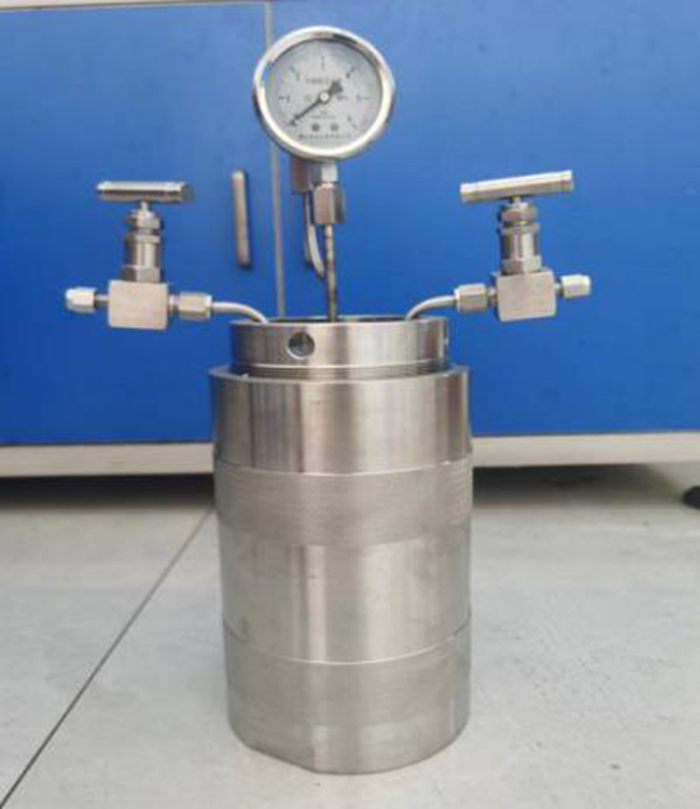
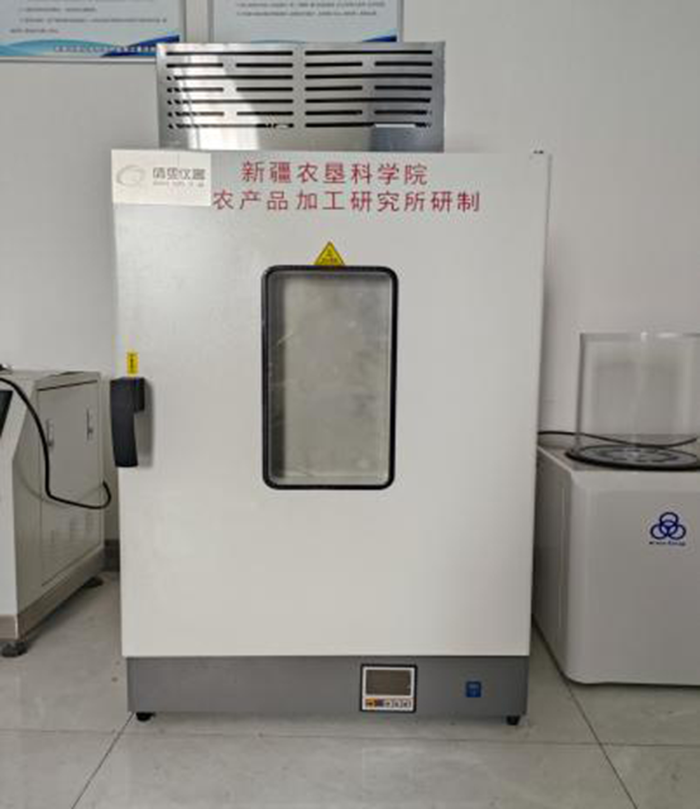
图2
1.2 方法
1.2.1 红枣热风微波耦合干燥工艺
热风温度60℃,微波功率200W,载重300 g。
1.2.2 预处理
(1)热烫处理:准确称取300 g红枣样品,在100℃的沸水中漂烫 80 s,捞出沥干,冷却至室温,待用。
(2)油酸乙酯结合预冻处理:准确称取300 g 红枣样品,在40℃油酸乙酯溶液中浸泡15 min。捞出后清洗表面油酯,置于-18℃条件下冻藏 12 h,室温解冻,待用[5]。
(3)二氧化碳浸渍处理:准确称取 300 g 红枣样品放入浸渍罐中,有序摆放,向罐中注入CO2气体,排出罐中的空气约1min后,关闭排气阀的出口,待压力表的压力升至设定值时关闭CO2。将浸渍罐放入调节好温度的水浴锅中,记录时间[6]。浸渍结束后,将样品进行真空包装,放入4℃冷藏,待用。
1.2.3 测定指标
1.2.3.1 干燥特性
红枣含水率测定参照国家标准(GB /T 5009.3-2010)中直接干燥法测定。W g/g(干基)计算公式如下:
含水率
式中,m1 表示称量瓶和鲜枣的样品质量(g);m2 表示称量瓶和红枣干燥后的质量(g);m3 表示称量瓶的质量(g)。
红枣的干燥特性以干燥时的速率变化来反映[7]。
式中, t1、t2 表示干燥阶段的某个时刻(s); Q1、Q2 表示 t1、 t2时刻下红枣的干基含水率(g/g)。
1.2.3.2 干燥能耗
红枣干燥到恒重时所消耗的电能即为干燥总能耗,干燥能力是指每消耗一定的单位能耗(kJ) 可以获得的干制品质量,能量消耗是指单位质量(g) 的干制品所消耗的能量。计算公式如下[8]:
式中,N表示单位能耗(kJ);E表示总能耗(kJ);G表示红枣除去干燥蒸发的水分后的单位质量(g)。
1.2.3.3 品质
色泽:用色彩色差仪分别测定干燥红枣的 L* (亮度)、a*(红度)、b*(绿度)及ΔE*(总色差)值[9]。
VC含量:称取红枣样品50 g,加入2.5%质量分数的偏磷酸溶液,冰冻下混合匀浆,定容至 50 mL,用冷冻离心机将样品离心后,取上清液,放入分光光度计中,测定样品VC的含量(mg/(100g))[10]。
总黄酮质量分数:采用紫外分光光度法测定总黄酮质量分数。准确称取红枣样品1.0g,加入30 mL 60%的乙醇溶液,过滤后将提取液定容至100 mL容量瓶中,以芦丁作为对照样品液,其中芦丁标准曲线为
总酚质量分数:采用福林-酚(Folin-Phenol)试剂法测定红枣中的总酚含量,准确称取1.0g红枣样品,加入50%的甲醇溶液10 mL混合匀浆,超声时间20 min,取出后放入冷冻离心机内,冷冻离心后取上清液2 mL加水稀释至10 mL[12]。以没食子酸作为对照样品,没食子酸标准曲线为 y=1.45x+0.050 3,R2=0.996 6。
1.2.3.4 微观结构
采用扫描电镜测定。将样品置于粘样台,表面喷金后置于扫描电子显微镜100倍下对其切面表观形貌扫描观察。
1.2.3.5 挥发性成分
将固相微萃取(solid phase microextraction,SPME)萃取纤维头在气相色谱-质谱联用仪(Gas Chromatography-Mass Spectrometer,GC-MS)样品进样口老化至250℃,消除杂质。准确称取干燥后样品2g,研磨后移入15mL萃取瓶中,快速密封。将样品瓶放置在固相微萃取装置上,设定温度为50℃,预热15 min,将SPME萃取头插入样品瓶的顶部空气部分,使萃取头高出样品表面约1.0 cm,顶空萃取30 min。
1.3 数据处理
测定指标为3次重复。采用 SPSS 22.0 软件对不同预处理红枣产品进行差异性分析(P≤0.5时,表示差异显著,P>0.05 时,表示差异不显著);绘图采用Origin2021软件。
2 结果与分析
2.1 不同预处理方式对红枣干燥特性的影响
研究表明,在红枣干燥初期阶段,含水率随时间的增加快速降低,各组间差异不显著(P>0.05),各处理组干燥速率相近。在干燥的中后期,红枣内部水分不断降低,能效转化效率降低,此时各组间干燥速率出现显著性差异(P<0.05),干燥后期水分含量较低,此时水分的蒸发受红枣表皮结构影响增强。干燥400 min后,与对照组相比,各预处理组的干燥速率均显著提高,且各预处理组的组间差异也较为显著,3种预处理方法均可以加快红枣干燥速率。但由于作用机理不同,红枣后期干燥速率也不相同,其中油酸乙酯预处理组在400 min时含水率就降低至0.2g/g,油酸乙酯作为一种表面活性剂,可以破坏和溶解红枣表面蜡质层从而缩短干燥时间。
干燥速率前期呈上升趋势,中期进入恒速阶段,后期呈缓慢下降趋势。干燥初期红枣含水量较多,大量蒸发内部水分,干燥速率较快。当含水率达到 1.0 g/g 时,红枣干燥速率缓慢下降。其中油酸乙酯预处理组干燥速率最大,干燥时间较对照组提高了42.8%。图1
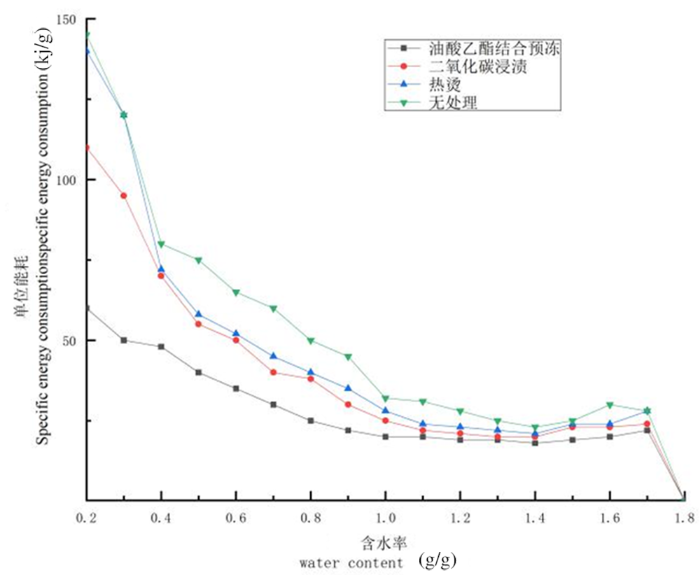
2.2 不同预处理方式对红枣干燥能耗的影响
图3
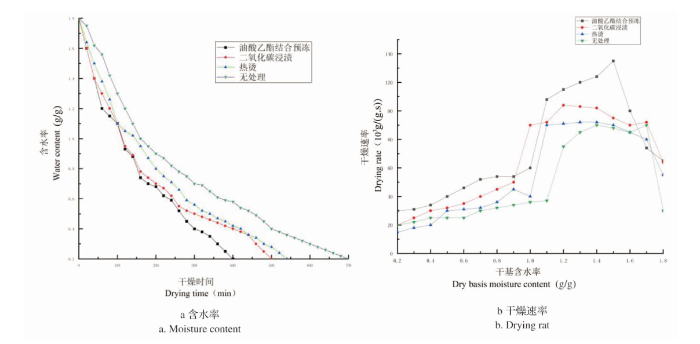
图3
预处理方式下红枣含水率和干燥速率的变化
Fig.3
Changes of different pretreatments on moisture content and drying rate of Chinese jujube
图4
2.3 不同预处理方式对红枣品质的影响(表3)
表3 不同预处理方式下红枣品质的变化
Tab.3
| 预处理 方式 Preprocessing method | 颜色参数 Color parame ters | VC (mg/ (100g)) | 总黄酮 Total flavonoide (mg/g) | 总酚 Phenolics (mg/g) | 铁还原力 Lron restores power (mg/g) | DPPH (mg/g) | |||
|---|---|---|---|---|---|---|---|---|---|
| L* | a* | b* | ΔE | ||||||
| 鲜样Fresh sample | 37.44±1.52a | 1.04±0.21d | 10.54±0.66a | - | 636.23±28.63a | 4.13±0.15a | 4.66±0.18a | 11.05±0.13a | 11.05±0.13a |
| 无处理No processing | 30.01±0.62c | 3.38±0.20a | 7.65±0.64b | 4.97±0.23a | 39.42±2.37bc | 1.68±0.03d | 1.92±0.02c | 3.68±0.14d | 2.75±0.04e |
| 二氧化碳浸渍 CO2 immersion | 32.88±0.15b | 2.79±0.07b | 9.70±0.04a | 4.37±0.16a | 56.17±1.39bc | 2.57±0.12b | 2.24±0.08b | 7.93±0.10b | 10.04±0.11b |
| 热烫Blanch | 32.85±0.80b | 2.94±0.15ab | 9.57±0.88a | 4.81±0.13a | 41.35±2.45bc | 1.81±0.05cd | 1.85±0.03c | 5.04±0.13c | 6.14±0.11d |
| 油酸乙酯结合预冻 Ethyloleate combined with prefreezing | 33.18±0.36b | 2.16±0.32c | 9.56±0.34a | 4.53±0.08a | 33.86±1.27c | 1.92±0.04c | 1.87±0.03c | 5.29±0.22c | 6.49±0.09c |
2.3.1 不同预处理方式对红枣色泽的影响
研究表明,与鲜样相比,各处理组亮度(L*)降低,对照组的L*最小,其他预处理组L*差异不显著(P>0.05),预处理对干燥过程中红枣亮度的影响不大。各处理组的红度值(a*)显著高于对照组(P<0.05),其中热烫处理组的a* 值最高,红枣在干燥过程中,发生美拉德反应,随着干燥时间的不断增加,色泽逐渐变暗,红枣的绿度(b*值)与鲜样相比差异不显著,对照组的b*值最低。干燥后各处理组的 ΔE值差异不显著,其中CO2浸渍处理组的 ΔE值最低,干燥样品的色泽最接近鲜样。
2.3.2 不同预处理方式对红枣VC 含量的影响
红枣在干燥后,VC 含量显著降低,加热过程中VC大量损失。其中,二氧化碳浸渍组VC 含量最高,油酸乙酯结合预冻组VC含量最低。热烫处理与对照组相比,并无显著性差异(P>0.05),热烫处理对红枣细胞膜的影响较小。
2.3.3 不同预处理方式对红枣总黄酮、总酚的影响
研究表明,与鲜样相比,不同处理组红枣在干燥后总黄酮、总酚含量均降低,加热会造成红枣中的活性成分损失。各处理组的总黄酮、总酚含量均高于对照组,其中二氧化碳浸渍组相比于其他处理组,总黄酮和总酚含量最高,而CO2浸渍处理不会改变红枣的表皮结构,并且可以酸化红枣,使红枣细胞内部的pH值降低,增强酮类、酚类的稳定性。
2.3.4 不同预处理方式对红枣抗氧化性的影响
研究表明,铁还原力越大,红枣的总抗氧化能力越强。与鲜样相比,干燥后的红枣的抗氧化能力显著下降,与其他处理组相比,CO2浸渍组的抗氧化能力最强。因为CO2处理组的总黄酮、总酚、VC含量较高,这些活性成分可以增强红枣的抗氧化能力。
2.4 不同预处理方式对红枣微观结构的影响
研究表明,对照组结构较为平整紧凑;热烫和油酸乙酯预冻处理组对红枣结构破环严重;CO2浸渍处理组结构较为致密,并出现微小孔洞,样品被浸泡在CO2中产生了空气泡,空气泡破裂后对样品的结构造成冲击,这种冲击会形成新的微观通道,并引起震动和微触动。微观通道可以促进水分的扩散,加速干燥速率。图5
图5
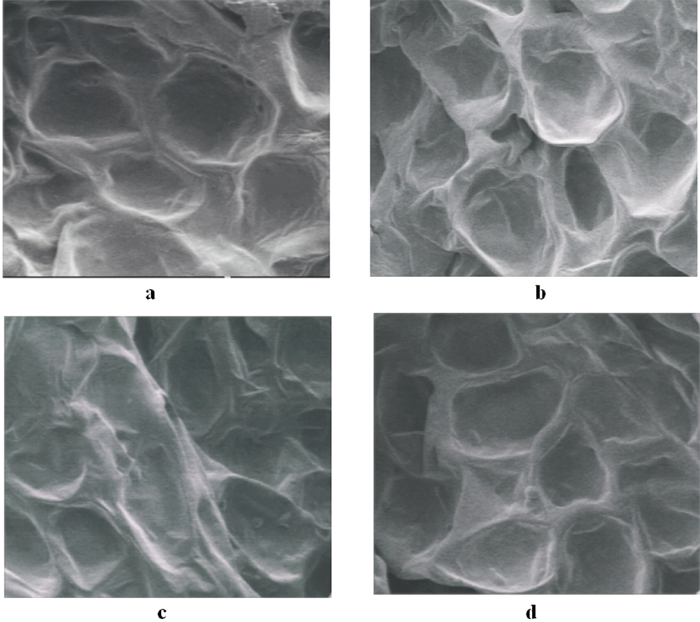
图5
不同前处理下红枣微观结构的变化
注:a:对照组;b:热烫处理组;c:油酸乙酯结合预冻处理组;d:二氧化碳浸渍处理组
Fig.5
Changes of Different Pretreatment on the Microstructure of Jujube
Notes:a:Control group; b:Blanching group; c:Ethyl oleate combined with pre-freezing treatment group; d:carbon dioxide impregnationgroup
2.5 不同预处理方式对红枣挥发性成分的影响
研究表明,共检测到81种挥发性化合物,包括21种酸类、12种酯类、10种醇类、17种醛类、6种酮类、10种烃类、4种杂环类和1种其他挥发性化合物。不同预处理组之间酯类物质的种类和相对含量存在差异性,其中热烫处理组酯类化合物种类最多,各处理组的丁内酯、丁酸丁酯较鲜样呈现一定程度的减少,而己酸乙酯、己酸甲酯则呈现不同程度增加。丁酸丁酯具有强烈的水果香气,在鲜枣中含量较多,干燥后有所减少。各处理组检出10种醇类化合物,鲜枣中含有高达8.10%的醇类物质,经干燥处理后,不同处理组醇类物质均有所减少。红枣经干燥后,醛类比例不同程度地降低。鲜枣的醛类物质主要是苯甲醛,苯甲醛具有独特的气味,是由苯丙氨酸的代谢引起的,释放出类似于苦杏仁的芳香气味。所有处理的样品中均含有相对较高的3-羟基-2-丁酮,干燥会使烃类物质种类及含量显著增加,其中热烫处理组烃类种类最多。杂环类物质干燥后相对含量降低,其香气阈值较低,对香气有一定的贡献,主要能赋予红枣坚果味,其中,热烫预处理中杂环类物质相对含量较高。表4
表4 不同处理红枣的挥发性成分
Tab.4
| 编号 Number | 挥发性成分 Volatide components | 相对含量Relative content(%) | ||||
|---|---|---|---|---|---|---|
| 鲜样 Fresh | 对照组 Control group | 热烫 Heating | CO2 | 油酸乙酯 结合预冻 Alkalime ethyl oleat | ||
| 酸类Acids | ||||||
| 1 | 乙酸 | 21 | 34.7 | 33.13 | 31.73 | 31.25 |
| 2 | 己酸 | 13.68 | 13.01 | 13.15 | 11.8 | 12.79 |
| 3 | 庚二酸 | 3.19 | 1.5 | 2.13 | 1.51 | 1.75 |
| 4 | 正癸酸 | 2.41 | - | 1.16 | 2.99 | 2.9 |
| 5 | 戊酸 | 2.35 | 1.79 | 2.3 | 1.79 | 2.24 |
| 6 | 辛酸 | 1.99 | 0.99 | 1.44 | 1.04 | 1.07 |
| 7 | 丁酸 | 1.32 | 1.99 | 1.96 | 2.09 | 2.67 |
| 8 | 3-甲基丁酸 | 1.29 | 2.34 | - | 1.86 | 1.94 |
| 9 | 月桂酸 | 1.04 | - | - | - | - |
| 10 | 丙酸 | 0.78 | 1.18 | 1.32 | 1.62 | 1.48 |
| 11 | 反式-2-庚烯酸 | 0.6 | - | - | - | - |
| 12 | 壬二酸 | 0.58 | 0.19 | 0.25 | 0.22 | 0.2 |
| 13 | 2-己烯酸 | 0.44 | 0.47 | 0.42 | 0.45 | 0.45 |
| 14 | 7-辛烯酸 | 0.43 | - | - | - | 0.27 |
| 15 | 2-辛烯酸 | 0.41 | 0.24 | 0.29 | 0.32 | - |
| 16 | 苯甲酸 | 0.33 | 0.83 | 0.19 | 0.29 | 0.32 |
| 17 | 巴豆酸 | 0.26 | 0.4 | 0.38 | 0.75 | 0.65 |
| 18 | 异戊酸 | - | - | - | 1.03 | - |
| 19 | 十二烷酸 | - | 1.27 | 0.29 | 0.59 | 1.78 |
| 20 | 2-庚二酸 | - | 0.29 | - | 0.34 | - |
| 21 | 反式-2-庚烯酸 | - | - | 0.38 | - | 0.37 |
| 小计Total | 52.1 | 61.19 | 58.79 | 60.42 | 62.13 | |
| 酯类Esters | ||||||
| 1 | 丁内酯 | 1.59 | 0.44 | 0.48 | 0.46 | 0.46 |
| 2 | 己酸乙酯 | 1.31 | 3.58 | 3.17 | 2.84 | 2.76 |
| 3 | 丁酸丁酯 | 2.07 | 0.74 | 1.41 | 0.59 | - |
| 4 | 己酸甲酯 | 0.4 | - | 0.66 | 0.84 | 0.49 |
| 5 | 戊酸甲酯 | - | - | 0.17 | 0.18 | 0.18 |
| 6 | 邻苯二甲酸异丁酯 | 0.3 | - | - | - | - |
| 7 | 十六烷酸甲酯 | 0.29 | 0.15 | 0.21 | 0.26 | 0.03 |
| 8 | 邻苯二甲酸二甲酯 | 0.21 | 0.09 | 0.19 | 0.14 | 0.04 |
| 9 | 丁基庚酯 | 0.14 | - | - | - | - |
| 10 | 10-甲基十一碳烯酸甲酯 | - | 0.38 | 0.08 | - | - |
| 11 | 反式-3-烯基异丁酯 | - | 0.39 | - | 0.17 | - |
| 12 | 邻苯二甲酸二丁酯 | - | - | 0.51 | - | 0.22 |
| 小计Total | 6.31 | 5.77 | 6.88 | 5.48 | 4.18 | |
| 醇类Alcohols | ||||||
| 1 | 1-辛烯-3-醇 | 6.75 | 1.84 | 1.91 | 1.85 | 1.95 |
| 2 | 1,2-庚烷二醇 | - | 0.14 | - | - | 0.18 |
| 3 | 1-己烯-3-醇 | 0.25 | - | - | - | - |
| 4 | 1-壬烯-4-醇 | 0.18 | - | 0.14 | 0.16 | - |
| 5 | 1-戊烯-3-醇 | - | - | - | 0.09 | 0.07 |
| 6 | 2.3-丁二醇 | 0.05 | 0.24 | 0.96 | 1.26 | 0.26 |
| 7 | 2-甲基环戊醇 | 0.39 | - | - | - | - |
| 8 | 3-辛醇 | 0.48 | 0.26 | 0.15 | 0.29 | |
| 9 | 4-庚醇 | - | - | 0.07 | - | - |
| 10 | 苄醇 | - | - | - | - | 0.14 |
| 小计Total | 8.1 | 2.48 | 3.23 | 3.36 | 2.89 | |
| 醛类Aldehydo | ||||||
| 1 | 苯甲醛 | 6.08 | 6.15 | 3.45 | 4.21 | 3.59 |
| 2 | 苯乙醛 | - | 0.03 | - | 0.09 | 0.03 |
| 3 | 丁醛 | - | - | 0.04 | - | - |
| 4 | 庚醛 | - | 0.12 | - | - | 0.04 |
| 5 | 己醛 | - | - | - | - | 0.33 |
| 6 | 间苯二甲醛 | - | - | - | 0.05 | 0.06 |
| 7 | 糠醛 | 0.45 | 1.31 | 0.96 | 1.66 | 1.46 |
| 8 | (E)-2-庚烯醛 | 0.13 | - | - | - | - |
| 9 | (E)-2-甲基-2-丁烯醛 | 0.12 | - | - | - | - |
| 10 | 1,4-苯二甲醛 | 0.05 | 0.05 | - | - | - |
| 11 | 14α-吗啡醛 | - | 0.22 | 0.6 | 0.77 | 0.73 |
| 12 | 2,4-二甲基苯甲醛 | - | - | 0.05 | - | - |
| 13 | 2-丁烯醛 | - | - | - | 0.03 | 0.04 |
| 14 | (E)-2-己烯醛 | 8.37 | 0.18 | 0.18 | 0.13 | 0.12 |
| 15 | 2-甲氧基-α,5-二甲基苯乙醛 | - | - | - | 1.42 | - |
| 16 | 2-羟基苯甲醛 | 0.1 | 0.04 | 0.05 | 0.05 | 0.07 |
| 17 | 3-甲基-2-噻吩甲醛 | 0.11 | - | - | - | - |
| 小计Total | 15.41 | 8.1 | 5.33 | 8.41 | 6.47 | |
| 酮类Ketones | ||||||
| 1 | 3-羟基-2-丁酮 | - | 10.2 | 13.25 | 14.57 | 15.13 |
| 2 | 2-庚酮 | 0.37 | - | 0.04 | 0.03 | - |
| 3 | 6-甲基-3,5-庚二烯-2-酮 | 0.31 | 0.35 | 0.21 | 0.19 | - |
| 4 | 2(3H)-呋喃酮 | 0.34 | - | - | 0.67 | 0.97 |
| 5 | 3-戊烯-2-酮 | - | 0.3 | 0.25 | 0.05 | 0.34 |
| 6 | 2,6,6-三甲基-2-环己烯-1,4-二酮 | - | 0.06 | 0.08 | 0.07 | 0.08 |
| 小计Total | 1.02 | 10.91 | 13.83 | 15.58 | 16.52 | |
| 烃类Hydrocarbons | ||||||
| 1 | 苯乙烯 | 0.94 | 0.85 | 0.1 | 0.87 | - |
| 2 | 邻异丙基甲苯 | 0.98 | - | - | - | - |
| 3 | 对-二甲苯 | 0.28 | 0.09 | 0.16 | - | - |
| 4 | 四氯乙烯 | 0.1 | 0.14 | 0.12 | 0.12 | 0.12 |
| 5 | 十五烷 | 0.01 | 0.08 | 0.07 | 0.05 | 0.06 |
| 6 | 十八烷 | - | 0.08 | 0.03 | 0.04 | - |
| 7 | 1,2,3,5-四甲基苯 | - | 0.39 | - | - | - |
| 8 | 萘 | 0.23 | 0.16 | - | - | - |
| 9 | 1-二甲基甲硅氧基十八烷 | 0.11 | - | 0.1 | - | 0.1 |
| 10 | 邻辛烯 | - | - | 0.22 | 0.17 | - |
| 小计Total | 2.65 | 1.79 | 0.8 | 1.25 | 0.28 | |
| 杂环类Heterocycles | ||||||
| 1 | 2-乙基-6-甲基吡嗪 | - | 1.43 | 1.15 | - | 0.17 |
| 2 | 4-甲基噻唑 | - | 0.16 | - | 0.16 | 0.13 |
| 3 | 2,6-二甲基吡嗪 | - | 0.13 | 0.1 | - | - |
| 4 | 四氢-2,5-二甲基呋喃 | - | - | 0.2 | - | 0.15 |
| 小计Total | 1.72 | 1.45 | 0.16 | 0.45 | ||
| 其他类Other categories | ||||||
| 小计Total | 0.06 | 12.33 | 3.26 | 2.54 | 9.36 | |
不同处理组干燥红枣中中酸类占比最高,约60%左右,其后依次为为酮类、醛类、酯类、醇类,烃类、杂环类物质含量占较低,其中油酸乙酯结合预冻处理组挥发性成分较多。图6
图6
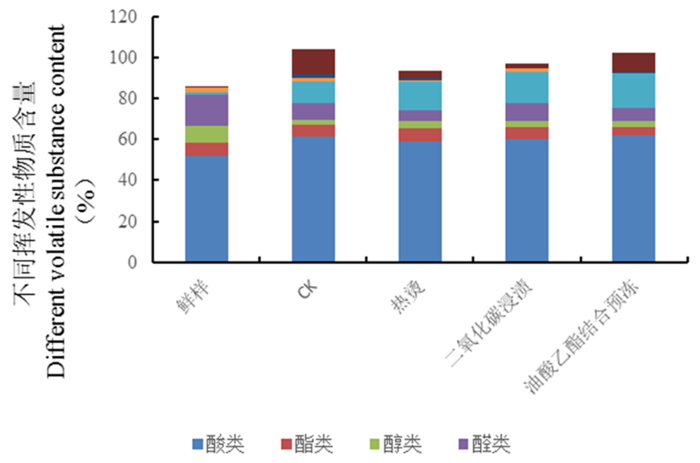
图6
不同预处理干燥下红枣挥发性成分占比
Fig.6
Proportions of volatile substances in jujube prepared by different treatments
不同预处理组红枣干燥样品色差较大,说明不同预处理组红枣干燥样品挥发性成分差异显著。a区域的挥发性物质为不同处理组红枣干燥样品所共有的挥发性成分,b区域不同处理组的挥发性成分含量均小于鲜样,因为红枣在高温干燥时会丧失一些香气成分,同时产生一些新的挥发性物质。c区域中热烫处理组挥发性成分较其他处理组含量较高。通过b和c区域的挥发性物质可以对红枣不同预处理方式进行区分。图7
图7
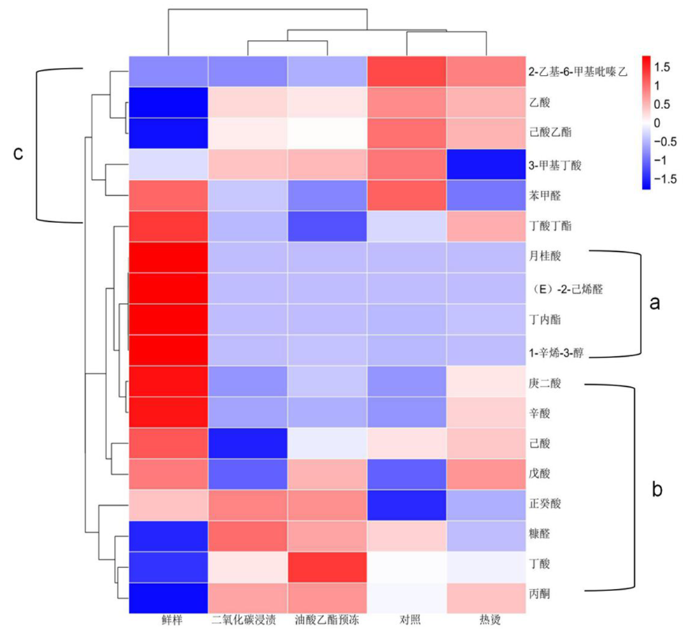
图7
不同预处理红枣主要挥发性成分挥发性物质聚类热图
Fig.7
Clustering heat map of volatile substances in jujube prepared by different treatments
3 讨论
红枣内水分含量较低,蒸发过程逐渐减慢,干燥速率降低[15],同时因为红枣细胞缺水,形成了高渗透压,阻碍了内部水分向表皮的扩散[16]。油酸乙酯预处理节省干燥时间的效果也在其他水果干燥中可以观察到,如酸樱桃[17]、李[18]和甜樱桃[19]。红枣内部含有大量多糖、蛋白质等亲水性大分子与细胞高渗透压的综合作用结果使能效转化逐渐降低,单位能耗显著升高[20]。红枣从鲜红色变成暗红色,热烫处理可以降低红枣中酶的活性,保持较好的色泽[21-22]。干燥时间对不同处理组的红枣色泽有一定的影响,但影响不大[23]。 CO2气体进入细胞内部,使细胞形成无氧环境,VC的稳定性增强 [24]。而油酸乙酯是一种表面活性剂,会破坏红枣细胞膜结构,又加上冷冻处理,使红枣表皮结构进一步被破坏,导致干燥过程中VC大量流失[25]。热烫、油酸乙酯浸泡均不同程度的破坏红枣表皮结构,在加热过程中加速活性成分酮类和酚类的流失[26],干燥过程中红枣的酮类、酚类及VC等营养活性成分发生氧化作用流失所造成的[27]。在海绵效应的作用下,组织结构会不断受到交替挤压和扩张的影响,导致样品组织结构的变形和褶皱形成[28],酸和醛是干燥红枣的主要挥发性化合物,其中含量较多的是乙酸和己酸,干燥会使红枣中酸类物质的相对含量上升,与SONG等[29]的研究结果一致。在干燥过程中,醇类物质被用来合成酯类物质,因此有一定的损失,同时还会合成其他的醇类物质[30]。研究和结论与陈恺等[31]对测定新疆哈密大枣干燥后的香气成分结果一致。通过不同的颜色深浅来表示每种成分的数量,颜色越深代表数量越多,颜色越浅代表数量越少[32]。油酸乙酯作为一种表面活性剂,可以破坏和溶解红枣表面蜡质层从而缩短干燥时间;由于CO2浸渍处理可以改变细胞结构,提高细胞膜的通透性,产生孔隙结构,提高红枣干燥的传质传热效率,较好的钝化酶的活性,抑制酶促褐变,同时也能减缓或抑制非酶褐变,使红枣的褐变程度降低;CO2浸渍处理不会改变红枣的表皮结构,并且可以酸化红枣,使红枣细胞内部的pH值降低,增强酮类、酚类、VC 的稳定性;样品被浸泡在CO2中通过空气泡的冲击作用形成了新的微观通道,微观通道可以促进水分的扩散,加速干燥速率;酸类和醛类是红枣干燥产品的主要挥发性物质,不同处理组间香气成分差异显著,其中热烫预处理组具有较多的香气成分。
4 结论
油酸乙酯结合预冻处理组干燥效率提高了33.3%,各处理组色泽a*值均增加,预处理可以提高红枣干燥产品的色泽,其中CO2浸渍组的色泽 ΔE* 值最小(ΔE* =4.37±0.16),颜色最接近鲜样,CO2浸渍预处理组红枣干燥样品的VC、酚类及酮类等活性物质含量最高,VC含量较对照组高出29.8%,并且抗氧化性及自由基清除能力较强,具有较好的营养品质,微观结构观测到,CO2浸渍预处理组内部呈多小孔状,可以加快红枣的干燥速率,选择CO2浸渍预处理技术可提高红枣热风微波耦合干燥产品的品质。
参考文献
番木瓜片热风微波耦合干燥条件及干燥模型建立
[J].
Drying conditions and drying model of Papaya slices during combined microwave-convective hot air dehydration
[J].
花生果微波-热风耦合干燥特性及能耗分析
[J].
Characteristics and energy consumption of microwave coupled with hot air drying process of peanut pods
[J].
热风微波耦合干燥胡萝卜片工艺
[J].
Coupled hot air and microwave drying technology for carrot slices dehydration
[J].
热风微波耦合干燥技术和设备的研究进展
[J].
Advances in coupled hot-air and microwave drying technique and equipment
[J].
热风微波耦合干燥牛蒡动力学模型研究
[J].
热风微波耦合干燥可以很好地保护干后物料的品质,并且减少物料的干燥时间。利用Newton、Henderson and Pabis、Lagarithmic、Page、Wang and Singh等5种干燥模型方程,对热风微波耦合干燥过程中牛蒡含水率随时间的动态变化进行模拟,并通过试验对各模拟结果进行验证。结果表明,Lagarithmic方程模拟的结果与实际含水率变化较为接近。
Study on dynamic model of coupled hot air and microwave drying of burdock
[J].With microwavehot air combined drying, high product quality and short drying period can be achieved. In the present study, 5 kinetic models based on Newton, Henderson and Pabis, Lagarithmic, Page, Wang and Singh equations, respectively, were built with the drying curves of burdock. Experiments were carried out to verify the effect of the built models. It was shown that the model based on Lagarithmic equation was the most suitable one for predicting the dynamic of the moisture content during microwavehot air combined drying.<br>
热风微波耦合干燥系统的设计与试验
[J].
Design and test of microwave coupled drying system for hot air
[J].
热风微波耦合干燥鲜枣的研究
[J].
Study on coupled hot air and microwave drying of fresh jujube
[J].
热蒸汽烫漂联合热风微波耦合干燥香菇的工艺优化
[J].
Optimization of the technology of hot steam blanching coupled with hot air-microwave combined drying process of shiitakes
[J].
山药微波热风耦合干燥特性及动力学模型
[J].为探索山药微波热风耦合干燥特性,采用微波热风耦合干燥技术研究不同切片厚度、热风温度、热风速率 和微波功率密度对山药干燥特性及水分有效扩散系数的影响,并建立干燥动力学模型。结果表明:山药微波热风耦 合干燥过程按干基含水率的变化主要分为加速和降速两个阶段,无明显恒速阶段;山药的水分有效扩散系数范围 为0.879 1×10⁻⁶~8.245 8×10⁻⁶ m2/s,其值与切片厚度、热风温度和微波功率密度成正比,并随热风速率的增大先 减小后增大;与热风速率和热风温度相比,切片厚度和微波功率密度对水分有效扩散系数的影响更加显著。通过拟 合9 种常用干燥模型,表明Two-term exponential模型的R2平均值最大,χ2平均值和均方根误差平均值最小,分别为 0.998 0、0.000 2和0.014 7。相同实验条件下Two-term exponential模型的预测值与实验值拟合较好,表明该模型适合 预测山药微波热风耦合干燥过程的水分含量变化规律。本研究结果可为微波热风耦合干燥技术应用于山药及其他农 产品的干燥提供理论依据。
Drying characteristics and kinetic model of Chinese yam using microwave coupled with hot air
[J].The effects of material thickness, air temperature, air velocity and microwave power on the drying characteristics and effective moisture diffusion coefficient were investigated by using microwave coupled with hot air. Meanwhile, a model for describing the drying kinetics was established through nonlinear fitting. The experimental results showed that the drying process was mainly divided into two periods, namely accelerated and decelerated change of dry basis moisture content, without obvious constant-speed period. The effective moisture diffusion coefficients, ranging from 0.879 1 × 10⁻⁶ to 8.245 8 × 10⁻⁶ m 2/s, were directly proportional to material thickness, air temperature and microwave power density and initially decreased and then increased with increasing air velocity. Furthermore, the effects of material thickness and microwave power density on effective moisture diffusion coefficient were greater than those of air temperature and air velocity. Among 9 common drying kinetic models, the mean values of R2, χ2 and root-mean-square error for the Two-term exponential model were minimum, which were 0.998 0, 0.000 2 and 0.014 7, respectively. The predicted values from this model were nearly consistent with the experimental values under identical experimental conditions. Therefore, the model could be used to predict the moisture change of Chinese yam during the drying process. These research findings can provide a technical foundation for the application of microwave coupled with hot air in the drying of Chinese yam and other agricultural products.
微波与热风耦合干燥技术的研究发展现状
[J].
Research and development status of microwave and hot air coupling drying technology
[J].
预处理对红枣分段间歇微波耦合热风干燥特性及品质的影响
[J].
Effects of pretreatment on characteristics and qualities of Chinese jujube drying by segmented intermittent microwave coupled with hot air
[J].
Influence of pretreatment solution on the drying of sour cherry
[J].
Effect of dipping treatment on air drying of plums
[J].
Drying characteristics of sweet cherry
[J].
微波-热风耦合干燥处理对牛肉干品质的影响
[J].该文采用微波-热风耦合干燥技术对牛肉干进行干燥,通过与单一热风干燥及单一微波干燥对比,考察其对牛肉干的色泽、嫩度、质构特性、微观结构、水分分布和风味等品质特性的影响。结果表明,与单一热风干燥或微波干燥相比,微波-热风耦合干燥处理可以明显改善牛肉干的色泽,提高牛肉干的嫩度,降低牛肉干的硬度。热风干燥可以较好地保护牛肉干肌纤维束结构,但是微波干燥会破坏其肌纤维束结构,而微波-热风耦合干燥可以弥补微波干燥引发的结构损伤。与单一干燥相比,微波-热风耦合干燥过程在微波和热风的共同作用下,可显著提高牛肉干内部不易流动水弛豫时间(T<sub>2</sub>),增强其流动性,有利于水分子分布的均一性。最后,对不同干燥方式牛肉干的挥发性成分进行鉴定,发现热风干燥或微波干燥会造成原有风味物质的大量损失,而微波-热风耦合干燥可以更好地保留风味物质,并能够促进杂环胺类物质的生成,赋予牛肉干较好的烤香味。因此,微波-热风耦合干燥对提高牛肉干整体品质具有重要意义,是一种具有发展前景的干燥方式。
Effect of combined microwave-hot air drying on quality of beef jerky
[J].The effects of microwave coupled with hot air drying processing on the color, tenderness, texture, microstructure, water distribution, and flavor of beef jerky was evaluated and compared with single hot air drying and single microwave drying. Compared with single hot air drying or microwave drying, microwave coupled with hot air drying can manifestly improve the color and tenderness of beef jerky as well as reduce its hardness. The muscle fiber bundle structure of beef jerky could be well preserved by hot air drying but was damaged by microwave drying, while combined microwave-hot air drying could greatly compensate for the structural damage generated by microwave drying. In comparison with the single drying process, combined microwave-hot air drying could significantly improve the relaxation time (<i>T</i><sub>2</sub>) of immobile water in beef jerky and enhance its fluidity, which was beneficial to the uniform distribution of water molecules within the beef jerky. The volatile components in beef jerky by different drying processes were further identified. Single hot air drying or microwave drying caused a great loss of original flavor substances in beef jerky, while combined microwave-hot air drying could better retain the flavor substances and promote the generation of heterocyclic amines (HCAs), which endowed beef jerky with a superior roasting flavor. Therefore, combined microwave-hot air drying has broad application prospects in the production of beef jerky with good quality.
宝珠梨微波热风耦合干燥工艺优化及动力学模型研究
[J].
Study on optimization and kinetic model of microwave hot-air coupled drying process of Baozhu pear
[J].
Determination of volatile aroma compounds in beef using differences in steak thickness and cook surface temperature
[J].Top loin steaks with a United States Department of Agriculture (USDA) grade of Select were cut 1.3cm, 2.5cm, or 3.8cm thick and cooked on a skillet at 177°C, 204°C, or 232°C. Aroma compounds described as fatty, tallow, and oily are highly related to the identity of beef flavor. These compounds are produced in the highest quantity when steaks are cooked either at low temperatures (177°C) or for short periods of time. Whereas, aroma compounds described as roasted, nutty, or fruity are developed from browning the surface of the steak as a result of cooking at high skillet surface temperatures (232°C) or for long periods of time, as would be seen cooking thick steaks (3.8cm). This study shows that the amount of specific aroma compounds can be predicted (r(2) values up to 0.62) from measured cooking times and temperatures. It may be possible to develop beef steak flavor by recommending steak thickness and cooking temperatures. Copyright © 2016 Elsevier Ltd. All rights reserved.
Recent development of microwave fluidization technology for drying of fresh fruits and vegetables
[J].
Evolution of physicochemical properties of pear during drying by conventional techniques, portable-NMR, and modelling
[J].
Modelling of vitamin C degradation during thermal and high-pressure treatments of red fruit
[J].
Comparative evaluation of the effects of pulsed electric field and freezing on cell membrane permeabilisation and mass transfer during dehydration of red bell peppers
[J].
Thermal stability of genistein and daidzein and its effect on their antioxidant activity
[J].Soy isoflavones, present in many processed soy foods, are known for their phytoestrogenic and antioxidant activities. The aim of this work was to study the kinetics of genistein and daidzein degradation at elevated temperatures and to follow changes in their antioxidant activity. Daidzein and genistein in model solutions (pH 7 and 9) were thermally treated at 120 degrees C or incubated at 70, 80, and 90 degrees C. Isoflavone degradation was observed at all temperatures, with apparent first-order kinetics at 70-90 degrees C, and E(a) = 8.4 and 11.6 kcal/mol at pH 9, respectively. Microcalorimetric stability tests showed a similar pattern of degradation, however, with higher E(a) (genistein, 73.7 kcal/mol; daidzein, 34.1 kcal/mol) that may be attributed to the anaerobic conditions. The antioxidant activity of incubated isoflavone solutions, followed by the ABTS test, decreased rapidly at pH 9 for genistein, whereas only moderate reduction was observed for daidzein (pH 7 and 9) or genistein at pH 7. This may indicate different degradation mechanisms for genistein and daidzein.
GC/MS coupled with MOS e-nose and flash GC e-nose for volatile characterization of Chinese jujubes as affected by different drying methods
[J].
Effect of hot air drying on volatile compounds of Flammulina velutipes detected by HS-SPME-GC-MS and electronic nose
[J].
不同干制方式对新疆哈密大枣香气成分的影响
[J].通过不同干制方式对新疆哈密大枣进行处理,采用顶空固相微萃取联合气相色谱-质谱联用分析鉴定40?℃干制、45?℃干制、晒干、阴干和鲜枣的香气成分及相对含量,探索不同干制方式对红枣香气成分的影响。结果表明:50/30?μm?DVB/CAR/PDMS纤维头对红枣香气成分的灵敏度最佳,检出的香气成分种类和相对含量也最多,明显优于其他纤维头。5?种红枣样品中共分离出66?种香气成分,主要香气物质种类为醛类、酯类、酸类和酮类。采用主成分分析法对香气物质种类评价结果可知:45?℃干制处理的红枣香气品质最佳,其次是40?℃干制和晒干处理的红枣,阴干处理的样品香气品质最差。
Effects of drying conditions on aroma compounds of Hami jujube from Xinjiang
[J].The objective of the current study was to explore the effect of different drying methods on the aroma compound composition of red jujubes. Fresh Hami jujubes from Xinjiang and dried jujubes obtained by different drying methods, namely, hot air drying at 40 ℃ and 45 ℃, sun drying, and shade drying were analyzed by head-space solid phase micro-extraction coupled with gas chromatography-mass spectrometry (GC-MS) for their aroma compound composition. The results showed that a 50/30 μm divinylbenzene/carboxen/polydimethylsiloxane (DVB/CAR/PDMS) fiber exhibited high sensitivity and selectivity in the extraction of aroma compounds. A total of 66 aroma compounds were identified from five samples, the predominant ones being aldehydes, esters, acids and ketone. Principal component analysis (PCA) was adopted to investigate the eight main aroma compounds for Chinese jujube. Jujubes dried by hot air at 45 ℃ had the best aroma quality, followed by those dried at 40 ℃ and the sun dried ones, and the aroma quality of the shade dried samples was the worst.
Exploring the bovine rumen bacterial community from birth to adulthood
[J].


