

0 引言
【研究意义】稻米是全球最重要的粮食作物之一[1]。稻米占我国居民口粮消费超60%以上[2],据《中国统计年鉴2024》[3]显示,我国稻谷种植面积达到0.29×10⁸ hm2(4.3亿亩),占粮食作物种植总面积的24.33%。新疆水稻作为我国具有地方特色的作物,其单位面积产量较全国平均水平高出35.18%,已成为我国西北地区高产稻作区的代表[4]。【前人研究进展】新疆属于干旱半干旱地区,干旱的气候条件使得新疆成为我国土壤盐渍化面积很大的地区,其盐渍化土壤面积为0.22×10⁸ hm2(3.27亿亩),占全国盐渍化土壤总面积的22%。可耕地土壤盐渍化面积近133.33×10⁴ hm2(2 000万亩),其中南疆地区超过66.67×10⁴ hm2(1 000万亩)[5],土壤盐渍化制约了新疆农业生产。已有研究证明,种植水稻是在中重度盐碱地实现“活碱-增产”的粮食作物[6]。水稻需要的生长环境,不仅可以淋溶盐碱土壤的可溶性盐碱成分[7],而且可以改进土壤质量,提高土壤肥力[8],如耐盐碱水稻(“海水稻”)在新疆岳普湖县测产达548.53 kg/667m2。此外,种植水稻能调节气候[9]、增加空气湿度、改善环境、提高地下水位,发挥湿地作用,防止土地荒漠化,增加绿洲面积,同时部分地区水资源丰富、低洼、地下水位高的区域,不适合旱作物只能种植水稻。然而新疆水稻发展也面临着挑战,农业水资源不足[10],种稻人工成本较高[11],致使新疆水稻生产在种植面积上有所递减,严重制约着新疆水稻产业现代化发展。【本研究切入点】新疆水稻种植水稻历史悠久[12]。新疆米泉以及天山南北区域先后有种植,温宿县阿克苏地区、伊犁哈萨克自治州察布查尔锡伯自治县等地也陆续大面积种植水稻[13]。20世纪50年代,新疆开展水稻育种工作,积极引进国内外优良品种[14],地方品种逐渐被引进品种和新育成的品种所代替,良种的推广促进了新疆水稻增产,每次更新换代都使单产提高15~30 kg/667m2[15]。新疆维吾尔自治区审定委员会审定的水稻品种有80多份,近几年选育出一批耐盐品种,其中新稻11号、新稻36号、新稻56号等优质高产的水稻品种在新疆占据较大的种植面积,成为本地主栽品种。需结合新疆水稻生产现状,探讨在新质生产力下新疆水稻高质量发展的路径以实现稻米产业稳步发展。【拟解决的关键问题】基于《中国统计年鉴》和《新疆统计年鉴》(1983-2024)的统计数据,分析新疆水稻生产的现状(面积、产量、单产、区域分布)及存在的问题,为新疆水稻生产走向轻简化和适度规模化种植提供科学对策。
1 材料与方法
1.1 材料
统计数据来自《中国统计年鉴》(1983-2024)和《新疆统计年鉴》(1983-2024)。
1.2 方法
采用 Microsoft Excel 2010 进行数据处理,并进行制图。
2 结果与分析
2.1 新疆水稻生产现状
2.1.1 水稻面积逐年减少
研究表明,1983年至2023年新疆玉米种植面积基本呈现上升的趋势,粮食作物总面积和小麦种植面积呈“先降后升”的趋势,并在2007年最低,分别为137.87×10⁴ hm2(2 068.65万亩)和60.58×10⁴ hm2(908.7万亩),而水稻种植面积于1985年至2018年趋于7.33×10⁴ hm2(110万亩)上下浮动,2018年后呈急速减少的趋势,至2022年水稻种植面积最少,仅有3.67×10⁴ hm2(55.05万亩)。图1
图1
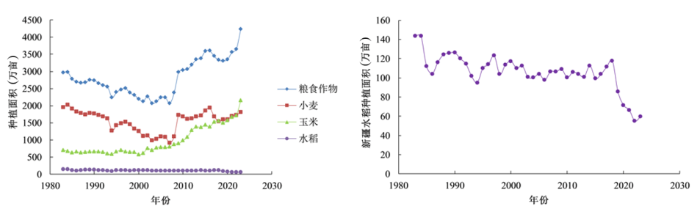
图1
1983~2023年新疆主要粮食作物种植面积
Fig1
Planting Area of Major Grain Crops in Xinjiang from 1983 to 2023
2.1.2 水稻总产量逐渐下降
研究表明,1983年至2023年新疆粮食总产量和玉米产量呈现快速上升趋势,小麦产量总体呈现上升趋势,但2009年至2023年基本稳定在600×104~700×104 t/年,水稻产量于1983年至2018年总体呈上升趋势,2018年后呈急速减少的趋势,至2022年水稻产量最低,为34.60×104 t。图2
图2

图2
1983-2023年新疆主要粮食作物产量
Fig.2
Yield of Major Grain Crops in Xinjiang from 1983 to 2023
2.2 水稻单产稳步增长
研究表明,1983年至2023年新疆小麦、玉米、水稻单位面积产量总体均呈上升趋势,其中水稻单位面积产量于2014年最大,为676.43 kg/667m2,玉米单位面积产量2022年最大,为628.78 kg/667m2,小麦单位面积产量于2023年最大,为387.47 kg/667m2,较同一年水稻、玉米分别低39.76%、36.76%。图3
图3

图3
1983~2023年新疆主要粮食作物单位面积产量
Fig.3
Unit area yield of major grain crops in Xinjiang from 1983 to 2023
2.3 新疆水稻优势地区分布
研究表明,2023年新疆粮食总播种面积282.48×10⁴ hm2(4 237.16万亩),水稻种植面积3.97×10⁴ hm2(59.48万亩),占比总播种面积1.40%,水稻总产量382 952.00 t,全疆水稻单位面积产量平均为643.89 kg/667m2,其中以新疆生产建设兵团(简称兵团)最大,为684.28 kg/667m2。
2023年水稻生产在新疆大部分地区均有分布(全区仅东疆区域无水稻生产)。其中,北疆产区是乌鲁木齐市和伊犁哈萨克自治州,占水稻总面积比重4.31%和18.39%;南疆产区为阿克苏地区、喀什地区、和田地区,占水稻总面积比重18.59%、5.80%、12.59%,以及兵团,占水稻总面积比重37.86%。
表1 2023年新疆各地州市水稻分布
Tab.1
| 区域 Region | 各地州 (市) Each prefecture (city) | 粮食播种面积 The acreage sown in grain crops (万亩)(104 hm2) | 水稻播种面积 Rice planting area (万亩)(104 hm2) | 水稻 总产量 Total rice yield (t) | 水稻占粮食 播种面积 比重 Proportion of rice planting area in total grain cultivation area (%) | 单位 面积产量 Yield per unit area (kg/667m2) | 占水稻 总面积 比重 Proportion of total rice area (%) | |||||
|---|---|---|---|---|---|---|---|---|---|---|---|---|
| 新疆北疆 North Xinjiang | 乌鲁木齐市 | 12.93(0.86) | 2.57(0.17) | 17 055.00 | 19.84 | 664.91 | 4.31 | |||||
| 伊犁哈萨克自治州 | 600.09(40.01) | 10.94(0.73) | 70 845.00 | 1.82 | 647.87 | 18.39 | ||||||
| 塔城地区 | 449.85(29.99) | 0.05(0.003) | 234.00 | 0.01 | 520.00 | 0.08 | ||||||
| 阿勒泰地区 | 162.71(10.85) | 0.11(0.007) | 350.00 | 0.06 | 333.33 | 0.18 | ||||||
| 克拉玛依市 | 6.03(0.40) | 0.03(0.002) | 126.00 | 0.50 | 420.00 | 0.05 | ||||||
| 博尔塔拉蒙古自治州 | 100.62(6.71) | 0.12(0.008) | 695.00 | 0.12 | 579.17 | 0.20 | ||||||
| 昌吉回族自治州 | 346.55(23.10) | 0.06(0.004) | 317.00 | 0.02 | 528.33 | 0.10 | ||||||
| 新疆东疆 Eastern Xinjiang | 哈密市 | 36.18(2.41) | 0.00(0.00) | 0.00 | 0.00 | 0.00 | 0.00 | |||||
| 吐鲁番市 | 0.90(0.06) | 0.00(0.00) | 0.00 | 0.00 | 0.00 | 0.00 | ||||||
| 新疆 南疆 Southern Xinjiang | 巴音郭楞蒙古自治州 | 137.00(9.13) | 0.11(0.007) | 466.00 | 0.08 | 443.81 | 0.18 | |||||
| 阿克苏地区 | 545.67(36.37) | 11.06(0.74) | 73 663.00 | 2.03 | 666.33 | 18.59 | ||||||
| 克孜勒苏柯尔克孜自治州 | 85.14(5.68) | 1.01(0.067) | 6 603.00 | 1.18 | 657.01 | 1.69 | ||||||
| 喀什地区 | 768.29(51.22) | 3.45(0.23) | 20 277.00 | 0.45 | 587.74 | 5.80 | ||||||
| 和田地区 | 287.39(19.16) | 7.49(0.498) | 38 255.00 | 2.60 | 511.09 | 12.59 | ||||||
| 新疆生产建设兵团 | 697.83(46.52) | 22.52(1.501) | 154 066.00 | 3.23 | 684.28 | 37.86 | ||||||
| 合计 | 4 237.16(282.48) | 59.48(3.966) | 382 952.00 | 1.40 | 643.89 | / | ||||||
注:资料来源《新疆统计年鉴2024》[
Notes:Data source《Xinjiang Statistical 2024》[
表2 新疆水稻主要种植区域
Tab.2
| 稻作区名称 Name of rice growing area | 主要产稻地区 Major rice-producing regions |
|---|---|
| 伊犁河谷早中熟稻区 Yili Valley mid-ripening rice region | 察布查尔县、新疆生产 建设兵团第四师 |
| 天山北麓中熟稻区 Mid maturing rice area at the northery foot of Tianshan Mounntains | 乌鲁木齐市米东区 |
| 南疆北部中晚熟稻区 Southern Xinjiang late- maturing rile region | 阿克苏地区温宿县、 新疆生产建设兵团第一师 |
| 南疆西南部晚熟及 复播稻区 Late maturing and planted rice areas in Southwestern Sounern Xinjiang | 喀什地区、和田地区 |
3 讨论
3.1 新疆水稻生产存在的问题
3.1.1 绿色发展有待提高
需构建水稻高质量发展经济体系,深化水稻生产经营改革,多种形式发展水稻产业。
3.1.2 水稻政策性扶持不足
受水资源短缺的影响,现有稻田缺少应有保护,加上政策性调减与扶持减少、稻区农田高标准建设投入不足,稻谷收购价格偏低(2.8元/kg)。此外,棉花补贴籽棉0.35元/kg,小麦补贴230元/667m2,玉米补贴150元/667m2,水稻仅部分地区有补贴政策,造成水稻面积和总产量减少。
3.1.3 良种良法创新有待提升
优质、耐盐碱、节水型水稻新品种不足。受地域分布广、稻作技术不同等因素影响,自主培育的品种较多(新稻11号、新稻36号、新稻42号、新稻50号、新稻58号、新粳8号、新粳伊2号和新农粳伊4号),品种覆盖率占全疆85%以上,但突出有影响力的主导品种还较少,优质高产耐盐碱节水广适性品种较少。
现代化轻简化栽培技术不够完善。当前机插秧多采用小拱棚育苗,缺少集中大棚育苗,直播还采用水撒播、稳产性差,与高产高效轻简化机直播技术不配套,种稻相较于其他作物人工成本较大。管理粗放、大水漫灌、大量施用化肥和除草剂,与优质高产节本保优高效栽培技术不配套,育苗机插技术、机械直播技术、节水种稻技术、盐碱地种稻技术、稻田综合种养技术等还需要进一步研究完善和推广应用。
3.1.4 产业化水平有待加强
三级良种繁育体系尚不健全。缺少特有的新疆大米品牌。全疆水稻规模化、标准化、集约化生产水平不高,优质大米种植基地缺少,企业生产加工规模和产品质量不高,水稻生产“三品一标”不够健全,品牌培育能力不足、知名度不高,难以实现稻米优质优价。
3.2 对策
3.2.1 合理布局产业功能区划
探索新疆水稻种植制度的调整,构建新疆绿色且特色稻米产业,完善产业协同机制,提高科技支撑的经济效益,构建多层级的新疆水稻智慧服务体系(水肥一体化、机械轻简化、无人机技术等)。
3.2.2 加大种稻政策扶持力度
恢复种稻补贴、集中育秧、农机、农资等纳入补贴范畴。在测土配方、农资配送、病虫害统防统治、农机作业专业化服务等方面实现新型农业经营组织全覆盖,开展全程农业社会化综合服务,加快新疆水稻产业技术体系建设,重点扶持或建设一批优质水稻标准化生产示范园项目。
3.2.3 深化“藏粮于地,藏粮于技”战略
加强中低产田改造,提高耕地质量,加强田间整理、沟渠、机耕道、林网建设,打造高标准稻田,改善稻田基础设施条件。结合大力推进水稻节水栽培技术,可节水1/3左右,若综合配套旱育稀植机插秧、轻简机械旱直播、节水控灌栽培等其他一些节水技术,大面积用水量控制在600~1 000 m3/667m2,可增加水稻种植面积33.33×104 hm2(50万亩)以上,可增加30×104 t产量,加大新疆盐碱地的综合开发和利用,扩大耐盐碱水稻、沙漠水稻种植,增加耕地面积。
强化技术推广与科技服务,推广标准化节本高效生产技术体系,实现无公害绿色有机栽培生产,全面提高新疆水稻生产技术水平,增加单产和总产。加大“农业+研学+旅游”有机融合,大力推进“稻+N(蟹、虾、鱼、鸭等)”稻田综合种养技术应用推广,实现“一地多用、一地多收,一水多用、一水多收”的节水型休闲观光旅游的绿色有机水稻产业[20],发展“稻田画”特色水稻产业,通过创意设计吸引客流,借力农家乐承接消费,最终反哺水稻种植标准化与品牌化。
3.2.4 做好产业化推广服务
建议健全良种繁育体系:加快建设育种家基地与标准化良种生产基地,健全原原种、原种、良种生产技术制度,扶持本地种子企业,推广优质良种替代自留种。强化技术服务体系:充实农技队伍,加强绿色技术培训,建立新品种示范田并强化跟踪服务能力。打造区域公共品牌:推进规模化、标准化种植基地建设,完善“三品一标”认证,扶持企业加工升级,集中培育“新疆大米”地域品牌(羊脂籽米、抓饭香米),实现优质优价。
4 结论
1983~2018年新疆水稻种植面积稳定于7.33×10⁴ hm2(110万亩)左右,但2018年后急剧下降,2022年降至3.67×10⁴ hm2(55.05万亩),产量同步下滑;水稻单产稳定增长,2023年全疆平均643.89 kg/667m2,显著高于小麦和玉米;水稻生产主要分布于南疆(阿克苏地区、和田地区)和新疆生产建设兵团(占37.86%),北疆(伊犁哈萨克自治州、乌鲁木齐市)次之;新疆需创制耐盐碱、节水抗旱水稻新品种提高种植面积,同时建议加大政策扶持,恢复并落实种稻补贴,新疆需保持和适度规模化水稻生产。
参考文献
Differential Impacts of Whole‐Growth‐Duration Warming on the Grain Yield and Quality Between Early and Late Rice (Oryza sativa) in a Double Rice Cropping System
[J].
我国水稻的肥料贡献率时空变化及影响因素
[J].
【目的】从全国尺度上解析近30年(1988—2017)水稻产量的肥料贡献率变化及其影响因素,为水稻可持续生产和肥料的科学施用提供理论依据。【方法】基于全国稻作区耕地质量监测数据(338个点位),分析不同稻作模式、种植区域、气候条件和土壤质地的水稻肥料贡献率年际变化,并结合随机森林模型探讨各因素对水稻肥料贡献率变化的相对贡献。【结果】在施肥区和不施肥区水稻品种和栽培技术相同的条件下,近30年全国水稻的肥料贡献率整体呈现前20年逐渐升高,近10年趋于平稳的特征,总体变化幅度为41.20%—51.89%,但不同稻作模式存在差异,单季稻、双季稻和水稻-其他作物轮作的水稻肥料贡献率分别为38.58%—55.49%、41.96%—51.05%和42.34%—53.43%。不同区域的水稻肥料贡献率在近30年的平均值表现出西南(55.82%)>长江中游(46.73%)>华北(46.27%)>东北(45.90%)>华南(45.83%)>长江下游(44.25%)。结合施肥年限和水稻肥料贡献率的拟合方程发现,东北、华北、西南、长江中游、长江下游和华南的水稻肥料贡献率达到稳定的施肥年限分别为15.2、18.5、19.0、15.3、15.3和14.5 a。不同气候条件也显著影响水稻的肥料贡献率,其中,亚热带季风气候(49.23%)>温带季风气候(45.90%)>热带季风气候(34.57%)。不同土壤质地的水稻肥料贡献率则表现出黏土(43.25%—64.80%)>壤土(40.65%—48.46%)>砂土(26.20%—45.98%)。随机森林模型显示,氮肥和磷肥是调控水稻肥料贡献率变化的主要因素,同时,无霜期、年均降雨、年均温度、钾肥及土壤有机质含量也是影响水稻肥料贡献率的关键指标。【结论】在1988—2017年,全国稻作区的水稻肥料贡献率整体呈现前期逐渐增加后期趋于平稳的趋势,且稻作模式、区域、气候和土壤质地条件均影响水稻肥料贡献率的年际变化。氮肥和磷肥对水稻肥料贡献率变化的影响较大。相比其他土壤肥力指标,土壤有机质是影响水稻肥料贡献率变化的关键土壤肥力因子。
Spatio-Temporal Variations of Fertilizer Contribution Rate for Rice in China and Its Influencing Factors
[J].【Objective】 Spatio-temporal variations and driving factors of fertilizer contribution rate were conducted for the paddy soil in China, so as to provide a theoretical basis for the sustainable development of rice and scientific recommended application of fertilizers in rice cultivation areas. 【Method】 Data was cited from a total of 338 long-term paddy soil monitoring sites located in rice-producing provinces of China for this study. The effects of fertilizer contribution rate for cropping system, climate, regions, soil texture and its driving factors were evaluated. 【Result】 In the past 30 years (1988-2017), the fertilizer contribution rate for rice increased first and then levelled off in China in the condition of same rice variety and cultivation techniques both in fertilization and none-fertilization plots. The variable range of fertilizer contribution rate for rice was from 41.20% to 51.89%. The fertilizer contribution rate for rice was 38.58%-55.49%, 41.96%-51.05%, and 42.34%-53.43% in single, double rice, and rice and other cropping systems, respectively. After 30 years, the fertilizer contribution rate for rice from high to low was as follows: Southwest China (55.82%), Middle of Yangtze River (46.73%), North China (46.27%), North east China (45.90%), South China (45.83%) and Lower of Yangtze River (44.25%). According to the fitting equation, it was found that the stable fertilization years of fertilizer contribution rate for rice was 15.2 a, 18.5 a, 19.0 a, 15.3 a, 15.3 a and 14.5 a in the Northeast China, North China, Southwest China, Middle of Yangtze River, Lower of Yangtze River and South China, respectively. The fertilizer contribution rate for rice in subtropical monsoon (49.23%) was much higher than temperate monsoon (45.90%) and tropical monsoon (34.57%). The fertilizer contribution rate for rice with different soil texture was 43.25%-64.80% for clay soil, 40.65%-48.46% for loam soil, and 26.20%- 45.98% for sand soil. Among the fertilization factors, nitrogen and phosphate fertilizer were the main factors affecting fertilizer contribution rate. Among the climatic factors, frost-free period, mean annual rainfall and mean annual temperature were the main factors and soil organic matter was the most important one among the soil factors. 【Conclusion】 The fertilizer contribution rate for rice was increased first and then levelled off in 1988-2017, and there was different for fertilizer contribution rate for rice under different rice cropping systems, regions, climate and texture. Nitrogen and phosphate fertilizers were main factors of fertilizer contribution rate for rice in China. Moreover, the soil organic matter in paddy soil was the most important to fertilizer contribution rate for rice in soil fertility indexes.
Drought resistance in rice from conventional to molecular breeding: a review
[J].
Spatial distribution of soil salinization under the influence of human activities in arid areas, China
[J].
Long-term rice cultivation increases contributions of plant and microbial-derived carbon to soil organic carbon in saline-sodic soils
[J].
Productivity of saline soils can be improved by integrating soil-crop system management
[J].
Role of rice cultivation on fluorine distribution behavior in soda saline-alkali land
[J].
Spatiotemporal variation in rice evapotranspiration under the influence of rice expansion: a case study in the Sanjiang Plain, Northeast China
[J].
新疆农业节水与水资源高效利用的对策与建议
[J].
countermeasures and recommendations for agricultural water conservation and high-efficient water resources utilization in Xinjiang
[J].
The Impact of Rural Population Aging on Agricultural Cropping Structure: Evidence from China’s Provinces
[J].
伊犁河谷水稻种植存在的问题及对策
[J].
Problems and Countermeasures in Rice Planting in the Ili River Valley
[J].
近40a来新疆地区太阳辐射状况研究
[J].
Analysis of the solar radiation of Xinjiang Uygur Autonomous Region in recent 40 years
[J].
近20年新疆水稻生产发展及影响因素分析
[J].以新疆各水稻种植区域生产数据为基础,分析了1995-2014年新疆各区域水稻产量时空变化特征及其主要影响因素。结果表明,1995-2014年的20年间,新疆水稻总产增加了58.0%;北疆南部的水稻总产最高,2010-2014年其总产占新疆水稻总产的46.7%,其次是南疆北部(占比为36.5%)和南疆西南部(占比为16.7%),北疆北部占比最低。1995-2014年新疆水稻种植面积增加了2.3%。2010-2014年北疆南部水稻种植面积占新疆水稻种植面积的46.2%,南疆北部占34.1%,南疆西南部占19.7%,北疆北部占比最小。1995-2014年新疆水稻单产增加了54.3%,是总产增加的主要原因;各区域平均单产从高到低依次为北疆南部(8 593.5 kg/hm2)、南疆北部(8 179.1 kg/hm2)、南疆西南部 (6 933.3 kg/hm2)和北疆北部(3 144.7 kg/hm2)。因此,稳定水稻种植面积是增加新疆水稻总产的基本条件;选育抗旱、耐低温、高产优质的粳稻品种,研发推广高产高效栽培技术和防灾减灾技术,提高单产,是新疆水稻总产稳定增加的主要途径。
Development of Rice Production in Recent Twenty Years and Its Influencing Factors in Xinjiang Uygur Autonomous Region
[J].In order to reveal the spatial and temporal variation of rice production in Xinjiang and determine its influencing factors, the author collected and analyzed the related data from 1995 to 2014 in its four major rice-planting regions, namely, the north region of Northern Xinjiang, the south region of Northern Xinjiang, the north region of Southern Xinjiang and the southwest region of Southern Xinjiang. The total grain production of rice was increased by 58.0% from 1995 to 2014 in Xinjiang. With the sustainable increasing of rice areas of the south region of Northern Xinjiang, the rice planting area of Xinjiang increased by 2.3% during 1995-2014. Except for the south region of Northern Xinjiang, the planting area in other three regions tended to decrease year by year. In the period of 2010-2014, the south region of Northern Xinjiang was the largest in both total grain production and planting area in Xinjiang,accounting for 46.7% and 46.2%, respectively. The south region of Northern Xinjiang accounted for 36.5% and 34.1%, the southwest region of Southern Xinjiang had 16.7% and 19.7%, and the north region of Northern Xinjiang was smallest in both of them. From 1995 to 2014, the grain yield per hectare was increased by 54.3%, which could explain largely the increment of total grain production in Xinjiang. The average grain yield per hectare in recent 20 years ranked as: the north region of Northern Xinjiang (8 593.5 kg/hm2)> the south region of Northern Xinjiang (8 179.1 kg/hm2)> the north region of Southern Xinjiang (6 933.3 kg/hm2)>the southwest region of Southern Xinjiang(3 144.7 kg/hm2). The adverse climate change in recent years hinders the enhancement of grain yield in Xinjiang,particularly in the south region of Northern Xinjiang and the north region of Southern Xinjiang. In order to further increase the total grain production of rice in Xinjiang, major effective policies should concentrate on stabilizing planting areas in the south region of Northern Xinjiang and preventing the decline of planting areas in other three regions. The technological improvement should focus on breeding high yielding varieties with tolerance to drought and low temperature, prevention and reduction of natural disasters and adoption of proper farming management.
Advances and challenges in the breeding of salt-tolerant rice
[J].
节水抗旱稻的概念与发展历程
[J].
Concept and development history of water-saving and drought-resistance rice(WDR)
[J].
Co-cultivation of rice and aquatic animals: Improving soil fertility and providing more rice in China
[J].


